Просмотр архива за вторник, 28 апреля 2026
Daily bulletin on solar and geomagnetic activity from the SIDC
Существующий: 2026 Apr 28 1235 UTC
SIDC Forecast
Солнечные вспышки
M-class flares expected (probability >=50%)
Geomagnetism
Minor storm expected (A>=30 or K=5)
Солнечные протоны
Quiet
| 10cm flux | Ap | |
|---|---|---|
| 28 Apr 2026 | 140 | 007 |
| 29 Apr 2026 | 135 | 031 |
| 30 Apr 2026 | 130 | 029 |
Solar Active Regions and flaring
Solar flaring activity was low over the past 24 hours, with only C-class flares identified. The largest flare was a C9.0 flare (SIDC Flare 7541) peaking on Apr 28 at 09:23 UTC, which was produced by SIDC Sunspot Group 847 (NOAA Active Region 4420). During the flare, the source region (SIDC Sunspot Group 847) of the flare had beta- gamma-delta configuration of its photospheric magnetic field. A total of 7 numbered sunspot groups were identified on the disk over the past 24 hours. SIDC Sunspot Groups 805 and 847 (NOAA AR 4425 and 4420) are the most complex regions with their beta-gamma-delta magnetic configuration. Solar flaring activity is expected to be low to moderate over the next 24 hours, with few C-class flares, possibly M-class flares and a low chance for X-class flares.
Выбросы корональной массы
No Earth-directed coronal mass ejections (CMEs) were detected in the available coronagraph observations during the last 24 hour.
Корональные отверстия
SIDC Coronal Hole (CH) 149, spanning 8 S - 25 S (negative polarity), has crossed the central meridian, and the high-speed streams from this CH may enhance the solar wind environment near Earth during Apr 29 - May 01.
Солнечный ветер
Solar wind conditions have transitioned to slow solar wind regime. The solar wind speed ranged between 355 km/s and 480 km/s. The North-South component (Bz) ranged between -3 and 4 nT. The interplanetary magnetic field ranged from 2 nT to 5 nT. Slow solar wind conditions are expected to continue over the next 24 hours unless the high speed streams from the SIDC Coronal Hole 149, which crossed the central meridian during Apr 26-28 (negative polarity), arrives at Earth.
Geomagnetism
Geomagnetic conditions were globally and locally quiet (NOAA Kp and K BEL 1 to 2). In the next 24 hours, active to minor storm conditions (K 4 to 5) are possible if the high speed streams from the SIDC Coronal Hole 149, which crossed the central meridian during Apr 26-28 (negative polarity), arrives at Earth.
Proton flux levels
The greater than 10 MeV GOES proton flux was below the threshold level over the past 24 hours and it is expected to remain so for the next 24 hours.
Electron fluxes at geostationary orbit
The greater than 2 MeV electron flux, as measured by GOES-19 and GOES-18 satellites, remained below the threshold level over the past 24 hours and is expected to remain so in the coming 24 hours. The 24h electron fluence is presently at normal level and is expected to be at normal to moderate levels in the next 24 hours.
Today's estimated international sunspot number (ISN): 137, based on 18 stations.Solar indices for 27 Apr 2026
| Wolf number Catania | 148 |
| 10cm solar flux | 142 |
| AK Chambon La Forêt | 007 |
| AK Wingst | 007 |
| Estimated Ap | 007 |
| Estimated international sunspot number | 134 - Based on 30 stations |
Noticeable events summary
| Day | Begin | Max | Конец | Loc | Strength | OP | 10cm | Catania/NOAA | Radio burst types | |
|---|---|---|---|---|---|---|---|---|---|---|
| Нет | ||||||||||
Provided by the Solar Influences Data analysis Center© - SIDC - Processed by SpaceWeatherLive
Все время в UTC
<< Перейти на сегодняшнюю страницу обзора
Последние новости
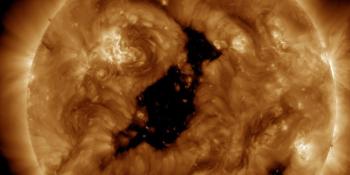
Coronal hole faces Earth

X1.5 solar flare

M2.7 solar flare, CME arrival possible
Последние сообщения с форума
Поддержка SpaceWeatherLive.com!
A lot of people come to SpaceWeatherLive to follow the Solar activity or if there is a chance to see the aurora, but with more traffic comes higher costs to keep the servers online. If you like SpaceWeatherLive and want to support the project you can choose a subscription for an ad-free site or consider a donation. With your help we can keep SpaceWeatherLive online!



Факты о космической погоде
| Последняя X-вспышка | 24/04/2026 | X2.5 |
| Последняя M-вспышка | 17/05/2026 | M1.4 |
| Последняя геомагнитная буря | 16/05/2026 | Kp6- (G2) |
| Безупречные дни | |
|---|---|
| Последние 365 дней | 3 дней |
| 2026 | 3 дней (2%) |
| Последний безупречный день | 24/02/2026 |
| Среднемесячное количество солнечных пятен | |
|---|---|
| апреля 2026 | 79.3 -6.6 |
| мая 2026 | 90.4 +11.1 |
| Последние 30 дней | 99.3 +8.3 |