Arşiv Salı, 6 Ocak 2026 görüntüleniyor
SIDC'den güneş ve jeomanyetik aktivite hakkında günlük bülten
Yayınlandı: 2026 Jan 06 1232 UTC
SIDC Tahmini
Güneş patlamaları
C-class flares expected, (probability >=50%)
Jeomanyetizma
Quiet (A<20 and K<4)
Güneş protonları
Quiet
| 10cm akı | Ap | |
|---|---|---|
| 06 Jan 2026 | 152 | 007 |
| 07 Jan 2026 | 148 | 007 |
| 08 Jan 2026 | 142 | 010 |
Güneş Aktif Bölgeleri ve parlama
Solar flaring activity was low over the past 24 hours, with several C-class flares recorded. The largest flare was a C4.0 flare (SIDC Flare 6589), peaking at 07:54 UTC on January 6, associated with SIDC Sunspot Group 709 (NOAA Active Region 4323; magnetic type beta). There are currently seven numbered active regions on the visible solar disk. A new region emerged in the northwestern hemisphere (SIDC Sunspot Group 755, N11W61; magnetic type beta), but it remained quiet. SIDC Sunspot Group 745 (NOAA Active Region 4325; magnetic type beta), that remains the largest active region, is approaching the west solar limb and did not produce any flaring activity. Solar flaring activity is expected to remain low over the next 24 hours, with C-class flares likely and a chance for M-class flares.
Koronal Kütle Atılımı
A faint coronal mass ejection (SIDC CME 619) was observed in SOHO/LASCO-C2 at around 02:12 UTC on January 6, directed toward the southeast from Earth’s perspective. The CME is likely associated with a C2.1 flare, peaking at 00:21 UTC on January 6, produced by SIDC Sunspot Group 722 (NOAA Active Region 4334) and a small coronal dimming. While the bulk of the ejecta is expected to miss Earth, a glancing blow cannot be fully excluded. Further analysis is ongoing. No other Earth-directed CMEs were detected in the available coronagraph imagery over the past 24 hours.
Koronal delikler
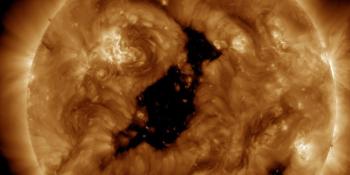
A large negative polarity transequatorial coronal hole (SIDC Coronal Hole 144) has started to cross the central meridian. The associated high-speed stream is expected to arrive at Earth starting late on January 8
Güneş rüzgarı
Over the past 24 hours, solar wind parameters (ACE and DSCOVR) reflected the waning influence of an ICME. The solar wind speed decreased from around 450 km/s to 380 km/s. The interplanetary magnetic field remained below 8 nT, and its southward component reached a minimum of about -6 nT. Slow solar wind conditions are expected to prevail over the next days, with a possibility of further enhancements from late on January 8 due to the anticipated arrival of a high-speed stream from a large negative polarity coronal hole (SIDC Coronal Hole 144)
Jeomanyetizma
Geomagnetic conditions were quiet to unsettled both globally and locally over Belgium (NOAA Kp = 1 to 3-; K-Bel = 1 to 3). Mostly quiet geomagnetic conditions are expected over the next days. From late on January 8, geomagnetic conditions may reach active to minor storm levels, due to the expected arrival of a high-speed stream from a large recurrent negative polarity coronal hole (SIDC Coronal Hole 144).
Proton akı seviyeleri
The greater than 10 MeV proton flux, as measured by the GOES-19 satellite, was at background levels over the past 24 hours and is likely to remain so over the next 24 hours.
Jeostatik yörüngedeki elektron akıları
The greater than 2 MeV electron flux, as measured by the GOES-19 satellite, remained below the 1000 pfu threshold over the past 24 hours. The greater than 2 MeV electron flux, as measured by the GOES-18 satellite, exceeded the 1000 pfu threshold between 19:00 and 23:00 UTC on January 5 and remained below the threshold for the rest of the period. The greater than 2 MeV electron flux is expected to remain below the 1000 pfu threshold over the next 24 hours. The electron fluence was at normal to moderate levels and is expected to be at normal levels over the next 24 hours.
Bugünün tahmini uluslararası güneş lekesi sayısı (ISN): 1 Tahmini gunes lekesi sayisi, 2 Istasyon sayisi.05 Jan 2026 için güneş endeksleri
| Kurt numarası Catania | /// |
| 10cm güneş akısı | 154 |
| AK Chambon La Forêt | 013 |
| AK Wingst | 011 |
| Tahmini Ap | 012 |
| Tahmini uluslararası güneş lekesi sayısı | 103 - 19 istasyonlarına göre |
Dikkat çeken olayların özeti
| Gün | Başlamak | Maksimum | Son | Yer | Kuvvet | OP | 10cm | Katanya/NOAA | Radyo patlaması türleri | |
|---|---|---|---|---|---|---|---|---|---|---|
| Yok | ||||||||||
Güneş Etkileri Veri Analiz Merkezi tarafından sağlanmıştır© - SIDC - SpaceWeatherLive tarafından işlendi
UTC'deki tüm zamanlar
<< Günlük genel bakış sayfasına git
Son haberler
Coronal hole faces Earth

X1.5 solar flare

M2.7 solar flare, CME arrival possible
Güncel forum mesajları
SpaceWeatherLive.com'u Destekle!
Birçok insan SpaceWeatherLive'a Güneş aktivitelerini takip etmek ya da aurora görme şansı olup olmadığına bakmak için geliyor, ancak daha fazla trafikle birlikte sunucuları çevrimiçi tutmak da daha yüksek maliyetler gerektiriyor. SpaceWeatherLive'ı beğendiyseniz ve projeyi desteklemek istiyorsanız, reklamsız bir site için abonelik seçebilir veya bağış yapmayı düşünebilirsiniz. Sizin yardımınızla SpaceWeatherLive'ı çevrimiçi tutabiliriz!



Uzay Hava Durumu Gerçekleri
| Son X-patlaması | 2026/06/03 | X1.0 |
| Son M-patlaması | 2026/06/03 | M7.9 |
| Son jeomanyetik fırtına | 2026/05/16 | Kp6- (G2) |
| Lekesiz günler | |
|---|---|
| Son 365 gün | 3 gün |
| 2026 | 3 gün (2%) |
| Son lekesiz gün | 2026/02/24 |
| Aylık ortalama güneş lekesi sayısı | |
|---|---|
| Nisan 2026 | 79.3 -6.6 |
| Haziran 2026 | 139.5 +60.2 |
| Son 30 gün | 97.8 +5.2 |