Arşiv Cumartesi, 24 Ocak 2026 görüntüleniyor
SIDC'den güneş ve jeomanyetik aktivite hakkında günlük bülten
Yayınlandı: 2026 Jan 24 1253 UTC
SIDC Tahmini
Güneş patlamaları
M-class flares expected (probability >=50%)
Jeomanyetizma
Quiet (A<20 and K<4)
Güneş protonları
Warning condition (activity levels expected to increase, but no numeric forecast given)
| 10cm akı | Ap | |
|---|---|---|
| 24 Jan 2026 | 174 | 007 |
| 25 Jan 2026 | 175 | 007 |
| 26 Jan 2026 | 175 | 007 |
Güneş Aktif Bölgeleri ve parlama
Solar flaring activity was very low over the past 24 hours, with the soft X-ray flux remaining below C level for most of the period. A total of 10 numbered sunspot groups were identified on the disk, with additional short-lived groups emerging and disappearing. A long-duration C5.9 flare was observed on 2026 Jan 23 (start 21:41 UTC, peak 23:29 UTC) from near latitude -24 on the east limb; given its limb location, the flare may have been partially occulted and could have been larger if the source was just behind the limb, and such events are often associated with CME activity. On the visible disk, the largest identified flare was a C4.1 event (SIDC Flare 6725) peaking on January 24 at 08:31 UTC, produced by SIDC Sunspot Group 768 (NOAA Active Region 4351). Solar flaring activity is expected to be moderate over the next 24 hours, with C-class flares expected and M-class flares likely.
Koronal Kütle Atılımı
Two halo coronal mass ejections (CMEs) were automatically detected by the CACTus tool over the past 24 hours. The first event was first detected on 2026 Jan 23 at 15:12 UTC, with a central position angle near 141 degrees, an angular width of about 180 degrees, and a projected speed of roughly 600-700 km/s. No clear source signature was identified on the visible solar disk, and the event is therefore considered likely backside. A second event was first detected on 2026 Jan 23 at 22:35 UTC, with a central position angle near 123 degrees, an angular width of about 208 degrees, and a projected speed of roughly 800-900 km/s. The CME appears to originate just behind the limb, as associated coronal dimming extended up to the visible disk. Given this geometry, the CME is also considered likely backside, with no Earth-directed component expected. No Earth-directed coronal mass ejection (CME) were observed in SOHO/LASCO images over the past 24 hours.
Koronal delikler
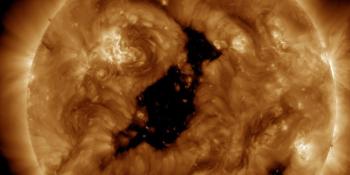
SIDC Coronal Hole 146 (trans-equatorial coronal hole with a positive polarity) first reached the central meridian on January 16 and is now partially positioned on the western side of the Sun. A new SIDC Coronal Hole 147 (equatorial coronal hole with a negative polarity) is positioned on the Eastern side of the Sun, and is expected to cross the central meridian tomorrow.
Güneş rüzgarı
Over the past 24 hours, solar wind conditions were moderately elevated and fairly steady. Solar wind speed ranged from about 480 km/s to about 640 km/s and remained mostly near 520 to 600 km/s. The interplanetary magnetic field (IMF) stayed at low to moderate levels, with the total IMF Bt between about 4 and 8 nT, while the north south component Bz fluctuated between about -6 nT and +6 nT without long-lasting strongly southward intervals. Overall, these signatures are consistent with a continuing recovery toward more typical solar wind conditions, although speeds remain somewhat elevated.
Jeomanyetizma
Geomagnetic activity was mostly active earlier in the interval and then eased. Globally, NOAA Kp was around active levels (about Kp 4) for much of the afternoon and evening of January 23 through early January 24, before decreasing to unsettled levels (around Kp 2) after about 03:00 UTC. Over Belgium, K_BEL reached active to minor storm levels, peaking near 5 during the evening of January 23 (around 18:00 to 22:00 UTC), then decreased to mostly 2 to 3 overnight, with a return to active levels (around 4) later in the morning. Further unsettled to active intervals remain possible, with a low chance of minor storming if Bz turns persistently southward while solar wind speed stays elevated.
Proton akı seviyeleri
The solar energetic particle event associated with the X1.9 flare (SIDC Flare 6678, peaking on 2026 Jan 18 at 18:09 UTC) remained ongoing until 2026 Jan 22 at 08:35 UTC, when the greater than 10 MeV GOES proton flux dropped below the 10 pfu threshold. The greater than 10 MeV flux is expected to continue to decay toward background levels. A new solar energetic particle event cannot be excluded given the number of sunspot groups currently on the visible disk, in particular the most magnetically complex regions.
Jeostatik yörüngedeki elektron akıları
The greater than 2 MeV GOES electron flux stayed above to the 1000 pfu alert threshold over the past 24 hours. In response of the elevated solar wind speed in the past 4 days, the greater than 2 MeV electron flux may remain near or above the threshold during the next 24 hours. The 24-hour electron fluence remained at moderate levels and is expected to stay around these levels, with a possible increase if elevated electron flux persists.
Bugünün tahmini uluslararası güneş lekesi sayısı (ISN): 1 Tahmini gunes lekesi sayisi, 2 Istasyon sayisi.23 Jan 2026 için güneş endeksleri
| Kurt numarası Catania | 216 |
| 10cm güneş akısı | 180 |
| AK Chambon La Forêt | 046 |
| AK Wingst | 030 |
| Tahmini Ap | 032 |
| Tahmini uluslararası güneş lekesi sayısı | 168 - 11 istasyonlarına göre |
Dikkat çeken olayların özeti
| Gün | Başlamak | Maksimum | Son | Yer | Kuvvet | OP | 10cm | Katanya/NOAA | Radyo patlaması türleri | |
|---|---|---|---|---|---|---|---|---|---|---|
| Yok | ||||||||||
Güneş Etkileri Veri Analiz Merkezi tarafından sağlanmıştır© - SIDC - SpaceWeatherLive tarafından işlendi
UTC'deki tüm zamanlar
<< Günlük genel bakış sayfasına git
Son haberler
G3 geomagnetic storm watch for 4 and 5 June
Coronal hole faces Earth

X1.5 solar flare
Güncel forum mesajları
Daha fazla konuSpaceWeatherLive.com'u Destekle!
Birçok insan SpaceWeatherLive'a Güneş aktivitelerini takip etmek ya da aurora görme şansı olup olmadığına bakmak için geliyor, ancak daha fazla trafikle birlikte sunucuları çevrimiçi tutmak da daha yüksek maliyetler gerektiriyor. SpaceWeatherLive'ı beğendiyseniz ve projeyi desteklemek istiyorsanız, reklamsız bir site için abonelik seçebilir veya bağış yapmayı düşünebilirsiniz. Sizin yardımınızla SpaceWeatherLive'ı çevrimiçi tutabiliriz!



Uzay Hava Durumu Gerçekleri
| Son X-patlaması | 2026/06/03 | X1.0 |
| Son M-patlaması | 2026/06/06 | M1.8 |
| Son jeomanyetik fırtına | 2026/06/11 | Kp5 (G1) |
| Lekesiz günler | |
|---|---|
| Son 365 gün | 3 gün |
| 2026 | 3 gün (2%) |
| Son lekesiz gün | 2026/02/24 |
| Aylık ortalama güneş lekesi sayısı | |
|---|---|
| Mayıs 2026 | 101.4 +22.1 |
| Haziran 2026 | 127.7 +26.3 |
| Son 30 gün | 110.7 +16.8 |