Перегляд архіву четвер, 8 травня 2014
Щоденний бюлетень про сонячну та геомагнітну активність від SIDC
Випущено: 2014 May 08 1232 UTC
Прогноз SIDC
Сонячні спалахи
Eruptive (C-class flares expected, probability >=50%)
Геомагнетизм
Quiet (A<20 and K<4)
Сонячні протони
Quiet
| 10 см потік | Ap | |
|---|---|---|
| 08 May 2014 | 142 | 011 |
| 09 May 2014 | 145 | 011 |
| 10 May 2014 | 145 | 011 |
Бюлетень
Catania group 36 (NOAA AR 2051), which already turned behind the west limb, produced another M1.2 flare, peaking at 16:29 UT. Activity is now shifting to the eastern hemisphere where Catania group 34 (NOAA AR 2056) produced the biggest flare of the past 24 hours, an M5.3 flare peaking at 10:07 UT. In thh hour before, X-ray flux was already increased by enhanced emission from the east limb, associated with expected returning NOAA AR 2046. Further flaring in the C level is expected over the coming days especially from the regions on the eastern hemisphere with chances for M flares. The M1.2 flare originating from NOAA AR 2051 (Catania group 36) was associated with a partial halo CME. It was detected by CACTus combined with a number of preceding CME's (and therefore incorrectly classified as full halo) but the main component is first visible in LASCO data at 16:24 UT. Another, full halo, CME, first visible in LASCO data at 3:24 UT seems to originate from the same region, with hence the bulk of the mass expelled in western direction form the Sun Earth line with projected speeds of around 800km/s as seen from STEREO A. Given the location of the source region around the limb both CME's are not expected to be geoeffective. A fast forward shock was observed in ACE solar wind data around 21:35 UT May 7. Solar wind speed jumped from about 330 km/s to about 380 km/s and total magnetic field jumped from around 5 nT to above 8nT. Density and temperature also increased. The shock was possibly a late signature of the May 3 CME. Bz was negative and increasing in magnitude after that event to almost -12nT. It has been varying between -12nT and +10nT afterwards. Wind speed was fluctuating around the 340 km/s level. Geomagnetic conditions have been quiet up to the shock arrival. Afterwards, active geomagnetic conditions were observed: NOAA Kp increased to 4 for the 3-6UT interval, local K Dourbes has been at K=4 level since 7 UT. The active geomagnetic conditions are expected to first settle down although unsettled (and possibly active) conditions may accompany the influence of a coronal hole high speed stream later on.
Розрахунок міжнародної кількості сонячних плям станом на сьогодні (ISN): 096, за даними 12 станцій.Сонячні індекси за 07 May 2014
| Число Вольфа, Катанія | 111 |
| Сонячний потік 10 см | 146 |
| AK Chambon La Forêt | 015 |
| AK Wingst | 004 |
| Розрахунковий індекс Ap | 005 |
| Розрахункова міжнародна кількість сонячних плям | 083 - За даними 22 станцій |
Зведення помітних подій
| День | Початок | Макс | Кінець | Розташування | Сила | OP | 10cm | Катанія/NOAA | Типи радіоімпульсів |
|---|---|---|---|---|---|---|---|---|---|
| 07 | 1607 | 1629 | 1703 | N15E50 | M1.2 | SF | 36/2051 | III/1 |
Надано Центром Аналізу Даних Сонячного Впливу (SIDC)© - SIDC - Оброблено SpaceWeatherLive
Весь час у UTC
Останні новини
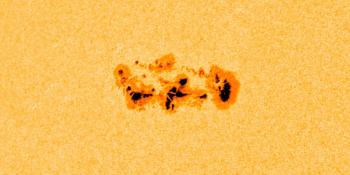
Complex sunspot region 4366

CME impact! S4 solar radiation storm

X1.9 solar flare with earth-directed CME
Останні повідомлення з форума
Більше темПідтримайте SpaceWeatherLive.com!
Багато людей заходять на SpaceWeatherLive, щоб стежити за сонячною активністю або якщо є можливість побачити полярне сяйво, але зі збільшенням трафіку зростають і витрати на підтримку серверів в мережі. Якщо вам подобається SpaceWeatherLive і ви хочете підтримати проект, ви можете вибрати підписку на безрекламний сайт або розглянути можливість зробити пожертву. З вашою допомогою ми зможемо підтримувати SpaceWeatherLive онлайн!



Факти про космічну погоду
| Останній X-спалах | 2026/02/04 | X4.21 |
| Останній M-спалах | 2026/02/25 | M2.4 |
| Останній геомагнітний шторм | 2026/03/03 | Kp5 (G1) |
| Дні без сонячних плям | |
|---|---|
| Останні 365 днів | 3 днів |
| 2026 | 3 днів (5%) |
| Останній день без сонячних спалахів | 2026/02/24 |
| Середня кількість сонячних плям протягом місяця | |
|---|---|
| лютого 2026 | 78.2 -34.3 |
| березня 2026 | 75 -3.2 |
| Останні 30 днів | 57.2 -67.7 |