Перегляд архіву середа, 12 лютого 2025
Щоденний бюлетень про сонячну та геомагнітну активність від SIDC
Випущено: 2025 Feb 12 1231 UTC
Прогноз SIDC
Сонячні спалахи
M-class flares expected (probability >=50%)
Геомагнетизм
Minor storm expected (A>=30 or K=5)
Сонячні протони
Quiet
| 10 см потік | Ap | |
|---|---|---|
| 12 Feb 2025 | 153 | 011 |
| 13 Feb 2025 | 154 | 024 |
| 14 Feb 2025 | 155 | 008 |
Сонячно-активні області та спалахи
Solar flaring activity over the last 24 hours has been at low levels, with multiple C-class flares. The largest flare was a C7.6 flare (SIDC Flare 3584) peaking at 14:05 UTC on February 11, which was associated with SIDC Sunspot Group 391 (NOAA Active Region 3981, magnetic type beta-gamma). There are currently seven numbered active regions on the solar disk. The most complex one is SIDC Sunspot Group 346 (NOAA AR 3990, magnetic type beta-gamma). SIDC Sunspot Group 391 (NOAA AR 3981) has rotated behind the west limb. SIDC Sunspot Group 398 (NOAA AR 3991, magnetic type alpha) has rotated on disk from the east limb, in the southeast quadrant. The solar flaring activity is expected to be at low to moderate levels over the next 24 hours, with C-class flares expected and M-class flares probable.
Корональні викиди маси
A wide Coronal Mass Ejection (CME) was observed in LASCO/C2 and LASCO/C3 coronagraph imagery starting from around 18:30 UTC on February 11, lifting off the east limb. It is most likely associated with a C7.2 flare (SIDC Flare 3581) peaking at 18:25 UTC on February 11 and a filament eruption near SIDC Sunspot Group 398 (NOAA AR 3991). It is not expected to impact the Earth. Two CMEs were observed in LASCO/C2 coronagraph imagery, lifting off the west limb, most likely associated with eruptive activity near SIDC Sunspot Group 391 (NOAA Active Region 3981). The first CME was faint, observed around 23:30 on February 11 and the second around 08:50 UTC on February 12. Neither is expected to impact the Earth. No other Earth-directed CMEs were observed in the available coronagraph imagery.
Корональні діри
The southern, low-latitude, negative-polarity coronal hole (SIDC Coronal Hole 87) still resides on the central meridian. An associated high-speed stream may arrive at Earth starting from UTC midday on February 12.
Сонячний вітер
The solar wind conditions (ACE & DSCOVR) were enhanced during the last 24 hours, still under the influence of the high-speed stream from the negative polarity coronal hole (SIDC Coronal Hole 88). Speed values were between 500 km/s and 580 km/s. The interplanetary magnetic field values were around 5 nT. The Bz component varied between -5 nT and 5 nT. The interplanetary magnetic field angle was predominantly in the negative sector, with few positive intervals. Enhanced solar wind conditions are expected over the next 24-48 hours, pending the arrival of a high-speed stream from the southern, negative polarity coronal hole (SIDC Coronal Hole 87).
Геомагнетизм
Geomagnetic conditions globally were mostly at unsettled levels (NOAA Kp 3), reaching active levels (NOAA Kp 4) between 03:00 and 06:00 UTC on February 12. Geomagnetic conditions locally were mostly at unsettled levels (K Bel 3), reaching active levels (K Bel 4) between 17:00 UTC and 18:00 UTC on February 11. Mostly unsettled to active conditions, with a chance of minor storm intervals (NOAA Kp 5, K Bel 5) are expected globally and locally over the next 24 hours, in response to the expected arrival of a high-speed stream from the southern, negative polarity coronal hole (SIDC Coronal Hole 87).
Рівні потоку протонів
The greater than 10 MeV proton flux was below the threshold level over the past 24 hours. It is expected to remain below the threshold level over the next 24 hours.
Потоки електронів на геостаціонарній орбіті
The greater than 2 MeV electron flux measured by GOES 16 was above the threshold level between 14:00 UTC and 21:30 UTC on February 11. The greater than 2 MeV electron flux measured by GOES 16 was above the threshold level between 15:40 UTC on February 11 and 02:00 UTC on February 12. The 24-hour electron fluence is currently at moderate levels and is expected to remain so over the next 24 hours.
Розрахунок міжнародної кількості сонячних плям станом на сьогодні (ISN): 097, за даними 03 станцій.Сонячні індекси за 11 Feb 2025
| Число Вольфа, Катанія | 145 |
| Сонячний потік 10 см | 153 |
| AK Chambon La Forêt | 026 |
| AK Wingst | 017 |
| Розрахунковий індекс Ap | 018 |
| Розрахункова міжнародна кількість сонячних плям | 081 - За даними 10 станцій |
Зведення помітних подій
| День | Початок | Макс | Кінець | Розташування | Сила | OP | 10cm | Катанія/NOAA | Типи радіоімпульсів | |
|---|---|---|---|---|---|---|---|---|---|---|
| Немає | ||||||||||
Надано Центром Аналізу Даних Сонячного Впливу (SIDC)© - SIDC - Оброблено SpaceWeatherLive
Весь час у UTC
Останні новини
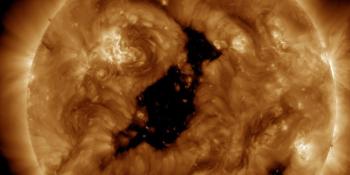
Coronal hole faces Earth

X1.5 solar flare

M2.7 solar flare, CME arrival possible
Останні повідомлення з форума
Підтримайте SpaceWeatherLive.com!
Багато людей заходять на SpaceWeatherLive, щоб стежити за сонячною активністю або якщо є можливість побачити полярне сяйво, але зі збільшенням трафіку зростають і витрати на підтримку серверів в мережі. Якщо вам подобається SpaceWeatherLive і ви хочете підтримати проект, ви можете вибрати підписку на безрекламний сайт або розглянути можливість зробити пожертву. З вашою допомогою ми зможемо підтримувати SpaceWeatherLive онлайн!



Факти про космічну погоду
| Останній X-спалах | 2026/04/24 | X2.5 |
| Останній M-спалах | 2026/05/17 | M1.4 |
| Останній геомагнітний шторм | 2026/05/16 | Kp6- (G2) |
| Дні без сонячних плям | |
|---|---|
| Останні 365 днів | 3 днів |
| 2026 | 3 днів (2%) |
| Останній день без сонячних спалахів | 2026/02/24 |
| Середня кількість сонячних плям протягом місяця | |
|---|---|
| квітня 2026 | 79.3 -6.6 |
| травня 2026 | 89.2 +9.9 |
| Останні 30 днів | 99.3 +7.6 |