查看星期日, 15 6月 2025歷史檔案
SIDC 太陽影響數據分析中心的每日公告
發布時間: 2025 Jun 15 1236 UTC
SIDC太陽影響數據分析中心的預報
太陽閃焰
M-class flares expected (probability >=50%)
地磁
Active conditions expected (A>=20 or K=4)
太陽質子
Quiet
| 10公分通量 | Ap | |
|---|---|---|
| 15 Jun 2025 | 151 | 014 |
| 16 Jun 2025 | 151 | 018 |
| 17 Jun 2025 | 151 | 011 |
太陽活動區和耀斑
Solar flaring activity was moderate over the past 24 hours, with four M-class flares identified. A total of seven numbered sunspot groups were observed on the visible solar disk during this period. SIDC Sunspot Group 513 (NOAA Active Region 4105) produced all four M-class flares. The largest event was an M6.8 flare (SIDC Flare 4639) that peaked on June 14 at 23:01 UTC. This region was also responsible for an M2.2 flare (SIDC Flare 4647) peaking on June 15 at 07:56 UTC, an M1.9 flare (SIDC Flare 4646) peaking on June 15 at 10:47 UTC, and an M1.0 flare (SIDC Flare 4637) peaking on June 14 at 18:04 UTC. Other numbered sunspot groups also contributed to flaring activity, in particular SIDC Sunspot Group 523 (NOAA Active Region 4114), which is currently located at N18E22, has a Beta-Gamma-Delta magnetic configuration, and continued to grow over the past 24 hours. Solar flaring activity is expected to remain moderate over the next 24 hours, with M-class flares likely and a small chance for X-class flares.
日冕物質拋射
A coronal mass ejection was visible in LASCO/C2 imagery starting at 08:36 UTC on June 15. This CME appears potentially fast and followed the M2.2 flare (SIDC Flare 4647), which peaked at 07:56 UTC and was produced by SIDC Sunspot Group 513 (NOAA Active Region 4105). The eruption seems to have generated a large coronal wave visible in SDO/AIA imagery. This CME is currently under analysis as it may result in a glancing blow to Earth. No other clear Earth-directed coronal mass ejections were identified in the available data.
日冕洞
The large SIDC Coronal Hole 104 (mid-latitude south coronal hole with a negative polarity) is currently transiting the central meridian. It is a recurrent coronal that first reached the central meridian on June 08.
太陽風
Solar wind conditions were moderately disturbed over the past 24 hours. The solar wind speed gradually increased, ranging from about 475 km/s to peaks near 573 km/s. This enhancement in solar wind speed is consistent with the arrival of a new high-speed stream associated with SIfrom DC Coronal Hole 104 (a mid-latitude southern coronal hole with positive polarity that crossed the central meridian on June 12). The total interplanetary magnetic field (Bt) was moderately elevated, fluctuating between 5 nT and peaks near 8 nT. The southward component (Bz) varied throughout the period, occasionally reaching minima near -6 nT, but without prolonged southward intervals. The phi angle was predominantly in the positive sector, supporting the connection to the high-speed stream from SIDC Coronal Hole 104. As the coronal hole is very large in longitude, we anticipate that the conditions will remain moderately disturbed over the next few days as the high-speed stream (HSS) continues to affect Earth before gradually diminishing as it moves away.
地磁
Geomagnetic conditions were mostly quiet to unsettled during the reporting period. The NOAA Kp index stayed within the quiet to unsettled range, and local K_BEL values reflected similar conditions. Geomagnetic activity is expected to remain generally unsettled over the next 24 hours, although isolated active periods are possible as the influence of the high-speed stream from SIDC Coronal Hole 104 persists.
質子通量水平
The greater-than-10 MeV proton flux, as measured by GOES-18, remained at background levels over the past 24 hours and is expected to stay at background levels throughout the next 24 hours. No solar energetic particle events were detected, and none are currently anticipated.
地球靜止軌道上的電子通量
The greater-than-2 MeV electron flux, as measured by the GOES-18 and GOES-19 satellite remained below the 1000 pfu alert threshold over the past 24 hours. Electron fluxes are expected to stay mostly below the alert threshold during the next 24 hours. The 24-hour electron fluence remained at normal to moderate levels and is anticipated to persist at those levels throughout the next day.
今日估計的國際太陽黑子數(ISN):147,基於15個觀測站。太陽活動指數 14 Jun 2025
| 卡塔尼亞沃爾夫數 | /// |
| 10厘米太陽通量 | 151 |
| AK Chambon La Forêt | 020 |
| AK Wingst | 026 |
| 估計地磁Ap指數 | 026 |
| 估計國際太陽黑子數 | 148 - 基於26個觀測站 |
顯著活動摘要
| 日 | 開始 | 最大值 | 結束 | 位置 | 強度 | OP | 10cm | 卡塔尼亞天體物理觀測站/美國國家海洋暨大氣管理局 | 電波爆發類型 |
|---|---|---|---|---|---|---|---|---|---|
| 14 | 1752 | 1804 | 1813 | ---- | M1.0 | 92/4105 | II/2 | ||
| 14 | 2251 | 2301 | 2309 | S16W74 | M6.8 | 1N | 92/4105 | ||
| 15 | 0745 | 0756 | 0802 | S14W67 | M2.2 | 1N | 92/4105 | II/3I/2 4 | |
| 15 | 1032 | 1047 | 1053 | ---- | M1.9 | 92/4105 |
由太陽影響數據分析中心提供© - SIDC - 由 SpaceWeatherLive處理
所有時間均採用 UTC 時間
最新新聞
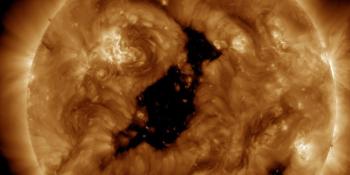
Coronal hole faces Earth

X1.5 solar flare

M2.7 solar flare, CME arrival possible
最新論壇訊息
請支持 SpaceWeatherLive.com!
很多網友來到 SpaceWeatherLive 追蹤太陽活動或極光觀測機會,但隨著流量增加,維持伺服器運作的成本也隨之越高。若您喜歡 SpaceWeatherLive 並想支持這個計畫,可選擇訂閱無廣告版本,或考慮捐款。有了您的幫助,我們才能讓 SpaceWeatherLive 持續運作!



太空天氣大事紀
| 上一個 X-閃焰 | 24/04/2026 | X2.5 |
| 上一個 M-閃焰 | 22/05/2026 | M2.3 |
| 上一個 地球磁爆 | 16/05/2026 | Kp6- (G2) |
| 無黑子天數 | |
|---|---|
| 過去 365 天內 | 3天 |
| 2026 | 3天 (2%) |
| 上一個無黑子日 | 24/02/2026 |
| 黑子數月平均 | |
|---|---|
| 4月 2026 | 79.3 -6.6 |
| 5月 2026 | 94.2 +14.9 |
| 過去 30 天內 | 97.1 +4.3 |