查看星期五, 20 2月 2026歷史檔案
SIDC 太陽影響數據分析中心的每日公告
發布時間: 2026 Feb 20 1245 UTC
SIDC太陽影響數據分析中心的預報
太陽閃焰
C-class flares expected, (probability >=50%)
地磁
Moderate (ISES: Major) magstorm expected (A>=50 or K=6)
太陽質子
Quiet
| 10公分通量 | Ap | |
|---|---|---|
| 20 Feb 2026 | 115 | 027 |
| 21 Feb 2026 | 114 | 013 |
| 22 Feb 2026 | 114 | 011 |
太陽活動區和耀斑
Solar flaring activity was low over the past 24 hours, with only C-class flares identified. The largest flare was a C2.8 flare (SIDC Flare 7053) peaking on February 20 at 03:07 UTC, which was produced by SIDC Sunspot Group 795 (NOAA Active Region 4377). A total of 4 numbered sunspot groups were identified on the disk over the past 24 hours. SIDC Sunspot Group 762 (NOAA Active Region 4374) is the most complex region with its beta magnetic configuration, and it was stable over the past 24 hours. Solar flaring activity is expected to be low over the next 24 hours, with C-class flares very likely and a chance for M-class flares.
日冕物質拋射
Two or more coronal mass ejections (CMEs), with angular widths of about 60 deg, were observed in the available SOHO/LASCO-C2 images, starting from 21:12 UTC on Feb 19 on SE limb. First one was associated to a filament eruption near the SE limb which was observed in SDO/AIA 193Å and 94Å images, but it had no Earth-directed components. Further CMEs are also possibly associated to further filament eruption from the same region. No other Earth-directed CMEs were detected in the available coronagraph observations during the last 24 hour.
日冕洞
A negative polarity, recurrent coronal hole which spans 10 S to 30 N, began to traverse the central meridian on Feb 20. The associated high speed streams are expected to arrive at Earth from Feb 23. SIDC Coronal Hole 146 which is an elongated, positive polarity, recurrent coronal hole is still crossing the central meridian since Feb 13.
太陽風
Over the past 24 hours, solar wind parameters continued to reflect the waning influence of a high-speed stream (HSSs) from the elongated, positive polarity, recurrent coronal hole (SIDC Coronal Hole 146) which started to cross the central meridian on Feb 13. The solar wind speed increases occasionally due to the irregular shape of the same coronal hole. The solar wind speed ranged from 425 km/s to 590 km/s. The interplanetary magnetic field ranged between 4 nT and 10 nT, and the North- South component (Bz) ranged between -3 nT and 6 nT. In the next 24 hours, mildly enhanced solar wind conditions are possible due to the irregular shape of the same coronal hole and then later a gradual transition to slow solar wind. Solar wind conditions may also be enhanced if the interplanetary coronal mass ejection (ICME) associated to the CME (associated to a filament eruption) that was observed lifting from the Sun in the afternoon of Feb 16 arrives late.
地磁
Geomagnetic conditions were globally and locally at quiet to unsettled conditions (NOAA Kp and K BEL 1 to 3), during the past 24 hours. Quiet to unsettled conditions are expected in the next 24 hours. Active to moderate storm conditions are possible, if interplanetary coronal mass ejection (ICME) associated to the CME (associated to a filament eruption) that was observed lifting from the Sun in the afternoon of Feb 16 arrives late.
質子通量水平
The greater than 10 MeV GOES proton flux was below the threshold level over the past 24 hours and it is expected to remain so for the next 24 hours.
地球靜止軌道上的電子通量
The greater than 2 MeV electron flux, as measured by GOES-18 satellite, increased and exceeded the 1000 pfu threshold level from 13:30 UTC on Feb 19 to 04:00 UTC on Feb 20 over the past 24 hours. It is above the threshold level since 11:50 UTC on Feb 20 and is expected to remain so mostly in the next 24 hours. The greater than 2 MeV electron flux, as measured by GOES-19 satellite, exceeded above the 1000 pfu threshold level around 12:00 UTC on Feb 19 and dropped below the threshold level around 00:10 UTC on Feb 20. It was then fluctuating around the threshold and again went above the threshold level since 08:10 UTC on Feb 20 and expected to remain so. It was in response to the high speed streams (HSS) from the elongated, positive polarity, coronal hole (SIDC Coronal Hole 146) which started to cross the central meridian since Feb 13. The 24h electron fluence was at moderate levels and is expected to remain at moderate level in the coming 24 hours.
今日估計的國際太陽黑子數(ISN):041,基於07個觀測站。太陽活動指數 19 Feb 2026
| 卡塔尼亞沃爾夫數 | 067 |
| 10厘米太陽通量 | 116 |
| AK Chambon La Forêt | 017 |
| AK Wingst | 011 |
| 估計地磁Ap指數 | 011 |
| 估計國際太陽黑子數 | 042 - 基於17個觀測站 |
顯著活動摘要
| 日 | 開始 | 最大值 | 結束 | 位置 | 強度 | OP | 10cm | 卡塔尼亞天體物理觀測站/美國國家海洋暨大氣管理局 | 電波爆發類型 | |
|---|---|---|---|---|---|---|---|---|---|---|
| 無 | ||||||||||
由太陽影響數據分析中心提供© - SIDC - 由 SpaceWeatherLive處理
所有時間均採用 UTC 時間
最新新聞
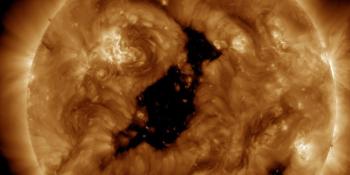
Coronal hole faces Earth

X1.5 solar flare

M2.7 solar flare, CME arrival possible
最新論壇訊息
請支持 SpaceWeatherLive.com!
很多網友來到 SpaceWeatherLive 追蹤太陽活動或極光觀測機會,但隨著流量增加,維持伺服器運作的成本也隨之越高。若您喜歡 SpaceWeatherLive 並想支持這個計畫,可選擇訂閱無廣告版本,或考慮捐款。有了您的幫助,我們才能讓 SpaceWeatherLive 持續運作!



太空天氣大事紀
| 上一個 X-閃焰 | 24/04/2026 | X2.5 |
| 上一個 M-閃焰 | 22/05/2026 | M2.3 |
| 上一個 地球磁爆 | 16/05/2026 | Kp6- (G2) |
| 無黑子天數 | |
|---|---|
| 過去 365 天內 | 3天 |
| 2026 | 3天 (2%) |
| 上一個無黑子日 | 24/02/2026 |
| 黑子數月平均 | |
|---|---|
| 4月 2026 | 79.3 -6.6 |
| 5月 2026 | 91.5 +12.2 |
| 過去 30 天內 | 94.7 +1.9 |