Předpověď počasí ve vesmíru - diskuse
Vydáno: 2026 Jun 04 0030 UTC
Připraveno americkým ministerstvem obchodu, NOAA, střediskem pro předpověď vesmírného počasí a zpracováno na SpaceWeatherLive.com
Sluneční aktivita
24 h Shrnutí
Solar activity remained at high levels. Activity was dominated by Region 4455 (N14W21, Dki/beta-gamma-delta), which produced frequent C-class flares alongside three significant flare events: an M9.3/Sf at 03/0136 UTC, an M7.7/1b at 03/0700 UTC, and an X1.0/1n at 03/1128 UTC. There are eight numbered regions on the visible disk. Region 4455 remains complex, maintaining its anti-Hale configuration and displaying a newly developed delta structure. Continuous flux emergence and spot growth with penumbral development were observed just ahead of its mature, positive polarity lead spot. Regions 4458 (S05W08, Dai/beta) and 4459 (N14E36, Dai/beta-gamma) both showed growth and consolidation, with Region 4459 showing rapid spot development in its trailing area and gaining a mixed-polarity gamma configuration. Region 4461 (S21E59, Cai/beta-gamma) also showed flux emergence driving a gamma configuration, though extreme foreshortening near the limb limits high-confidence analysis of its overall complexity. Region 4462 (N17E60, Dao/beta) consolidated and showed increased separation between its poles. The remaining regions were stable or in decline. Several eruptive events occurred during the reporting period: The M9.3/Sf flare at 03/0136 UTC was accompanied by wideband radio emissions, including a Type IV radio sweep, a Type II sweep with an estimated shock velocity of 253 km/s, and a 10.7cm radio burst peaking at 360 sfu. An associated CME became visible in LASCO C2 imagery at approximately 03/0213 UTC and GOES CCOR1 at 03/0215 UTC. While faint in coronagraph imagery, GOES/SUVI imagery implies a partial to full halo profile, and COR2 triangulation confirms an Earth-directed component. Modeling indicates this event is the most Earth-directed CME of the periods events. The M7.7/1B flare at 03/0700 UTC was accompanied by by wideband radio emissions, including a Type IV sweep, a Type II sweep with an estimated shock velocity of 313 km/s, and a prominent three-minute 10.7cm radio burst peaking at 540 sfu with a Castelli-U signature. The associated CME was first seen in LASCO C2 at 03/0748 UTC and CCOR1 at 03/0745 UTC. GOES/SUVI 304 imagery shows much of the ejecta was deflected significantly northward by an adjacent positive polarity coronal hole. STEREO COR2 imagery and modeling shows that though that while it retains an Earth-directed glancing component, it is the least directly targeted event of the period. The X1.0/1N flare at 03/1128 UTC was accompanied by wideband radio emissions, including a Type IV sweep and a 10.7cm radio burst peaking at 180 sfu. An associated CME was observed in CCOR1 imagery at 03/1200 UTC. GOES/SUVI 304 imagery suggests that the ejecta was deflected both eastward and northward. Triangulation with COR2 and modeling confirm an Earth-directed component. Together, these three eruptions are anticipated to arrive at Earth mid- to late on 04 June.Předpověď
Solar activity is expected to be at moderate to high levels through 06 June. M-class (R1-R2/Minor-Moderate) flaring remains likely, with a slight chance for X-class (R3/Strong or greater) events, primarily due to the eruptive capabilities of Regions 4455, 4458, and 4459.Energetické částice
24 h Shrnutí
The greater than 2 MeV electron flux at geosynchronous orbit was at low to moderate levels, with a peak flux of 400 pfu observed at 03/1755 UTC. The greater than 10 MeV proton flux at geosynchronous orbit remained at baseline background levels.Předpověď
The greater than 2 MeV electron flux at geosynchronous orbit is anticipated to rise to high levels on 04 June in response to CME effects, remaining high through 06 June. While the greater than 10 MeV proton flux is expected to remain below the S1 threshold, proton enhancements are possible on 04 June due to CME shock front interactions.Solární bouře
24 h Shrnutí
Solar wind parameters continued to be slightly elevated with conditions reflecting possible embedded transient influences. Total magnetic field (Bt) averaged near 8 nT during the first half of the reporting period before dropping sharply around 03/0800 UTC. Following this, Bt was variable and reached as low at 0.5 nT during one of several solar sector boundary crossings around 1845 UTC. After this crossing, Bt steadily increased ending the period around 10 nT. The North-South (Bz) component was mostly northward, but turned south later in the period after 1845 UTC and reached a maximum deflection of -6 nT. Wind speeds held steady near 400 km/s for most of the period before a distinct increase to near 450 km/s late in the period. The phi angle showed a distinct transition into the positive (away from the Sun) sector late in the period.Předpověď
Mild enhancements are expected early on 04 June under the initial onset of positive polarity high-speed stream (+CH HSS) influences. Conditions will escalate dramatically mid- to late on 04 June with the arrival of the multiple 03 June CMEs. These significant enhancements are expected to persist through 05 June with elevated conditions persisting through 06 June.Geoprostor
24 h Shrnutí
The geomagnetic field was quiet to unsettled.Předpověď
Geomagnetic field conditions are expected to escalate rapidly from quiet to active, reaching up to G3 (Strong) geomagnetic storming levels mid- to late on 04 June and persisting into 05 June in response to the multiple CME arrivals. There is a chance for isolated periods of G4 (Severe) geomagnetic storming during the peak of the multi-CME passage over 04-05 June. Conditions are expected to drop to active levels, with a remaining chance for isolated G1 (Minor) storming thresholds, on 06 June as CME effects gradually wane.Poslední zprávy
středa 13. května 2026
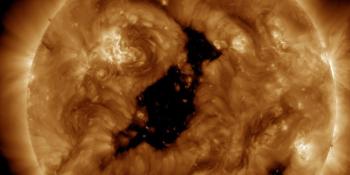
Coronal hole faces Earth

pondělí 30. března 2026
X1.5 solar flare

úterý 17. března 2026
M2.7 solar flare, CME arrival possible
Nejnovější zprávy na fóru
Další témataPodpora SpaceWeatherLive.com!
Mnoho lidí navštěvuje SpaceWeatherLive, aby sledovali sluneční aktivitu nebo pokud je šance spatřit polární záři, ale s větší návštěvností přicházejí i vyšší náklady na udržování serverů online. Pokud se vám SpaceWeatherLive líbí a chcete projekt podpořit, můžete si zvolit předplatné pro web bez reklam nebo zvážit darování. S vaší pomocí můžeme SpaceWeatherLive udržet online!



Fakta o počasí ve vesmíru
| Poslední X-záblesk | 03. 06. 2026 | X1.0 |
| Poslední M-záblesk | 03. 06. 2026 | M7.9 |
| Poslední geomagnetická bouře | 16. 05. 2026 | Kp6- (G2) |
| Dny bez skvrn | |
|---|---|
| Posledních 365 dnů | 3 dnů |
| 2026 | 3 dnů (2%) |
| Poslední den bez skvrn | 24. 02. 2026 |
| Průměrný měsíční počet slunečních skvrn | |
|---|---|
| dubna 2026 | 79.3 -6.6 |
| června 2026 | 140 +60.7 |
| Posledních 30 dnů | 97.7 +4.1 |
Tento den v historii*
Aurora on this day in history
No observations submitted for this day in history. If you've observed the aurora and you have some amazing photos to show off, submit your observations now!
Submit your aurora observation