Archiv von Donnerstag, 19 Juni 2003 anzeigen
Sonnenaktivitätsbericht
Für jede Sonneneruption in diesem Bericht wird ein Skalierungsfaktor vom Space Weather Prediction Center (SWPC) angewendet. Aufgrund dieses SWPC-Skalierungsfaktors werden Sonneneruptionen um 42 % kleiner gemeldet als die Daten für wissenschaftliche Zwecke. Der Skalierungsfaktor wurde aus unseren archivierten Sonneneruptionsdaten entfernt, um die tatsächlichen physikalischen Einheiten widerzuspiegeln.
Bericht der solaren und geophysikalischen Aktivität 2003 Jun 19 2200 UTCErstellt von NOAA © SWPC und verarbeitet von SpaceWeatherLive.com
Gemeinsamer Bericht der USAF und NOAA zur solaren und geophysikalischen Aktivität
SDF Nummer 170 ausgestellt am 19 Jun 2003 um 2200 Uhr UTCIA. Analyse der aktiven Sonnenflecken-Gruppen und der Aktivität vom 18-2100Z Uhr bis 19-2100Z Uhr Solar activity decreased to very low levels. Flare
activity was limited to several B-class flares. Region 386 (S07E30)
lost penumbral coverage over the period although it does retain a
delta magnetic structure in the dominant lead spot. Region 387
(N18E49) grew in both penumbral coverage and magnetic complexity
since yesterday, a gamma structure is now evident in the trailing
portion of the spot group. Newly numbered Region 388 (S03E08)
produced a minor B-class flare early in the period.
IB. Sonnenaktivitäts-Prognose
Solar activity is expected to be at
moderate levels. Region 386 remains capable of producing an
isolated major flare.
IIA. Geophysikalische Aktivität vom 18-2100Z Uhr bis 19-2100Z Uhr
The geomagnetic field was at predominantly active levels today.
Minor storm conditions were observed at both middle and high
latitudes between 19/0000 and 0300Z due to the influence of a
recurrent high speed coronal hole stream. The greater than 10 MeV
proton flux exceeded event threshold at 18/2050Z (reached a max of
24 pfu at 19/0450Z), ended at 19/1900Z and after careful review the
event is believed to have been the result of the M6.8 x-ray flare
from June 17. The greater than 2 MeV electron flux reached moderate
levels today.
IIB. Geophysikalische Aktivitätsprognose
The geomagnetic field is
expected to be at predominantly unsettled to active levels through
the interval. Minor storm conditions may exist due to a transient
passage during the first half of day one in response to the M6.8
x-ray flare from June 17.
III. Ereignis-Wahrscheinlichkeiten 20 Jun bis 22 Jun
| Klasse M | 50% | 50% | 50% |
| Klasse X | 15% | 15% | 15% |
| Protonensturm | 25% | 15% | 15% |
| PCAF | green | ||
IV. Penticton 10.7 cm Flux
  Beobachtet       19 Jun 123
  Vorhergesagt   20 Jun-22 Jun  125/125/125
  90 Tage Mittel        19 Jun 124
V. Geomagnetischer Ap Index
  Beobachtet Afr/Ap 18 Jun  036/054
  Geschätzt     Afr/Ap 19 Jun  023/025
  Vorhergesagt    Afr/Ap 20 Jun-22 Jun  020/025-020/025-012/020
VI. Geomagnetische Aktivität - Wahrscheinlichkeiten 20 Jun bis 22 Jun
| A. Mittlere Breiten | |||
|---|---|---|---|
| Aktiv | 40% | 40% | 25% |
| Geringer Sturm | 15% | 15% | 10% |
| Schwerwiegender Sturm | 10% | 10% | 05% |
| B. Hohe Breiten | |||
|---|---|---|---|
| Aktiv | 50% | 50% | 40% |
| Geringer Sturm | 20% | 20% | 15% |
| Schwerwiegender Sturm | 10% | 10% | 10% |
Alle Zeiten in UTC
Neueste Nachrichten
Sonntag, 1 Februar 2026
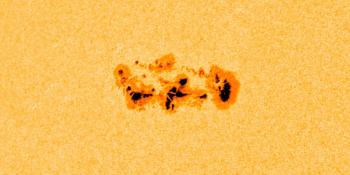
Complex sunspot region 4366

Montag, 19 Januar 2026
CME impact! S4 solar radiation storm

Sonntag, 18 Januar 2026
X1.9 solar flare with earth-directed CME
Neue Nachrichten im Forum
Did ChatGPT Find a New Solar Physics Formula? 28Incoming & Unnumbered Active Regions 218AR4378 6AR4379/4380 15CME March 1 7
Weitere Nachrichten im ForumUnterstützen Sie SpaceWeatherLive!
Viele Menschen nutzen SpaceWeatherLive, um die Sonnenaktivität zu verfolgen oder um zu schauen, ob es eine Chance gibt Polarlichter, zu sehen. Mit zunehmendem Datenverkehr steigen jedoch die Kosten für die Serververfügbarkeit. Wenn Ihnen SpaceWeatherLive gefällt und Sie das Projekt unterstützen möchten, können Sie ein Abonnement für eine werbefreie Website abschließen oder eine Spende tätigen. Mit Ihrer Hilfe können wir SpaceWeatherLive online halten!



Weltraumwetter-Fakten
| Letzte Klasse X-Eruption | 04/02/2026 | X4.21 |
| Letzte Klasse M-Eruption | 25/02/2026 | M2.4 |
| Letzter geomagnetischer Sturm | 22/02/2026 | Kp5+ (G1) |
| Tage ohne Flecken | |
|---|---|
| Letzte 365 Tage | 3 Tage |
| 2026 | 3 Tage (5%) |
| Letzter fleckenlose Tag | 24/02/2026 |
| Monatliche mittlere Sonnenfleckenzahl | |
|---|---|
| Januar 2026 | 112.6 -11.4 |
| Februar 2026 | 74.6 -38 |
| Letzte 30 Tage | 79 -41.8 |