Archiv von Montag, 6 Januar 2014 anzeigen
Tägliches Bulletin zur solaren und geomagnetischen Aktivität des SIDC
Ausgestellt: 2014 Jan 06 1240 UTC
Vorhersage des SIDC
Sonneneruptionen
Active (M-class flares expected, probability >=50%)
Geomagnetismus
Active conditions expected (A>=20 or K=4)
Sonnenprotonen
Proton event in progress (>10 MeV)
| 10cm Fluss | Ap | |
|---|---|---|
| 06 Jan 2014 | 220 | 003 |
| 07 Jan 2014 | 220 | 009 |
| 08 Jan 2014 | 220 | 017 |
Bulletin
A proton event is currently in progress. From January 6 on at 8h20 UTC the proton flux started to rise for > 10 MeV, > 50 MeV and > 100 MeV the energy levels. The event threshold of 10 pfu was passed on 9h15 UTC for > 10 MeV protons and on 9h45 UTC for > 50 MeV protons. The proton flux is still above (>10 MeV) or near (>50 MeV) the event threshold. This proton event was due to a strong flare erupting from NOAA AR 1936, which has turned around the west limb a few days ago. The flare was visible around 7h45 UTC in STEREO A EUV195 and (partly) in SDO/AIA imagery. The flare was associated with a metric type II radio burst, detected in Learmonth (estimated shock wave speed 1383 km/s) and Culgoora spectrographic data. There is also a strong westward halo CME, observed by STEREO A/COR2 and LASCO/C2. The CME speed at eruption is estimated around 1200 km/s, but has slowed down to 900 km/s. Due to the position of the solar origin we estimate the geoeffectiveness of this CME to be limited to at most a glancing blow around January 8 at 4h UTC. NOAA AR 1944 was relatively stable and produced three C flares over the past 24 hours. Region NOAA AR 1946 has shown some growth. The likelihood for C and M flares remains high. There is a slight chance for an X-flare. Current solar wind speed has decreased to 400 km/s. The magnitude of the interplanetary magnetic field remains around 5 nT, with a fluctuating Bz-component. Current geomagnetic conditions are quiet (estimated NOAA Kp and local K_Dourbes and K_Izmiran=0 to 1). Mainly quiet conditions are expected to continue for the next 24 hours. Unsettled to active (K=3 to 4) conditions might be reached on January 8 due to the possible arrival of a glancing blow from the CMEs of January 4 and January 6.
Die heute international geschätzte Sonnenfleckenanzahl (ISN): 120, basierend auf 09 Stationen.Solarindizes für den 05 Jan 2014
| Wolf-Zahl Catania | /// |
| 10cm Solarflux | 218 |
| AK Chambon La Forêt | 005 |
| AK Wingst | 002 |
| Geschätzer Ap-Wert | 002 |
| Geschätzte internationale Sonnenfleckenzahl | 095 - Basierend auf 19 Stationen |
Zusammenfassung auffälliger Ereignisse
| Tag | Start | Max | Ende | Loc | Stärke | OP | 10cm | Catania/NOAA | Radioburst-Typen | |
|---|---|---|---|---|---|---|---|---|---|---|
| Keine | ||||||||||
Zur Verfügung gestellt vom Solar Influences Data Analysis Center© - SIDC - Verarbeitet von SpaceWeatherLive
Alle Zeiten in UTC
Neueste Nachrichten

X1.5 solar flare

M2.7 solar flare, CME arrival possible
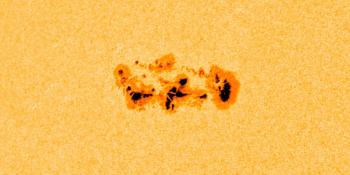
Complex sunspot region 4366
Neue Nachrichten im Forum
Unterstützen Sie SpaceWeatherLive!
Viele Menschen nutzen SpaceWeatherLive, um die Sonnenaktivität zu verfolgen oder um zu schauen, ob es eine Chance gibt Polarlichter, zu sehen. Mit zunehmendem Datenverkehr steigen jedoch die Kosten für die Serververfügbarkeit. Wenn Ihnen SpaceWeatherLive gefällt und Sie das Projekt unterstützen möchten, können Sie ein Abonnement für eine werbefreie Website abschließen oder eine Spende tätigen. Mit Ihrer Hilfe können wir SpaceWeatherLive online halten!



Weltraumwetter-Fakten
| Letzte Klasse X-Eruption | 30/03/2026 | X1.5 |
| Letzte Klasse M-Eruption | 09/04/2026 | M1.0 |
| Letzter geomagnetischer Sturm | 03/04/2026 | Kp7- (G3) |
| Tage ohne Flecken | |
|---|---|
| Letzte 365 Tage | 3 Tage |
| 2026 | 3 Tage (3%) |
| Letzter fleckenlose Tag | 24/02/2026 |
| Monatliche mittlere Sonnenfleckenzahl | |
|---|---|
| März 2026 | 85.9 +7.7 |
| April 2026 | 88.1 +2.2 |
| Letzte 30 Tage | 93.2 +32.7 |