Archiv von Donnerstag, 15 Februar 2018 anzeigen
Tägliches Bulletin zur solaren und geomagnetischen Aktivität des SIDC
Ausgestellt: 2018 Feb 15 1230 UTC
Vorhersage des SIDC
Sonneneruptionen
Quiet conditions (<50% probability of C-class flares)
Geomagnetismus
Active conditions expected (A>=20 or K=4)
Sonnenprotonen
Quiet
| 10cm Fluss | Ap | |
|---|---|---|
| 15 Feb 2018 | 075 | 015 |
| 16 Feb 2018 | 074 | 012 |
| 17 Feb 2018 | 073 | 012 |
Bulletin
Over the past 24 hours solar activity has been low. No significant flares have been recorded. Active Region (AR) 2699 (Mcintosh class:Dso; Mag. type:Beta) has been most active, showing considerable flux emergence and cancellation. The greater than 10MeV proton flux remained at background levels over the past 24 hours. No Earth directed Coronal Mass Ejections (CMEs) have been detected. Over the next 24 hours there is a reasonable probability that flaring activity will reach C-class levels with a small probability of M-class flares. The solar wind speed fluctuated around 310 km/s over the past 24 hours, but jumped to 350 km /s this morning with the arrival of a shock front. The total magnetic field strength has remained around 3 nT, but began fluctuating between 3 and 9 nT in the last few hours. The Bz component has fluctuated between -3 and +3 nT. Geomagnetic conditions ranged between Kp index 0-2 (NOAA) and local K index 0-2 (Dourbes) over the past 24 hours. The above mentioned shock front arrived at 07:55 UT this morning. The sudden increase in the solar wind speed (from about 310 to 350 km/s) was observed simultaneously with an increase in the density, temperature and the interplanetary magnetic field magnitude (from about 2 nT to 7 nT). Since the solar wind speed was, and is still rather low, and the Bz component of the interplanetary magnetic field was mostly positive, the shock arrival did not induce disturbed geomagnetic conditions. The shock is probably related to the CME produced at 01:25 UT on 12-Feb-2018, which was anticipated to arrive at approximately 12:00 UT today. A large coronal hole that passed the central meridian a couple of days ago may also be the cause, however the associated High Speed Stream (HSS) is expected to arrive later today / tomorrow. Enhanced solar wind conditions from the coronal hole and CME arrival are expected to cause geomagnetic conditions to be unsettled.
Die heute international geschätzte Sonnenfleckenanzahl (ISN): 016, basierend auf 10 Stationen.Solarindizes für den 14 Feb 2018
| Wolf-Zahl Catania | /// |
| 10cm Solarflux | 075 |
| AK Chambon La Forêt | 007 |
| AK Wingst | 003 |
| Geschätzer Ap-Wert | 003 |
| Geschätzte internationale Sonnenfleckenzahl | 023 - Basierend auf 22 Stationen |
Zusammenfassung auffälliger Ereignisse
| Tag | Start | Max | Ende | Loc | Stärke | OP | 10cm | Catania/NOAA | Radioburst-Typen | |
|---|---|---|---|---|---|---|---|---|---|---|
| Keine | ||||||||||
Zur Verfügung gestellt vom Solar Influences Data Analysis Center© - SIDC - Verarbeitet von SpaceWeatherLive
Alle Zeiten in UTC
Neueste Nachrichten

X1.5 solar flare

M2.7 solar flare, CME arrival possible
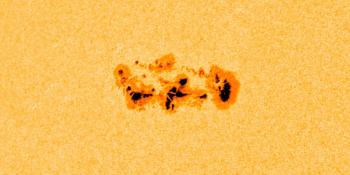
Complex sunspot region 4366
Neue Nachrichten im Forum
Unterstützen Sie SpaceWeatherLive!
Viele Menschen nutzen SpaceWeatherLive, um die Sonnenaktivität zu verfolgen oder um zu schauen, ob es eine Chance gibt Polarlichter, zu sehen. Mit zunehmendem Datenverkehr steigen jedoch die Kosten für die Serververfügbarkeit. Wenn Ihnen SpaceWeatherLive gefällt und Sie das Projekt unterstützen möchten, können Sie ein Abonnement für eine werbefreie Website abschließen oder eine Spende tätigen. Mit Ihrer Hilfe können wir SpaceWeatherLive online halten!



Weltraumwetter-Fakten
| Letzte Klasse X-Eruption | 30/03/2026 | X1.5 |
| Letzte Klasse M-Eruption | 04/04/2026 | M1.0 |
| Letzter geomagnetischer Sturm | 03/04/2026 | Kp7- (G3) |
| Tage ohne Flecken | |
|---|---|
| Letzte 365 Tage | 3 Tage |
| 2026 | 3 Tage (3%) |
| Letzter fleckenlose Tag | 24/02/2026 |
| Monatliche mittlere Sonnenfleckenzahl | |
|---|---|
| März 2026 | 85.9 +7.7 |
| April 2026 | 122.8 +36.9 |
| Letzte 30 Tage | 99.9 +42.1 |