Archiv von Montag, 30 November 2020 anzeigen
Tägliches Bulletin zur solaren und geomagnetischen Aktivität des SIDC
Ausgestellt: 2020 Nov 30 1330 UTC
Vorhersage des SIDC
Sonneneruptionen
C-class flares expected, (probability >=50%)
Geomagnetismus
Active conditions expected (A>=20 or K=4)
Sonnenprotonen
Quiet
| 10cm Fluss | Ap | |
|---|---|---|
| 30 Nov 2020 | 120 | 014 |
| 01 Dec 2020 | 122 | 021 |
| 02 Dec 2020 | 122 | 021 |
Bulletin
Solar activity was dominated by an M4 flare peaking at 13:11UT from over the East limb from an unnumbered region that is about to rotate onto the visible disc. Apart from the M flare X-ray flux remained below C level. There are currently 6 regions on disc of which NOAA AR 2786 (Beta-gamma) has the largest flaring potential, although it remained fairly stable over the past 24h. Other regions are less complex and show less flaring potential. The most uncertain factor is the region that is about to rotate onto the disc but which can not be analysed yet. Overall, one needs to factor in a considerable probability (40%) for further M flares with also a very slight possibility of an X-flare.
The M4 flare was associated with a type II radio burst and EUV wave. And in SoHO/LASCO C2 a corresponding CME is visible from around 13:25UT (the true time of emergence in C2 view must be in the data gap between 12:48UT and 13:25UT). The CME is directed well toward the East of the Sun-Earth line with a projected speed of around 1500 km/s. While the bulk is directed off the Sun-Earth line the associated shock wave leaves an asymmetric full halo signature in SoHO/LASCO C2 and C3 imagery. The bulk of the CME is hence not expected to arrive to Earth, and the CME is most probably even directed backward. However, given the uncertainty in its exact direction a glancing blow and arrival of the shock wave can not fully be excluded. If this is the case it should be expected late December 1 or early December 2.
No other Earth directed CMEs have been recorded.
The greater than 10MeV proton flux as measured by GOES rose slowly over the morning to around 3 pfu. It is not expected to rise much further although that can not be excluded. The greater than 2MeV electron flux exceeded the 1000 pfu alert threshold during its diurnal maximum, and this may occur again today. The 24h electron fluence was at moderate levels and is expected to be at normal to moderate levels over the next 24 hours. Overall a decreasing trend was expected although the current Solar wind increase of unknown origin may be changing that forecast if it persists.
Solar wind conditions rose unexpectedly. Especially over the morning, Solar wind speed increased to now around 530 km/s. During the rise, magnetic field reached a peak of 12nT, while Bz remained mostly positive. Total magnetic field has meanwhile declined to low values. The magnetic field phi angle jumped from the positive (away from the Sun) into the negative (towards the Sun) sector. As no clear origin of this increase could be identified we expect a slow return to nominal conditions as the transient passes. Should any shock from the December 29 CME arrive to Earth this could occur late December 1 or early December 2.
Geomagnetic conditions were quiet to unsettled (both local K Dourbes and NOAA Kp 0-3). Geomagnetic conditions are expected to be unsettled with possibly active periods given the current increased solar wind speed, and the possible CME shock arrival tomorrow.
Die heute international geschätzte Sonnenfleckenanzahl (ISN): 074, basierend auf 11 Stationen.Solarindizes für den 29 Nov 2020
| Wolf-Zahl Catania | /// |
| 10cm Solarflux | 116 |
| AK Chambon La Forêt | 009 |
| AK Wingst | 003 |
| Geschätzer Ap-Wert | 003 |
| Geschätzte internationale Sonnenfleckenzahl | 083 - Basierend auf 20 Stationen |
Zusammenfassung auffälliger Ereignisse
| Tag | Start | Max | Ende | Loc | Stärke | OP | 10cm | Catania/NOAA | Radioburst-Typen |
|---|---|---|---|---|---|---|---|---|---|
| 29 | 1234 | 1311 | 1341 | ---- | M4.4 | 240 | --/---- | VI/2II/2III/1 |
Zur Verfügung gestellt vom Solar Influences Data Analysis Center© - SIDC - Verarbeitet von SpaceWeatherLive
Alle Zeiten in UTC
Neueste Nachrichten
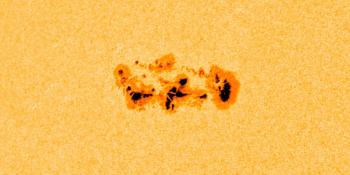
Complex sunspot region 4366

CME impact! S4 solar radiation storm

X1.9 solar flare with earth-directed CME
Neue Nachrichten im Forum
Unterstützen Sie SpaceWeatherLive!
Viele Menschen nutzen SpaceWeatherLive, um die Sonnenaktivität zu verfolgen oder um zu schauen, ob es eine Chance gibt Polarlichter, zu sehen. Mit zunehmendem Datenverkehr steigen jedoch die Kosten für die Serververfügbarkeit. Wenn Ihnen SpaceWeatherLive gefällt und Sie das Projekt unterstützen möchten, können Sie ein Abonnement für eine werbefreie Website abschließen oder eine Spende tätigen. Mit Ihrer Hilfe können wir SpaceWeatherLive online halten!



Weltraumwetter-Fakten
| Letzte Klasse X-Eruption | 04/02/2026 | X4.21 |
| Letzte Klasse M-Eruption | 25/02/2026 | M2.4 |
| Letzter geomagnetischer Sturm | 22/02/2026 | Kp5+ (G1) |
| Tage ohne Flecken | |
|---|---|
| Letzte 365 Tage | 3 Tage |
| 2026 | 3 Tage (5%) |
| Letzter fleckenlose Tag | 24/02/2026 |
| Monatliche mittlere Sonnenfleckenzahl | |
|---|---|
| Januar 2026 | 112.6 -11.4 |
| Februar 2026 | 75.5 -37.1 |
| Letzte 30 Tage | 81.7 -39.4 |