Archiv von Mittwoch, 16 April 2025 anzeigen
Tägliches Bulletin zur solaren und geomagnetischen Aktivität des SIDC
Ausgestellt: 2025 Apr 16 1231 UTC
Vorhersage des SIDC
Sonneneruptionen
C-class flares expected, (probability >=50%)
Geomagnetismus
Active conditions expected (A>=20 or K=4)
Sonnenprotonen
Quiet
| 10cm Fluss | Ap | |
|---|---|---|
| 16 Apr 2025 | 155 | 020 |
| 17 Apr 2025 | 156 | 019 |
| 18 Apr 2025 | 157 | 014 |
Solaraktive Regionen und Flares
Solar flaring activity over the last 24 hours has been moderate, with one M-class flare. The strongest flare was an M1.3 flare (SIDC Flare 4138) from beyond the west limb, peaking at 18:13 UTC on April 15. There are currently four numbered active regions on the solar disk. The most complex one is SIDC Sunspot Group 450 (NOAA Active Region 4060, magnetic type beta-gamma). A new, currently unnumbered active region (SIDC Sunspot Group 474, magnetic type beta) has rotated on disk from the east limb. A new, currently unnumbered active region (SIDC Sunspot Group 475, magnetic type beta) has emerged in the northeast quadrant, east of SIDC Sunspot Group 450 (NOAA Active Region 4060). The solar flaring activity is expected to be low over the next 24 hours, with C-class flares expected and a chance for M-class flares.
Koronaler Massenauswurf
Two narrow Coronal Mass Ejections (CMEs) were observed in LASCO/C2 coronagraph imagery, lifting off the east limb. The first was observed around 15:00 UTC on April 15 and the second around 00:00 UTC on April 16. They are most likely associated with flaring activity near the east limb and they are not expected to impact Earth. A filament eruption was observed in SDO/AIA 304 data, near SIDC Sunspot Group 450 (NOAA Active Region 4060), but no associated CME was observed in the available coronagraph imagery. No other Earth-directed CMEs were observed in the available coronagraph imagery.
Sonnenwind
A shock was detected in the solar wind data (DSCOVR) at 16:35 UTC on April 15. The interplanetary magnetic field jumped from 6 nT to 17 nT and briefly reached values up to 23 nT. The Bz component jumped from -4 nT to -11 nT. The solar wind speed jumped from 400 km/s to around 480 km/s and then increased up to 620 km/s. The solar wind density at the shock jumped from 5.6 ppcc to around 24.4 ppcc. The shock is most likely related to the expected interplanetary Coronal Mass Ejection (ICME) arrivals, associated with the CMEs that lifted off around 23:00 UTC on April 12 and the partial halo CME that lifted off around 08:30 UTC on April 13. Further enhancements in the solar wind parameters may be expected over the next 24 hours, also in the case of an early arrival of the high-speed stream from SIDC Coronal Hole 105.
Geomagnetismus
Geomagnetic conditions globally reached moderate storm levels (NOAA Kp 6 to 6+), between 18:00 UTC on April 15 and 00:00 UTC on April 16. Geomagnetic conditions locally reached minor storm levels (K BEL 5) at 17:00 UTC on April 16 and briefly escalated to moderate storm levels (K BEL 6) between 00:00 UTC and 01:00 UTC on April 16. Geomagnetic conditions globally and locally are currently at unsettled levels (NOAA Kp 3, K BEL 3). Mostly unsettled to active conditions (NOAA Kp 3 to 4, K BEL 3 to 4), with a chance for isolated minor storm periods (NOAA Kp 5, K BEL 5), are expected globally and locally over the next 24 hours, also in the case of an early arrival of the high-speed stream from SIDC Coronal Hole 105.
Protonenflusswerte
The greater than 10 MeV proton flux was below the threshold level over the past 24 hours. It is expected to remain below the threshold level over the next 24 hours.
Elektronenflüsse im geostationären Orbit
The greater than 2 MeV electron flux measured by GOES 18 was above the threshold level between 13:30 UTC and 21:40 UTC on April 15. The greater than 2 MeV electron flux measured by GOES 19 was above the threshold level between 11:50 UTC and 17:20 UTC on April 15. The greater than 2 MeV electron flux is expected to remain below the threshold over the next 24 hours. The 24-hour electron fluence is presently at normal levels and is expected to remain so over the next 24 hours.
Die heute international geschätzte Sonnenfleckenanzahl (ISN): 087, basierend auf 05 Stationen.Solarindizes für den 15 Apr 2025
| Wolf-Zahl Catania | /// |
| 10cm Solarflux | 153 |
| AK Chambon La Forêt | 051 |
| AK Wingst | 030 |
| Geschätzer Ap-Wert | 031 |
| Geschätzte internationale Sonnenfleckenzahl | 070 - Basierend auf 15 Stationen |
Zusammenfassung auffälliger Ereignisse
| Tag | Start | Max | Ende | Loc | Stärke | OP | 10cm | Catania/NOAA | Radioburst-Typen |
|---|---|---|---|---|---|---|---|---|---|
| 15 | 1004 | 1020 | 1028 | ---- | M1.5 | --/---- | |||
| 15 | 1757 | 1813 | 1827 | ---- | M1.3 | --/---- |
Zur Verfügung gestellt vom Solar Influences Data Analysis Center© - SIDC - Verarbeitet von SpaceWeatherLive
Alle Zeiten in UTC
Neueste Nachrichten
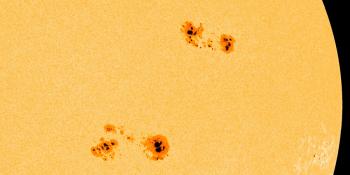
X1.1 solar flare, G2 watch
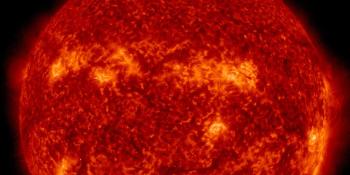
G3 geomagnetic storm watch for 4 and 5 June
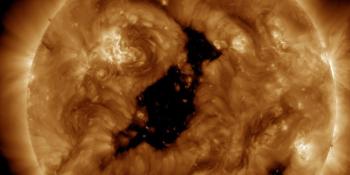
Coronal hole faces Earth
Neue Nachrichten im Forum
Unterstützen Sie SpaceWeatherLive!
Viele Menschen nutzen SpaceWeatherLive, um die Sonnenaktivität zu verfolgen oder um zu schauen, ob es eine Chance gibt Polarlichter, zu sehen. Mit zunehmendem Datenverkehr steigen jedoch die Kosten für die Serververfügbarkeit. Wenn Ihnen SpaceWeatherLive gefällt und Sie das Projekt unterstützen möchten, können Sie ein Abonnement für eine werbefreie Website abschließen oder eine Spende tätigen. Mit Ihrer Hilfe können wir SpaceWeatherLive online halten!



Weltraumwetter-Fakten
| Letzte Klasse X-Eruption | 04/07/2026 | X1.3 |
| Letzte Klasse M-Eruption | 20/07/2026 | M3.4 |
| Letzter geomagnetischer Sturm | 04/07/2026 | Kp7+ (G3) |
| Tage ohne Flecken | |
|---|---|
| Letzte 365 Tage | 3 Tage |
| 2026 | 3 Tage (1%) |
| Aktuelle Strecke | 3 Tage |
| Monatliche mittlere Sonnenfleckenzahl | |
|---|---|
| Juni 2026 | 94.4 -7.1 |
| Juli 2026 | 70.7 -23.7 |
| Letzte 30 Tage | 85 -22.1 |