Archiv von Montag, 30 März 2026 anzeigen
Tägliches Bulletin zur solaren und geomagnetischen Aktivität des SIDC
Ausgestellt: 2026 Mar 30 1249 UTC
Vorhersage des SIDC
Sonneneruptionen
M-class flares expected (probability >=50%)
Geomagnetismus
Major (ISES: Severe) magstorm expected (A>=100 or K>=7)
Sonnenprotonen
Warning condition (activity levels expected to increase, but no numeric forecast given)
| 10cm Fluss | Ap | |
|---|---|---|
| 30 Mar 2026 | 160 | 007 |
| 31 Mar 2026 | 160 | 007 |
| 01 Apr 2026 | 160 | 007 |
Solaraktive Regionen und Flares
Solar flaring activity was high over the past 24 hours, with one X-class flare and C-class flares observed. A total of nine numbered sunspot groups were present on the solar disk. The largest event was an X1.4 flare (SIDC Flare 7290), peaking on 30 March at 03:19 UTC, originating from SIDC Sunspot Group 836 (NOAA Active Region 4405). This flare was associated with a Type II radio emission, with an estimated shock velocity of 1872 km/s. Type II emissions are indicative of shock waves propagating through the solar corona and are typically associated with coronal mass ejections (CMEs), suggesting that a CME is likely associated with this event. SIDC Sunspot Group 836 (NOAA Active Region 4405), currently located at S27E40, has a Beta magnetic configuration and remained stable over the past 24 hours. Solar flaring activity is expected to be moderate over the next 24 hours, with C-class flares expected and M and X class flares likely.
Koronaler Massenauswurf
A coronal mass ejection (SIDC CME 644) was detected in SOHO/LASCO-C2 on 30 March at 03:24 UTC. Automated CACTus detection reports a full halo CME (width 360 degrees) with a principal angle of 132 degrees and a projected speed of 1024 km/s. This CME is associated with the X1.4 flare (SIDC Flare 7290), which peaked at 03:19 UTC from SIDC Sunspot Group 836 (NOAA Active Region 4405). This event was also accompanied by a Type II radio emission, indicating the presence of a shock wave propagating through the solar corona, with an estimated velocity of 1872 km/s. Initial 3D analysis suggests a propagation direction towards (S15E30) with an angular width of approximately 45 degrees and a speed of about 1835 km/s. The source region is consistent with the flare location at approximately (S27E42). Given its source location and propagation direction, this CME is expected to impact Earth in about 25-35 hours.
Koronale Löcher
SIDC Coronal Hole 149, an equatorial coronal hole with negative polarity is located near S12W18 and is currently crossing the central meridian. The coronal hole is well-defined and non-patchy, with no significant decay observed over the past 24 hours.
Sonnenwind
Solar wind parameters remained in a slow solar wind regime to slightly enhanced levels over the past 24 hours. Solar wind speed ranged between approximately 350 and 525 km/s, with a gradual increasing trend. The interplanetary magnetic field (IMF) was moderately enhanced, with the total field (Bt) reaching up to around 13 nT. The Bz component showed variable conditions, with alternating periods of northward and southward orientation. A high-speed solar wind stream associated with SIDC Coronal Hole 149 is expected to arrive at Earth around 02 April, with a probability of 75%. The solar wind speed is expected to increase to approximately 550 to 600 km/s. In addition, the CME associated with the X1.4 flare on 30 March is expected to arrive at Earth within approximately 25 to 35 hours. Initial analysis indicates a propagation direction towards (S15E30), with an angular width of about 45 degrees and a speed of approximately 1835 km/s. The possible interaction or combination of the ICME with the incoming high-speed stream will lead to enhanced and more complex solar wind conditions at Earth.
Geomagnetismus
Geomagnetic conditions were quiet to unsettled over the past 24 hours. The global NOAA Kp index reached up to 3, while the local K index (Belgium) remained at quiet to unsettled levels. Geomagnetic conditions are expected to become unsettled to active in the coming days due to the anticipated arrival of a high-speed solar wind stream on 02 April. In addition, the arrival of the ICME associated with the X1.4 flare may further enhance geomagnetic activity. The possible interaction or combination of the ICME with the high-speed stream could lead to more intensified and complex geomagnetic conditions. A moderate up to sever geomagnetic storm is possible, with a predicted maximum K index of 7 (+/-1).
Protonenflusswerte
The greater than 10 MeV proton flux remained at nominal levels over the past 24 hours. No proton event was observed; however, given the recent X-class flare and associated coronal mass ejection, an enhancement in proton flux cannot be excluded over the next 24 hours. A solar energetic particle (SEP) event remains possible.
Elektronenflüsse im geostationären Orbit
The greater than 2 MeV electron flux remained at normal to moderate levels over the past 24 hours. Electron flux values were mostly below the high flux threshold, with brief enhancements approaching the threshold level. Electron fluxes are expected to remain at normal to moderate levels over the next 24 hours. However, an increase to high levels is possible in the coming days in association with the expected arrival of a high-speed solar wind stream.
Die heute international geschätzte Sonnenfleckenanzahl (ISN): 139, basierend auf 16 Stationen.Solarindizes für den 29 Mar 2026
| Wolf-Zahl Catania | /// |
| 10cm Solarflux | 158 |
| AK Chambon La Forêt | 017 |
| AK Wingst | 014 |
| Geschätzer Ap-Wert | 017 |
| Geschätzte internationale Sonnenfleckenzahl | 139 - Basierend auf 24 Stationen |
Zusammenfassung auffälliger Ereignisse
| Tag | Start | Max | Ende | Loc | Stärke | OP | 10cm | Catania/NOAA | Radioburst-Typen |
|---|---|---|---|---|---|---|---|---|---|
| 30 | 0247 | 0319 | 0344 | ---- | X1.4 | 68/4405 |
Zur Verfügung gestellt vom Solar Influences Data Analysis Center© - SIDC - Verarbeitet von SpaceWeatherLive
Alle Zeiten in UTC
Neueste Nachrichten
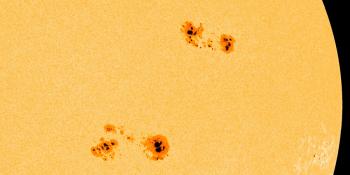
X1.1 solar flare, G2 watch
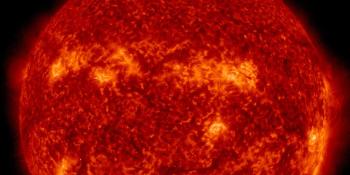
G3 geomagnetic storm watch for 4 and 5 June
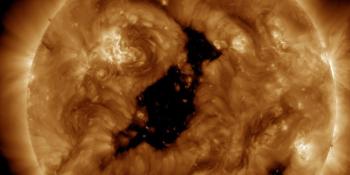
Coronal hole faces Earth
Neue Nachrichten im Forum
Unterstützen Sie SpaceWeatherLive!
Viele Menschen nutzen SpaceWeatherLive, um die Sonnenaktivität zu verfolgen oder um zu schauen, ob es eine Chance gibt Polarlichter, zu sehen. Mit zunehmendem Datenverkehr steigen jedoch die Kosten für die Serververfügbarkeit. Wenn Ihnen SpaceWeatherLive gefällt und Sie das Projekt unterstützen möchten, können Sie ein Abonnement für eine werbefreie Website abschließen oder eine Spende tätigen. Mit Ihrer Hilfe können wir SpaceWeatherLive online halten!



Weltraumwetter-Fakten
| Letzte Klasse X-Eruption | 04/07/2026 | X1.3 |
| Letzte Klasse M-Eruption | 20/07/2026 | M3.4 |
| Letzter geomagnetischer Sturm | 04/07/2026 | Kp7+ (G3) |
| Tage ohne Flecken | |
|---|---|
| Letzte 365 Tage | 3 Tage |
| 2026 | 3 Tage (1%) |
| Letzter fleckenlose Tag | 24/02/2026 |
| Monatliche mittlere Sonnenfleckenzahl | |
|---|---|
| Juni 2026 | 94.4 -7.1 |
| Juli 2026 | 70.7 -23.7 |
| Letzte 30 Tage | 85.8 -20.7 |