Archiv von Montag, 6 Juli 2026 anzeigen
Tägliches Bulletin zur solaren und geomagnetischen Aktivität des SIDC
Ausgestellt: 2026 Jul 06 1247 UTC
Vorhersage des SIDC
Sonneneruptionen
M-class flares expected (probability >=50%)
Geomagnetismus
Quiet (A<20 and K<4)
Sonnenprotonen
Warning condition (activity levels expected to increase, but no numeric forecast given)
| 10cm Fluss | Ap | |
|---|---|---|
| 06 Jul 2026 | 137 | 011 |
| 07 Jul 2026 | 135 | 016 |
| 08 Jul 2026 | 130 | 014 |
Solaraktive Regionen und Flares
Solar flaring activity was high over the past 24 hours, with 5 M-class flares identified. The largest flare was a M5.3 flare (SIDC Flare 8155) peaking on July 05 at 17:57 UTC, which was produced by SIDC Sunspot Group 860 (NOAA Active Regions 4479). During the flare, the source region (SIDC Sunspot Group 860) of the flare had beta- gamma-delta configuration of its photospheric magnetic field. A total of 6 numbered sunspot groups were identified on the disk over the past 24 hours. SIDC Sunspot Group 886 (NOAA Active Region 4478) is the most complex group with its beta-gamma magnetic configuration, but it has produced only C-class flares in the past 24 hours. Solar flaring activity is expected to be moderate over the next 24 hours, with C-class flares expected, possibly M-class flares and a low chance for X-class flares.
Koronaler Massenauswurf
A coronal mass ejections (CME) was first observed in SOHO/LASCO-C2 images around 17:12 UTC on Jul 05 at NW limb. It is possibly associated to flaring activities from the SIDC Sunspot Group 860 (NOAA Active Region 4479), which was on the W limb. With an angular width of about 85 deg and a projected speed of about 500 km/s, this CME is expected to miss the Earth. No other Earth-directed CMEs were detected in the available coronagraph observations during the last 24 hour.
Koronale Löcher
SIDC Coronal Hole (CH) 170, which is an equatorial CH with a negative polarity, has started to cross the central meridian on Jul 06. The high speed streams from this CH is expected to enhance the solar wind environment near Earth during Jul 09-10.
Sonnenwind
Earth is presently within the slow solar wind regime. The solar wind speed ranged between 400 km/s and 510 km/s. The interplanetary magnetic field ranged between 4 nT and 6 nT. The North-South component (Bz) ranged between -5 and 1 nT. Slow solar wind conditions are expected to continue over the next 24 hours, unless a coronal mass ejection (CME) that was observed on Jul 02 arrives late at Earth and enhances the solar wind conditions.
Geomagnetismus
Geomagnetic conditions were globally and locally at quiet to active conditions (NOAA Kp and K BEL 2 to 4). It is expected to remain so in the next 24 hours unless a coronal mass ejection (CME) that was observed on Jul 02 arrives late at Earth.
Protonenflusswerte
The greater than 10 MeV GOES proton flux was below the threshold level over the past 24 hours and it is expected to remain so for the next 24 hours. Any major eruption from the SIDC Sunspot Group 886 (NOAA Active Regions 4478), during the next 24 hours, could be possibly associated with a proton event.
Elektronenflüsse im geostationären Orbit
The greater than 2 MeV electron flux, as measured by GOES-18 satellite, increased and exceeded the 1000 pfu threshold level around 22:30 UTC on Jul 05. It was then fluctuating around the threshold level and is currently above the threshold level. The greater than 2 MeV electron flux, as measured by GOES-19 satellite, increased and exceeded the 1000 pfu threshold level around 10:20 on Jul 06 and is currently above the threshold level. This was possibly due to the enhanced solar wind speed on previous days. The electron flux is expected to remain above the threshold level in the next 24 hours. The 24h electron fluence was at nominal levels and is expected to remain so.
Die heute international geschätzte Sonnenfleckenanzahl (ISN): 073, basierend auf 16 Stationen.Solarindizes für den 05 Jul 2026
| Wolf-Zahl Catania | /// |
| 10cm Solarflux | 139 |
| AK Chambon La Forêt | 024 |
| AK Wingst | 022 |
| Geschätzer Ap-Wert | 022 |
| Geschätzte internationale Sonnenfleckenzahl | 098 - Basierend auf 21 Stationen |
Zusammenfassung auffälliger Ereignisse
| Tag | Start | Max | Ende | Loc | Stärke | OP | 10cm | Catania/NOAA | Radioburst-Typen |
|---|---|---|---|---|---|---|---|---|---|
| 05 | 1104 | 1110 | 1130 | N14W84 | M1.0 | SF | 62/4479 | ||
| 05 | 1641 | 1645 | 1648 | N13W87 | M1.4 | SF | 62/4479 | III/2II/1 | |
| 05 | 1751 | 1757 | 1802 | ---- | M5.3 | 62/4479 | |||
| 05 | 1856 | 1907 | 1911 | ---- | M1.4 | 62/4479 | III/1 | ||
| 05 | 2114 | 2122 | 2138 | ---- | M1.0 | 62/4479 | III/1 |
Zur Verfügung gestellt vom Solar Influences Data Analysis Center© - SIDC - Verarbeitet von SpaceWeatherLive
Alle Zeiten in UTC
Neueste Nachrichten
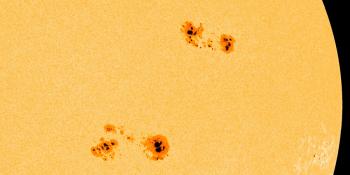
X1.1 solar flare, G2 watch
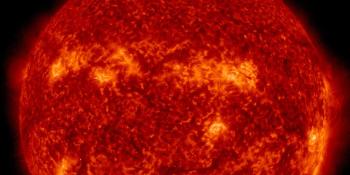
G3 geomagnetic storm watch for 4 and 5 June
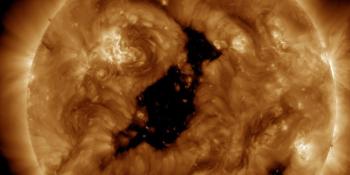
Coronal hole faces Earth
Neue Nachrichten im Forum
Unterstützen Sie SpaceWeatherLive!
Viele Menschen nutzen SpaceWeatherLive, um die Sonnenaktivität zu verfolgen oder um zu schauen, ob es eine Chance gibt Polarlichter, zu sehen. Mit zunehmendem Datenverkehr steigen jedoch die Kosten für die Serververfügbarkeit. Wenn Ihnen SpaceWeatherLive gefällt und Sie das Projekt unterstützen möchten, können Sie ein Abonnement für eine werbefreie Website abschließen oder eine Spende tätigen. Mit Ihrer Hilfe können wir SpaceWeatherLive online halten!



Weltraumwetter-Fakten
| Letzte Klasse X-Eruption | 04/07/2026 | X1.3 |
| Letzte Klasse M-Eruption | 20/07/2026 | M3.4 |
| Letzter geomagnetischer Sturm | 04/07/2026 | Kp7+ (G3) |
| Tage ohne Flecken | |
|---|---|
| Letzte 365 Tage | 3 Tage |
| 2026 | 3 Tage (1%) |
| Letzter fleckenlose Tag | 24/02/2026 |
| Monatliche mittlere Sonnenfleckenzahl | |
|---|---|
| Juni 2026 | 94.4 -7.1 |
| Juli 2026 | 70.7 -23.7 |
| Letzte 30 Tage | 85.8 -20.7 |