Viendo archivo del jueves, 15 mayo 2003
Informe geofísico
Any mentioned solar flare in this report has a scaling factor applied by the Space Weather Prediction Center (SWPC). Because of the SWPC scaling factor, solar flares are reported as 42% smaller than for the science quality data. The scaling factor has been removed from our archived solar flare data to reflect the true physical units.
Resumen de Actividad Solar y Geofísica 2003 May 15 0245 UTCPreparado por NOAA © SWPC y procesado por SpaceWeatherLive.com
Resumen conjunto USAF/NOAA actividad Solar y Geofísica
SGAS Número 135 publicado el 0245Z a las 15 May 2003 Este infórmese ha elaborado a partir de los datos recibidos en SWO el 14 MayA. Eventos Energéticos
Inicio  Max  Fin  Rgn   Loc   Xray  Op 245MHz 10cm   Barrido
Ninguno
B. Eventos de Protones
Ninguno.
C. Resumen de Actividad Geomagnética
The geomagnetic field has been at
unsettled to minor storm levels due to a favorably positioned
coronal hole. The greater than 2 MeV electron flux at
geosynchronous orbit reached high levels today.
D. Estratosfera caliente
Ninguno.
E. Indices Diarios: (preliminares en tiempo real/valores estimados)
10 cm 096  SSN 075  Afr/Ap 025/027   X-ray Background B1.0
Flujo Diario de Protones (flujo acumulado en 24 hr)
GT 1 MeV 6.8e+06   GT 10 MeV 1.1e+04 p/(cm2-ster-day)
(Satélite órbita sincronizada  GOES-10 , W135 grados)
Fluidez diaria de electrones
GT 2 MeV 7.80e+08 e/(cm2-ster-day)
(Satélite órbita sincronizada  GOES-10 , W135 grados)
3 Horas K-índices
Boulder 5 5 5 4 3 3 4 3 Planetary 5 5 5 4 3 4 4 3
F. Comentarios
  The GOES 10 energetic proton detectors are showing
intermittent, high noise levels in the higher energy proton channels
(greater than about 80 MeV). This problem was first noticed in data
taken April 26, 2003. To ensure continued operational monitoring of
important energetic particle data, it is necessary to reassign
primary/secondary designations for the GOES Space Environment
Monitor (SEM) detectors. Beginning 1500 UT on May 15, GOES-8 will
once again become the primary satellite for protons. GOES 12 will be
the primary satellite for magnetometer, X-ray, and electron
measurements. GOES 10 will be the secondary satellite for all SEM
sensors - magnetometer, X-ray sensor, and energetic particle sensor.
This short-term solution (approximately 2 - 3 months) will be in
place until we define and implement a permanent fix. A more detailed
explanation can be found at: http://www.sec.noaa.gov/GOES.html.
All times in UTC
< < Ir a la visión general diaria
Últimas noticias

lunes, 30 marzo 2026
X1.5 solar flare

martes, 17 marzo 2026
M2.7 solar flare, CME arrival possible
domingo, 1 febrero 2026
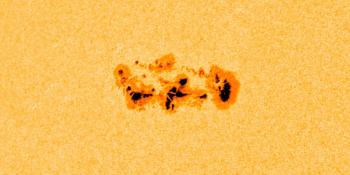
Complex sunspot region 4366
Últimos mensajes del foro
AR4409 169Space Weather Memes 817Photographing auroras 240AR4405 244JHelioviewer Tips and Settings 47
Más temasApoye a SpaceWeatherLive.com!
A lot of people come to SpaceWeatherLive to follow the Solar activity or if there is a chance to see the aurora, but with more traffic comes higher costs to keep the servers online. If you like SpaceWeatherLive and want to support the project you can choose a subscription for an ad-free site or consider a donation. With your help we can keep SpaceWeatherLive online!



Hechos clima espacial
| Último evento clase X | 30/03/2026 | X1.5 |
| Último evento clase M | 04/04/2026 | M1.0 |
| Últimas tormentas geomagnéticas | 03/04/2026 | Kp7- (G3) |
| Días sin manchas | |
|---|---|
| Last 365 days | 3 días |
| 2026 | 3 días (3%) |
| Último día sin manchas | 24/02/2026 |
| Promedio de manchas solares mensuales | |
|---|---|
| marzo 2026 | 85.9 +7.7 |
| abril 2026 | 128.3 +42.3 |
| Last 30 days | 97.5 +35.7 |
Efemérides*
Aurora on this day in history
No observations submitted for this day in history. If you've observed the aurora and you have some amazing photos to show off, submit your observations now!
Submit your aurora observation