Viendo archivo del lunes, 2 mayo 2016
Daily bulletin on solar and geomagnetic activity from the SIDC
Emitido: 2016 May 02 1242 UTC
SIDC Forecast
Llamarada solar
C-class flares expected, (probability >=50%)
Geomagnetism
Active conditions expected (A>=20 or K=4)
Protones solares
Quiet
| 10cm flux | Ap | |
|---|---|---|
| 02 May 2016 | 093 | 021 |
| 03 May 2016 | 094 | 007 |
| 04 May 2016 | 096 | 005 |
Bulletin
There are currently seven numbered sunspot groups visible on the solar disc, and all have simple configuration of their photospheric magnetic field. Two most complex groups are Catania sunspot group 64 and 67 (NOAA AR 2536 and 2539, respectively) with the beta configuration of their photospheric magnetic field. The strongest, out of two C-class flares reported during last 24 hours, was the impulsive C3.5 (peaking at 08:42 UT) on May 06. The flare originating from the newly emerged NOAA AR 2540, and was associated with the EIT wave, the type II radio burst (indicating the speed of the shock wave to be about 1800 km/s as reported by San Vito Observatory) and the CME. The angular width of the CME is at the moment not clearly visible (only few frames of coronagraph data are currently available). However, it seems that the CME is directed north-east from the Sun-Earth line. We expect C-class flares in the following 24 hours (probability is about 60 percent).
The Earth is presently inside the fast solar wind (the speed is about 500 km/s). The interplanetary magnetic field magnitude amounts about 7 nT. Early this morning, negative value of the Bz component of the interplanetary magnetic field (down to -10 nT) and the fast solar wind speed (about 500 km/s) induced geomagnetic storm conditions (NOAA reported planetary K index to be 6 and local station at Dourbes reported K=4). The arrival of the fast solar wind which induced the geomagnetic storm conditions could be associated with either of two coronal holes, the low latitude one on the northern hemisphere (between N10 and N30) or the narrow and elongated equatorial coronal hole, which both reached the central meridian in the late evening of April 26. Currently, the Bz component of the interplanetary magnetic field amounts about -5 nT and the geomagnetic conditions are quiet to unsettled. However, if the value of the Bz component decreases again, the intervals of the active and storm conditions are possible in the coming hours.
Today's estimated international sunspot number (ISN): 087, based on 22 stations.Solar indices for 01 May 2016
| Wolf number Catania | /// |
| 10cm solar flux | 092 |
| AK Chambon La Forêt | 044 |
| AK Wingst | 016 |
| Estimated Ap | 018 |
| Estimated international sunspot number | 084 - Based on 19 stations |
Noticeable events summary
| Day | Begin | Max | Fin | Loc | Strength | OP | 10cm | Catania/NOAA | Radio burst types | |
|---|---|---|---|---|---|---|---|---|---|---|
| Ninguno | ||||||||||
Provided by the Solar Influences Data analysis Center© - SIDC - Processed by SpaceWeatherLive
All times in UTC
< < Ir a la visión general diaria
Últimas noticias

X1.5 solar flare

M2.7 solar flare, CME arrival possible
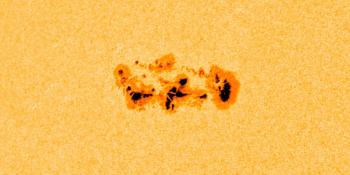
Complex sunspot region 4366
Últimos mensajes del foro
Más temasApoye a SpaceWeatherLive.com!
A lot of people come to SpaceWeatherLive to follow the Solar activity or if there is a chance to see the aurora, but with more traffic comes higher costs to keep the servers online. If you like SpaceWeatherLive and want to support the project you can choose a subscription for an ad-free site or consider a donation. With your help we can keep SpaceWeatherLive online!



Hechos clima espacial
| Último evento clase X | 30/03/2026 | X1.5 |
| Último evento clase M | 28/03/2026 | M1.3 |
| Últimas tormentas geomagnéticas | 25/03/2026 | Kp5+ (G1) |
| Días sin manchas | |
|---|---|
| Last 365 days | 3 días |
| 2026 | 3 días (3%) |
| Último día sin manchas | 24/02/2026 |
| Promedio de manchas solares mensuales | |
|---|---|
| febrero 2026 | 78.2 -34.3 |
| Last 30 days | 90 +16.9 |