Viendo archivo del sábado, 10 febrero 2024
Daily bulletin on solar and geomagnetic activity from the SIDC
Emitido: 2024 Feb 10 1327 UTC
SIDC Forecast
Llamarada solar
M-class flares expected (probability >=50%)
Geomagnetism
Quiet (A<20 and K<4)
Protones solares
Major proton event expected (100 pfu at >100 MeV)
| 10cm flux | Ap | |
|---|---|---|
| 10 Feb 2024 | 181 | 006 |
| 11 Feb 2024 | 179 | 003 |
| 12 Feb 2024 | 177 | 011 |
Solar Active Regions and flaring
Solar flaring activity reached high levels over the past 24 hours. The strongest activity was an X3.3 flare, start time 12:53 UTC, end time 13:31 UTC, peak time 13:14 UTC on Feb 9th, produced by NOAA AR 3575 from behind the south-west limb. Multiple low M-class flares were produced by NOAA AR 3576 (beta-gamma-delta) and an M3.4 flare with peak time 03:54 UTC on Feb 10th was produced by a region on the east limb. Two new un-numbered regions have developed on disc in the north- eastern quadrant and another new region has rotated onto disc from the east limb. NOAA AR 3576 remains the largest, most complex and most active region on the visible solar disc at present. The remaining regions have been either stable and inactive or shown some decay. The solar flaring activity is expected to be at moderate levels over the next days with likely further M-class flaring.
Eyección de masa coronal
The filament eruption, which produced a medium intensity coronal dimming visible in the SDO/AIA images around 21:00 UTC on Feb 8th is now associated with a narrow south-ward coronal mass ejection (CME). This narrow CME is expected to be off the Sun-Earth line, though a minor glancing blow is possible on Feb 12th. An almost full halo coronal mass ejection (CME) was observed in the LASCO/C2 coronagraph imagery around 13:25 UTC on Feb 9th. The eruption is related to the X3.3 flaring from NOAA AR 3575 from behind the south-west limb. A related type IV radio burst, fast shock and strong and fast coronal wave have accompanied the event. The CME is back-sided with no significant impact on Earth expected (expect for the ongoing radiation storm and possible GLE). A possible shock arrival cannot be fully excluded. Another strong and fast almost full halo CME was first detected in the LASCO/C2 coronagraph imagery around 04:24 UTC on Feb 10th. A coronal wave and dimming related to this event are visible in the SDO/AIA data. This eruption was related to an activity behind at the east limb. Based on the source location currently no impact on Earth is expected. Another coronal dimming is detected in the AIA images starting around 7:40 UTC on Feb 10th. We are awaiting for the coronagraph data to arrive to estimate possible impacts on Earth. No other Earth-directed CMEs have been detected in the available coronagraph imagery over the past 24 hours.
Viento solar
Over the past 24 hours the solar wind parameters (ACE and DSCOVR) have registered a mild ICME arrival, possibly the expected glancing blow from the Feb 6th CME. A weak shock was detected around 21:47 UTC on Feb 9th with a slight density decrease, and a jump in the temperature from about 2.4e4 K to 3.6e5 K. The total magnetic field mildly increased from 7 nT to 9.3 nT and the solar wind speed jumped from 395 km/s to 503 km/s. The solar wind velocity after steadily declined to below 400 km/s at present. The solar wind conditions are expected to be at weakly perturbed to nominal levels on Feb 10th and Feb 11th. Further enhancements in the solar wind parameters from another glancing blow arrival related to the Feb 8th filament eruption might be expected on Feb 12th.
Geomagnetism
The geomagnetic conditions over the past 24 hours were quiet to unsettled. Mostly quiet to unsettled geomagnetic conditions are expected to prevail on Feb 10th and Feb 11th. Quiet to active conditions are expected for Feb 12th with the possible arrival of another glancing blow ICME.
Proton flux levels
Over the past 24 hours the greater than 10 MeV GOES proton flux exceeded moderate radiation storm levels (100 pfu). The greater than 10 MeV GOES proton flux is expected to remain so on Feb 10th and possible still be at minor storm levels on Feb 11th. Further enhancements are possible given the eruptive activity in the east limb and any strong flaring from NOAA AR 3576.
Electron fluxes at geostationary orbit
The greater than 2 MeV GOES 16 electron flux was below the 1000 pfu threshold and is expected to remain so in the upcoming days.The 24h electron fluence was at nominal level and is expected to remain so in the next days.
Today's estimated international sunspot number (ISN): 161, based on 07 stations.Solar indices for 09 Feb 2024
| Wolf number Catania | 174 |
| 10cm solar flux | 183 |
| AK Chambon La Forêt | 011 |
| AK Wingst | 005 |
| Estimated Ap | 005 |
| Estimated international sunspot number | 133 - Based on 12 stations |
Noticeable events summary
| Day | Begin | Max | Fin | Loc | Strength | OP | 10cm | Catania/NOAA | Radio burst types |
|---|---|---|---|---|---|---|---|---|---|
| 09 | 1253 | 1314 | 1332 | S16E14 | X3.3 | SF | --/3575 | CTM/1VII/3IV/2III/2 | |
| 09 | 1754 | 1800 | 1807 | ---- | M1.2 | 65/3576 | |||
| 10 | 0042 | 0051 | 0100 | ---- | M1.5 | 65/3576 | |||
| 10 | 0304 | 0354 | 0429 | S15E04 | M3.4 | SF | --/---- |
Provided by the Solar Influences Data analysis Center© - SIDC - Processed by SpaceWeatherLive
All times in UTC
< < Ir a la visión general diaria
Últimas noticias

X1.5 solar flare

M2.7 solar flare, CME arrival possible
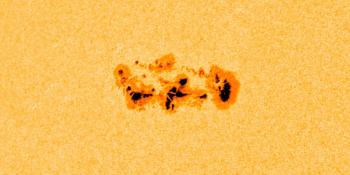
Complex sunspot region 4366
Últimos mensajes del foro
Apoye a SpaceWeatherLive.com!
A lot of people come to SpaceWeatherLive to follow the Solar activity or if there is a chance to see the aurora, but with more traffic comes higher costs to keep the servers online. If you like SpaceWeatherLive and want to support the project you can choose a subscription for an ad-free site or consider a donation. With your help we can keep SpaceWeatherLive online!



Hechos clima espacial
| Último evento clase X | 30/03/2026 | X1.5 |
| Último evento clase M | 04/04/2026 | M1.0 |
| Últimas tormentas geomagnéticas | 03/04/2026 | Kp7- (G3) |
| Días sin manchas | |
|---|---|
| Last 365 days | 3 días |
| 2026 | 3 días (3%) |
| Último día sin manchas | 24/02/2026 |
| Promedio de manchas solares mensuales | |
|---|---|
| marzo 2026 | 85.9 +7.7 |
| abril 2026 | 128.3 +42.3 |
| Last 30 days | 97.5 +35.7 |