Viendo archivo del martes, 27 mayo 2025
Daily bulletin on solar and geomagnetic activity from the SIDC
Emitido: 2025 May 27 1235 UTC
SIDC Forecast
Llamarada solar
M-class flares expected (probability >=50%)
Geomagnetism
Quiet (A<20 and K<4)
Protones solares
Warning condition (activity levels expected to increase, but no numeric forecast given)
| 10cm flux | Ap | |
|---|---|---|
| 27 May 2025 | 137 | 007 |
| 28 May 2025 | 140 | 013 |
| 29 May 2025 | 140 | 029 |
Solar Active Regions and flaring
Solar flaring activity over the last 24 hours has been moderate, with two M-class flares recorded. The strongest flare was an M2.9 flare (SIDC Flare 4467) peaking on May 26 at 13:06 UTC, which was produced by SIDC Sunspot Group 506 (NOAA Active Region 4098). This region also produced multiple C-class flares but is now rotating over the west limb. SIDC Sunspot Group 469 (NOAA AR 4100, magnetic type beta) also produced an M1.4 flare (SIDC Flare 4469) peaking on May 26 at 13:37 UTC. This event was associated with a Type II radio burst. SIDC sunspot groups 505 and 503 (NOAA Active regions 4097 and 4093) decayed over the period, while two new regions were numbered in the west hemisphere: SIDC sunspot groups 510 and 511 (magnetic type beta). These and the remaining regions on disk were quiet. The solar flaring activity is expected to be moderate over the next 24 hours, with M-class flares expected and a chance for X-class flares.
Eyección de masa coronal
A Coronal Mass Ejections (CME) directed to the east, first visible in SOHO/LASCO C2 imagery at 14:12 UTC on May 26, was associated with the M1.4 flare (SIDC Flare 4469) but is determined not to be Earth directed. No other Earth-directed Coronal Mass Ejections (CMEs) were observed in the available coronagraph imagery.
Agujeros coronales
An extended mid-latitude to equatorial coronal hole (SIDC Coronal Hole 116, negative polarity) continues to transit the central meridian since May 26. An associated high-speed stream is expected to arrive at Earth from May 29.
Viento solar
The solar wind conditions reflected the continued gradual return to a slow solar wind regime. The solar wind speed ranged between 400 km/s and 450 km/s. The interplanetary magnetic field ranged between 2 nT and 10 nT. The Bz component ranged between -7 nT and 3 nT. The interplanetary magnetic field angle phi was mostly in the positive sector. Slow solar wind conditions are expected over the next 24 hours, with a high-speed stream arrival possible from late on May 28, associated with SIDC Coronal Hole 99, which crossed the central meridian on May 25.
Geomagnetism
Geomagnetic conditions globally and locally were at quiet to unsettled levels (NOAA Kp 3, K BEL 3) over the past 24 hours. Quiet conditions are expected over the next 24 hours, with Active to Minor storm conditions expected from May 29.
Proton flux levels
The greater than 10 MeV proton flux was below the 10 pfu threshold over the past 24 hours. It is expected generally to remain below this threshold level over the next 24 hours, but a chance of an increase remains due to any high-level flaring activity from SIDC Sunspot Group 506 (NOAA Active Region 4098), which is located on the west limb.
Electron fluxes at geostationary orbit
The greater than 2 MeV electron flux measured by GOES 18 crossed the 1000 pfu threshold briefly between 19:40 and 22:10 UTC on May 26. The greater than 2 MeV electron flux measured by GOES 19 was just below the 1000 pfu threshold. The greater than 2 MeV electron flux is expected to remain below the 1000 pfu threshold over the next 24 hours. The 24-hour electron fluence is presently at normal levels and is expected to remain so over the next 24 hours.
Today's estimated international sunspot number (ISN): 114, based on 14 stations.Solar indices for 26 May 2025
| Wolf number Catania | 140 |
| 10cm solar flux | 133 |
| AK Chambon La Forêt | 016 |
| AK Wingst | /// |
| Estimated Ap | 012 |
| Estimated international sunspot number | 124 - Based on 24 stations |
Noticeable events summary
| Day | Begin | Max | Fin | Loc | Strength | OP | 10cm | Catania/NOAA | Radio burst types |
|---|---|---|---|---|---|---|---|---|---|
| 26 | 1250 | 1306 | 1315 | S05W67 | M2.9 | 2N | 83/4098 | ||
| 26 | 1327 | 1337 | 1344 | N11E70 | M1.4 | 1F | --/4100 | III/2II/2 |
Provided by the Solar Influences Data analysis Center© - SIDC - Processed by SpaceWeatherLive
All times in UTC
< < Ir a la visión general diaria
Últimas noticias
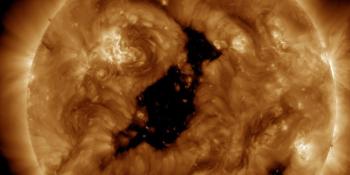
Coronal hole faces Earth

X1.5 solar flare

M2.7 solar flare, CME arrival possible
Últimos mensajes del foro
Apoye a SpaceWeatherLive.com!
A lot of people come to SpaceWeatherLive to follow the Solar activity or if there is a chance to see the aurora, but with more traffic comes higher costs to keep the servers online. If you like SpaceWeatherLive and want to support the project you can choose a subscription for an ad-free site or consider a donation. With your help we can keep SpaceWeatherLive online!



Hechos clima espacial
| Último evento clase X | 24/04/2026 | X2.5 |
| Último evento clase M | 17/05/2026 | M1.4 |
| Últimas tormentas geomagnéticas | 16/05/2026 | Kp6- (G2) |
| Días sin manchas | |
|---|---|
| Last 365 days | 3 días |
| 2026 | 3 días (2%) |
| Último día sin manchas | 24/02/2026 |
| Promedio de manchas solares mensuales | |
|---|---|
| abril 2026 | 79.3 -6.6 |
| mayo 2026 | 90.4 +11.1 |
| Last 30 days | 99.3 +8.3 |