Affichage des archives de lundi, 6 janvier 2014
Bulletin quotidien sur l'activité solaire et géomagnétique du SIDC
Publié: 2014 Jan 06 1240 UTC
Prévisions SIDC
Éruptions solaires
Active (M-class flares expected, probability >=50%)
Géomagnétisme
Active conditions expected (A>=20 or K=4)
Moniteur de Flux de Proton
Proton event in progress (>10 MeV)
| Flux de 10 cm | Ap | |
|---|---|---|
| 06 Jan 2014 | 220 | 003 |
| 07 Jan 2014 | 220 | 009 |
| 08 Jan 2014 | 220 | 017 |
Bulletin
A proton event is currently in progress. From January 6 on at 8h20 UTC the proton flux started to rise for > 10 MeV, > 50 MeV and > 100 MeV the energy levels. The event threshold of 10 pfu was passed on 9h15 UTC for > 10 MeV protons and on 9h45 UTC for > 50 MeV protons. The proton flux is still above (>10 MeV) or near (>50 MeV) the event threshold. This proton event was due to a strong flare erupting from NOAA AR 1936, which has turned around the west limb a few days ago. The flare was visible around 7h45 UTC in STEREO A EUV195 and (partly) in SDO/AIA imagery. The flare was associated with a metric type II radio burst, detected in Learmonth (estimated shock wave speed 1383 km/s) and Culgoora spectrographic data. There is also a strong westward halo CME, observed by STEREO A/COR2 and LASCO/C2. The CME speed at eruption is estimated around 1200 km/s, but has slowed down to 900 km/s. Due to the position of the solar origin we estimate the geoeffectiveness of this CME to be limited to at most a glancing blow around January 8 at 4h UTC. NOAA AR 1944 was relatively stable and produced three C flares over the past 24 hours. Region NOAA AR 1946 has shown some growth. The likelihood for C and M flares remains high. There is a slight chance for an X-flare. Current solar wind speed has decreased to 400 km/s. The magnitude of the interplanetary magnetic field remains around 5 nT, with a fluctuating Bz-component. Current geomagnetic conditions are quiet (estimated NOAA Kp and local K_Dourbes and K_Izmiran=0 to 1). Mainly quiet conditions are expected to continue for the next 24 hours. Unsettled to active (K=3 to 4) conditions might be reached on January 8 due to the possible arrival of a glancing blow from the CMEs of January 4 and January 6.
Estimation du nombre international de taches solaires (ISN) pour aujourd'hui : 120, sur la base de 09 stations.Indices solaires pour 05 Jan 2014
| Nombre de Wolf, observé par Catania | /// |
| Flux solaire à 10 cm | 218 |
| AK Chambon La Forêt | 005 |
| AK Wingst | 002 |
| Ap estimé | 002 |
| Nombre international de taches solaires estimé | 095 - Basé sur 19 stations |
Résumé des événements marquants
| Jour | Commencer | Max | Fin | Loc | Force | OP | 10cm | Catania/NOAA | Types de sursaut radio | |
|---|---|---|---|---|---|---|---|---|---|---|
| Aucun | ||||||||||
Données fournies par le Solar Influences Data analysis Center© - SIDC - Traité par SpaceWeatherLive
Toutes les heures sont indiquées en UTC
Dernières nouvelles

Happy New Year! Celebrate with an M7.1 solar flare!

M8.1 solar flare with earth-directed CME
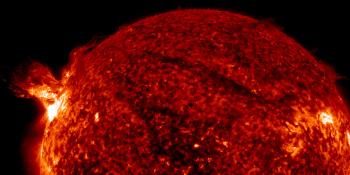
X1.9 solar flare, Coronal hole faces Earth
Aidez SpaceWeatherLive.com !
A lot of people come to SpaceWeatherLive to follow the Solar activity or if there is a chance to see the aurora, but with more traffic comes higher costs to keep the servers online. If you like SpaceWeatherLive and want to support the project you can choose a subscription for an ad-free site or consider a donation. With your help we can keep SpaceWeatherLive online!



La Météo Spatiale en faits
| Dernière classe X | 08/12/2025 | X1.1 |
| Dernière classe M | 14/01/2026 | M1.6 |
| Dernier orage géomagnétique | 11/01/2026 | Kp5+ (G1) |
| Jours sans taches solaires | |
|---|---|
| Dernier jour sans taches solaires | 08/06/2022 |
| Nombre mensuel moyen de taches solaires | |
|---|---|
| décembre 2025 | 124 +32.2 |
| janvier 2026 | 93.5 -30.5 |
| 30 derniers jours | 98.7 -7.5 |