Affichage des archives de mercredi, 26 février 2014
Bulletin quotidien sur l'activité solaire et géomagnétique du SIDC
Publié: 2014 Feb 26 1319 UTC
Prévisions SIDC
Éruptions solaires
Active (M-class flares expected, probability >=50%)
Géomagnétisme
Active conditions expected (A>=20 or K=4)
Moniteur de Flux de Proton
Proton event in progress (>10 MeV)
| Flux de 10 cm | Ap | |
|---|---|---|
| 26 Feb 2014 | 176 | 007 |
| 27 Feb 2014 | 178 | 028 |
| 28 Feb 2014 | 178 | 025 |
Bulletin
Solar activity has calmed down since the X-class firework of yesterday. Flaring activity in the past 24 hours has been at the C5 level in active regions NOAA1986-Cat48 and NOAA1989-Cat50. For the first region, the activity corresponds to a (recurrently) activating filament which we expect to erupt at some stage. Major (M or X class flaring) flaring potential remains in various active regions, in particular NOAA1982-46, NOAA1987-Cat54 and NOAA1990-Cat52. The CME associated with the X4.9 flare of Feb 25 00:49 expanded to a full halo CME. Propagation speeds above 1500 km/s were measured. Culgoora Observatory observed type II radio bursts with speeds of 2000 km/s and 700 km/s. As this CME was not completely Earth-directed, we expect that only a glancing blow of the shock will arrive at the Earth, early Feb 27. Soon thereafter (Feb 28 late onwards) we also expect the influence of the fast wind stream from a small coronal hole that crossed central meridian mid Feb 24. As a consequence, we expect episodes of active geomagnetic conditions from early Feb 27 onwards for about 48 hours.
Estimation du nombre international de taches solaires (ISN) pour aujourd'hui : 141, sur la base de 09 stations.Indices solaires pour 25 Feb 2014
| Nombre de Wolf, observé par Catania | /// |
| Flux solaire à 10 cm | 174 |
| AK Chambon La Forêt | 010 |
| AK Wingst | 003 |
| Ap estimé | 004 |
| Nombre international de taches solaires estimé | 125 - Basé sur 15 stations |
Résumé des événements marquants
| Jour | Commencer | Max | Fin | Loc | Force | OP | 10cm | Catania/NOAA | Types de sursaut radio | |
|---|---|---|---|---|---|---|---|---|---|---|
| Aucun | ||||||||||
Données fournies par le Solar Influences Data analysis Center© - SIDC - Traité par SpaceWeatherLive
Toutes les heures sont indiquées en UTC
Dernières nouvelles

M2.7 solar flare, CME arrival possible
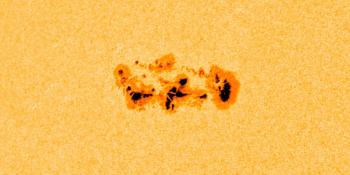
Complex sunspot region 4366

CME impact! S4 solar radiation storm
Forum
Aidez SpaceWeatherLive.com !
De nombreuses personnes consultent SpaceWeatherLive pour suivre l'activité solaire ou observer les aurores boréales, mais l'augmentation du trafic engendre des coûts plus élevés pour maintenir les serveurs en ligne. Si vous appréciez SpaceWeatherLive et souhaitez soutenir le projet, vous pouvez vous abonner pour un site sans publicité ou faire un don. Grâce à votre aide, SpaceWeatherLive restera accessible !



La Météo Spatiale en faits
| Dernière classe X | 04/02/2026 | X4.21 |
| Dernière classe M | 18/03/2026 | M2.7 |
| Dernier orage géomagnétique | 22/03/2026 | Kp7- (G3) |
| Jours sans taches solaires | |
|---|---|
| 365 derniers jours | 3 jours |
| 2026 | 3 jours (4%) |
| Dernier jour sans taches solaires | 24/02/2026 |
| Nombre mensuel moyen de taches solaires | |
|---|---|
| février 2026 | 78.2 -34.3 |
| mars 2026 | 77 -1.2 |
| 30 derniers jours | 68.9 -24 |