Affichage des archives de mardi, 4 juillet 2023
Bulletin quotidien sur l'activité solaire et géomagnétique du SIDC
Publié: 2023 Jul 04 1231 UTC
Prévisions SIDC
Éruptions solaires
M-class flares expected (probability >=50%)
Géomagnétisme
Quiet (A<20 and K<4)
Moniteur de Flux de Proton
Quiet
| Flux de 10 cm | Ap | |
|---|---|---|
| 04 Jul 2023 | 172 | 009 |
| 05 Jul 2023 | 174 | 011 |
| 06 Jul 2023 | 172 | 009 |
Régions solaires actives et éruptions solaires
The solar flaring activity was at low level with several C-class flares being detected in the last 24 hours. The largest flare was a C8.9 flare, peaking at 21:12 UTC on July 03, associated with NOAA AR 3360 (alpha class). NOAA AR 3354 (beta-gamma-delta class) remains the largest and most complex active region on the disk but produced only low C-class flares. Several C-class flares were also produced by NOAA AR 3358 (beta class) and by NOAA AR 3359 (beta class). The solar flaring activity is expected to be at low to moderate levels over the next 24 hours with a chance for isolated X-class flare.
Éjection de masse coronale
In the past 24 hours, several coronal mass ejections (CME) and flows were observed in the available SOHO/LASCO coronagraph imagery and automatically detected by the Cactus tool over. In particular, the CME was observed in SOHO/LASCO-C2 at around 21:48 UTC on July 03, likely related to the C8.9 flare from NOAA AR 3360 with an accompanying type II radio burst detected at around 21:31 UTC. The CME is directed to the east and the bulk of the CME is not expected to be Earth directed. However, a glancing blow at Earth may be possible. Full analysis is still ongoing, and more details will be provided later. Another CME, directed to south-east, was observed in SOHO/LASCO-C2 at around 04:12 UTC on July 04 with an associated on-disc dimming. We are awaiting corresponding coronagraph data for further analysis. No other Earth- directed CMEs have been detected in the available coronagraph imagery.
Trous coronaux
A large positive polarity coronal hole began to transit the central meridian on July 04. An associated high speed stream in in-situ solar wind measurements is expected for July 07.
Vent solaire
Over the past 24 hours the solar wind parameters were reflecting slow solar wind conditions. The solar wind speed was below 400 km/s. The interplanetary magnetic field magnitude ranged between 5 - 7 nT. The southward component of the interplanetary magnetic field fluctuated between -3 nT and 4 nT. The magnetic field orientation was predominantly in the positive sector (field directed away from the Sun). On July 04-05 solar wind parameters are expected to be slightly elevated due to the anticipated arrival of a mild high-speed stream from a small equatorial coronal hole with a negative polarity.
Géomagnétisme
Geomagnetic conditions were mostly quiet with some unsettled period observed by the local stations (K-BEL: 1 to 3). Quiet to unsettled geomagnetic conditions are expected on July 04-05 due to the anticipated arrival of a mild high-speed stream from a small equatorial coronal hole with a negative polarity.
Niveaux de flux de protons
The greater than 10 MeV proton was at the nominal levels in the past 24 hours. The proton flux is expected to remain below 10 pfu threshold over the next day, with a small chance that a particle event occurs in association with an X-class flare or a coronal mass ejection.
Flux d'électrons sur l'orbite géostationnaire
The greater than 2 MeV electron flux was above the 1000 pfu threshold for a short period. It is expected to remain close to the threshold for the next 24 hours. The 24-hour electron fluence was at moderate levels and it is expected to remain at moderate levels over the next 24 hours.
Estimation du nombre international de taches solaires (ISN) pour aujourd'hui : 137, sur la base de 15 stations.Indices solaires pour 03 Jul 2023
| Nombre de Wolf, observé par Catania | 189 |
| Flux solaire à 10 cm | 173 |
| AK Chambon La Forêt | 009 |
| AK Wingst | 006 |
| Ap estimé | 006 |
| Nombre international de taches solaires estimé | 154 - Basé sur 24 stations |
Résumé des événements marquants
| Jour | Commencer | Max | Fin | Loc | Force | OP | 10cm | Catania/NOAA | Types de sursaut radio | |
|---|---|---|---|---|---|---|---|---|---|---|
| Aucun | ||||||||||
Données fournies par le Solar Influences Data analysis Center© - SIDC - Traité par SpaceWeatherLive
Toutes les heures sont indiquées en UTC
Dernières nouvelles

Happy New Year! Celebrate with an M7.1 solar flare!

M8.1 solar flare with earth-directed CME
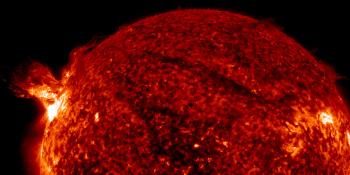
X1.9 solar flare, Coronal hole faces Earth
Aidez SpaceWeatherLive.com !
A lot of people come to SpaceWeatherLive to follow the Solar activity or if there is a chance to see the aurora, but with more traffic comes higher costs to keep the servers online. If you like SpaceWeatherLive and want to support the project you can choose a subscription for an ad-free site or consider a donation. With your help we can keep SpaceWeatherLive online!



La Météo Spatiale en faits
| Dernière classe X | 08/12/2025 | X1.1 |
| Dernière classe M | 31/12/2025 | M7.11 |
| Dernier orage géomagnétique | 02/01/2026 | Kp5 (G1) |
| Jours sans taches solaires | |
|---|---|
| Dernier jour sans taches solaires | 08/06/2022 |
| Nombre mensuel moyen de taches solaires | |
|---|---|
| décembre 2025 | 124 +32.2 |
| janvier 2026 | 111.2 -12.8 |
| 30 derniers jours | 106.5 -1.5 |