Affichage des archives de vendredi, 13 décembre 2024
Bulletin quotidien sur l'activité solaire et géomagnétique du SIDC
Publié: 2024 Dec 13 1231 UTC
Prévisions SIDC
Éruptions solaires
M-class flares expected (probability >=50%)
Géomagnétisme
Active conditions expected (A>=20 or K=4)
Moniteur de Flux de Proton
Warning condition (activity levels expected to increase, but no numeric forecast given)
| Flux de 10 cm | Ap | |
|---|---|---|
| 13 Dec 2024 | 164 | 007 |
| 14 Dec 2024 | 165 | 008 |
| 15 Dec 2024 | 166 | 011 |
Régions solaires actives et éruptions solaires
Solar flaring activity over the last 24 hours has been at moderate levels, with four M-class flares and several C-class flares. The strongest flare was an M2.2 flare (SIDC Flare 2939) peaking at 17:43 UTC on December 12, produced by SIDC Sunspot Group 318 (NOAA Active Region 3922, magnetic type beta). There are currently five numbered active regions on the solar disk. The most complex ones are SIDC Sunspot Group 288 (NOAA Active Region 3917, evolved to magnetic type beta- gamma-delta) and SIDC Sunspot Group 332 (NOAA Active Region 3920, magnetic type beta-delta). SIDC Sunspot Group 330 (NOAA Active region 3916) has decayed into plage. SIDC Sunspot Group 337 (NOAA Active Region 3924, magnetic type beta) has emerged in the southeast quadrant. The solar flaring activity is expected to be at moderate levels over the next 24 hours, with M-class flares expected and a chance for X-class flares.
Éjection de masse coronale
A faint coronal mass ejection (CME) was detected in LASCO/C2 coronagraph imagery around 12:00 UTC on December 12. Its source region is estimated to be near or beyond the east limb. It is not expected to have an impact on Earth. A second CME was detected in LASCO/C2 coronagraph imagery around 03:12 UTC on December 13. It is most likely associated with flaring activity near SIDC Sunspot Group 288 (NOAA AR 3917). Current analysis suggests that it will not have an impact on Earth. A large prominence eruption was observed in GOES/SUVI 304 data at the west limb, around 21:45 UTC on December 12, but no associated CME was observed in the available coronagraph imagery. No other Earth-directed CMEs were observed in the available coronagraph imagery.
Trous coronaux
A small, northern, positive polarity coronal hole, SIDC Coronal Hole 78, has crossed the central meridian. An associated high-speed stream may arrive at Earth starting from December 14.
Vent solaire
Over the past 24 hours, the solar wind parameters (ACE) reflected slow solar wind conditions. Speed values were around 350 km/s. The interplanetary magnetic field values were between 5 nT and 7 nT. The Bz component varied between -5 nT and 5 nT. The interplanetary magnetic field angle was predominantly in the positive sector. Mostly slow solar wind conditions are expected over the next 24 hours, with a chance for enhancements due to a possible high-speed stream arrival from the northern, positive polarity coronal hole (SIDC Coronal Hole 78).
Géomagnétisme
Geomagnetic conditions globally and locally were at quiet levels (NOAA Kp 2 and K BEL 2) in the last 24 hours. Quiet conditions are expected globally and locally over the next 24 hours, with possible unsettled to active intervals due to the possible high-speed stream arrival from the northern, positive polarity coronal hole (SIDC Coronal Hole 78).
Niveaux de flux de protons
The greater than 10 MeV proton flux was below the threshold level over the past 24 hours. It is expected to remain below the threshold level over the next 24 hours, pending no further eruptive activity.
Flux d'électrons sur l'orbite géostationnaire
The greater than 2 MeV electron flux measured by GOES 16 was enhanced but remained marginally below the threshold level in the last 24 hours. The greater than 2 MeV electron flux measured by GOES 18 was above the threshold between 15:30 UTC on December 12 and 23:45 UTC on December 12. The greater than 2 MeV electron flux measured by GOES 16 and GOES 18 is currently increasing and it is expected to be above the threshold over the next 24hours. The 24-hour electron fluence is expected to be mostly at normal levels over the next 24 hours.
Estimation du nombre international de taches solaires (ISN) pour aujourd'hui : 120, sur la base de 05 stations.Indices solaires pour 12 Dec 2024
| Nombre de Wolf, observé par Catania | 109 |
| Flux solaire à 10 cm | 161 |
| AK Chambon La Forêt | 007 |
| AK Wingst | 006 |
| Ap estimé | 005 |
| Nombre international de taches solaires estimé | 114 - Basé sur 07 stations |
Résumé des événements marquants
| Jour | Commencer | Max | Fin | Loc | Force | OP | 10cm | Catania/NOAA | Types de sursaut radio |
|---|---|---|---|---|---|---|---|---|---|
| 12 | 1731 | 1743 | 1750 | ---- | M2.2 | 47/3922 | III/2 | ||
| 12 | 2058 | 2107 | 2112 | ---- | M1.6 | 47/3922 | |||
| 13 | 0311 | 0318 | 0322 | S18E37 | M1.0 | SF | 47/3922 | III/2 |
Données fournies par le Solar Influences Data analysis Center© - SIDC - Traité par SpaceWeatherLive
Toutes les heures sont indiquées en UTC
Dernières nouvelles
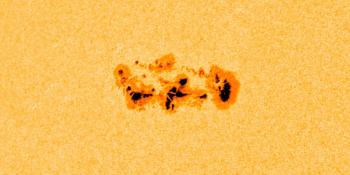
Complex sunspot region 4366

CME impact! S4 solar radiation storm

X1.9 solar flare with earth-directed CME
Forum
Aidez SpaceWeatherLive.com !
De nombreuses personnes consultent SpaceWeatherLive pour suivre l'activité solaire ou observer les aurores boréales, mais l'augmentation du trafic engendre des coûts plus élevés pour maintenir les serveurs en ligne. Si vous appréciez SpaceWeatherLive et souhaitez soutenir le projet, vous pouvez vous abonner pour un site sans publicité ou faire un don. Grâce à votre aide, SpaceWeatherLive restera accessible !



La Météo Spatiale en faits
| Dernière classe X | 04/02/2026 | X4.21 |
| Dernière classe M | 25/02/2026 | M2.4 |
| Dernier orage géomagnétique | 03/03/2026 | Kp5 (G1) |
| Jours sans taches solaires | |
|---|---|
| 365 derniers jours | 3 jours |
| 2026 | 3 jours (5%) |
| Dernier jour sans taches solaires | 24/02/2026 |
| Nombre mensuel moyen de taches solaires | |
|---|---|
| janvier 2026 | 112.6 -11.4 |
| mars 2026 | 75.5 -37.1 |
| 30 derniers jours | 58.7 -66 |