Visualizzazione archivio di venerdì, 20 marzo AM
Daily bulletin on solar and geomagnetic activity from the SIDC
Emesso: 2015 Mar 20 1230 UTC
SIDC Forecast
Brillamenti solari
Eruptive (C-class flares expected, probability >=50%)
Geomagnetism
Active conditions expected (A>=20 or K=4)
Protoni solari
Quiet
| 10cm flux | Ap | |
|---|---|---|
| 20 Mar 2015 | 109 | 026 |
| 21 Mar 2015 | 109 | 017 |
| 22 Mar 2015 | 109 | 031 |
Bulletin
Solar activity was low over the period. A long duration C7.9 flare from NOAA active region 2297 peaking at 1:33UT was the only significant event of the period. Only one other low class C flare was recorded originating from the same region. A new region started emerging before UT noon yesterday around N00W70, and seems to evolve rapidly but is of limited concern as it is currently already about to rotate beyond the west limb. The newly emerging region in the northern hemisphere mentioned yesterday was numbered NOAA 2304 and is fairly insignificant. With NOAA regions 2297 and 2302 disappearing beyond the western limb, the most significant potential flaring sources are moving away. Some C flaring may initially still be possible but the C flaring probability is in decline. The long duration C flare was associated with a partial halo CME is visible in SOHO/C2 coronagraph images from 2:00UT onwards. The angular extent of the CME was strongly overestimated by Cactus (wrongly reporting as full halo). At most it reaches an angular extent of 180 degrees. The ejection is predominantly directed westward (the source region located at 90 degrees longitude at the time of the event) with a faint northerly component. It is not expected to have any influence on Earth. Solar wind conditions showed the continued influence of the high speed stream from the southern negative polarity coronal hole, with solar wind speeds in the range of 550-650 km/s. Total magnetic field was between 5 and 8 nT with Bz variable. The magnetic field Phi angle was stable in the negative sector. The influence of the high speed stream is expected to last over the next 24 hours though declining, corresponding to unsettled to active geomagnetic conditions with later quiet to unsettled conditions. A recurrent equatorial coronal hole which is currently passing the central meridian is likely to influence solar wind conditions from March 22, onwards associated with active to minor storm geomagnetic conditions.
Today's estimated international sunspot number (ISN): 017, based on 07 stations.Solar indices for 19 Mar 2015
| Wolf number Catania | /// |
| 10cm solar flux | 109 |
| AK Chambon La Forêt | 038 |
| AK Wingst | 024 |
| Estimated Ap | 028 |
| Estimated international sunspot number | 040 - Based on 17 stations |
Noticeable events summary
| Day | Begin | Max | Fine | Loc | Strength | OP | 10cm | Catania/NOAA | Radio burst types | |
|---|---|---|---|---|---|---|---|---|---|---|
| Nessuna | ||||||||||
Provided by the Solar Influences Data analysis Center© - SIDC - Processed by SpaceWeatherLive
Tutti gli orari in UTC
<< Vai alla pagina della panoramica giornaliera
Ultime notizie

X1.5 solar flare

M2.7 solar flare, CME arrival possible
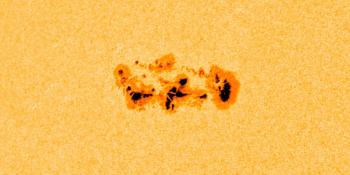
Complex sunspot region 4366
Ultimi messaggi dal forum
Supporta SpaceWeatherLive.com!
A lot of people come to SpaceWeatherLive to follow the Solar activity or if there is a chance to see the aurora, but with more traffic comes higher costs to keep the servers online. If you like SpaceWeatherLive and want to support the project you can choose a subscription for an ad-free site or consider a donation. With your help we can keep SpaceWeatherLive online!



Notizie sul meteo spaziale
| Ultimo brillamento X | 2026/03/30 | X1.5 |
| Ultimo brillamento M | 2026/04/09 | M1.0 |
| Ultima tempesta geomagnetica | 2026/04/03 | Kp7- (G3) |
| Giorni senza macchie | |
|---|---|
| Ultimi 365 giorni | 3 giorni |
| 2026 | 3 giorni (3%) |
| Ultimo giorno senza macchie | 2026/02/24 |
| Media mensile Numero di Macchie Solari | |
|---|---|
| marzo 2026 | 85.9 +7.7 |
| aprile 2026 | 89.7 +3.8 |
| Ultimi 30 giorni | 93.4 +33.3 |