Visualizzazione archivio di mercoledì, 4 giugno AM
Daily bulletin on solar and geomagnetic activity from the SIDC
Emesso: 2025 Jun 04 1231 UTC
SIDC Forecast
Brillamenti solari
M-class flares expected (probability >=50%)
Geomagnetism
Active conditions expected (A>=20 or K=4)
Protoni solari
Warning condition (activity levels expected to increase, but no numeric forecast given)
| 10cm flux | Ap | |
|---|---|---|
| 04 Jun 2025 | 135 | 031 |
| 05 Jun 2025 | 133 | 017 |
| 06 Jun 2025 | 125 | 031 |
Solar Active Regions and flaring
Solar flaring activity was moderate, with one M-class flare and several C-class flares recorded over the past 24 hours. The largest flare was an M1.4 flare (SIDC Flare 4543), peaking at 13:03 UTC on June 03, associated with SIDC Sunspot Group 513 (NOAA Active Region 4105; magnetic type beta-gamma). There are currently six numbered active regions on the visible solar disc. SIDC Sunspot Group 513, which rotated onto the disc from the southeast limb, was the main driver of the flaring activity observed over the past 24 hours. A new active region emerged in the northeast quadrant of the visible solar disc during the period, numbered SIDC Sunspot Group 514 (magnetic type alpha), but it did not produce any significant flaring activity. SIDC Sunspot Group 469 (NOAA Active Region 4100; magnetic type beta) has decreased in size and remained inactive. SIDC Sunspot Group 510 (NOAA Active Region 4101) is approaching the west limb. SIDC Sunspot Group 490 (NOAA Active Region 4104) has decayed into plage. Low flaring activity was also produced by SIDC Sunspot Group 508 (NOAA Active Region 4099; magnetic type beta). Solar flaring activity is expected to be at low to moderate levels over the next 24 hours, with M-class flares possible and a chance for X-class flares.
Espulsioni di massa coronale
A slow coronal mass ejection (SIDC CME 514) was observed in LASCO/C2 coronagraph data starting at 07:48 UTC on June 03. The CME is directed primarily toward the northeast from Earth’s perspective and is associated with a large filament eruption that occurred in the northern and northeastern regions near the center of the solar disk, starting around 00:50 UTC on June 03. While the bulk of the ejecta is expected to miss Earth, a mild glancing blow could be possible from late on June 06. No other Earth-directed CMEs have been detected in the available coronagraph imagery over the past 24 hours.
Vento solare
Over the past 24 hours, the solar wind parameters (ACE and DSCOVR) reflected the waning influence of the ICME and possible HSS influence. The interplanetary magnetic field remained below 9 nT, and the solar wind speed ranged between 500 km/s and 690 km/s. The southward component of the interplanetary magnetic field fluctuated between -8 nT and 6 nT. The magnetic field orientation was predominantly in the negative sector (field directed toward the Sun). Solar wind parameters are expected to gradually return to slow solar wind conditions over the next few days, with a chance of a weak enhancement from late on June 05 due to the possible arrival of a high-speed stream from a mid-latitude negative polarity coronal hole (SIDC Coronal Hole 111), and a probability of further enhancements from late on June 06 due to the CME associated with the filament eruption on June 04 (SIDC CME 514), which may have a glancing blow at Earth.
Geomagnetism
Geomagnetic conditions reached minor storm levels globally (NOAA Kp = 6-) between 12:00 and 15:00 UTC on June 03. Locally over Belgium, minor storm conditions were observed (K-Bel = 5). Geomagnetic conditions are expected to remain mostly unsettled to active over the next 24 hours.
Proton flux levels
Over the past 24 hours, the greater than 10 MeV GOES proton flux continued to decrease and, although still slightly elevated, remained below the 10 pfu threshold. The proton flux is expected to return to background levels over the next days, with a small chance of a particle event occurring in association with an X-class flare or a coronal mass ejection.
Electron fluxes at geostationary orbit
The greater than 2 MeV electron flux, as measured by GOES-19, exceeded the 1000 pfu threshold over the past 24 hours. The electron flux is expected to continue exceeding this threshold over the next day. The 24-hour electron fluence was at normal to moderate levels and is expected to remain at these levels over the next day.
Today's estimated international sunspot number (ISN): 095, based on 13 stations.Solar indices for 03 Jun 2025
| Wolf number Catania | 076 |
| 10cm solar flux | 135 |
| AK Chambon La Forêt | 035 |
| AK Wingst | /// |
| Estimated Ap | 038 |
| Estimated international sunspot number | 093 - Based on 24 stations |
Noticeable events summary
| Day | Begin | Max | Fine | Loc | Strength | OP | 10cm | Catania/NOAA | Radio burst types |
|---|---|---|---|---|---|---|---|---|---|
| 03 | 1252 | 1303 | 1312 | ---- | M1.4 | --/4105 | III/2 |
Provided by the Solar Influences Data analysis Center© - SIDC - Processed by SpaceWeatherLive
Tutti gli orari in UTC
<< Vai alla pagina della panoramica giornaliera
Ultime notizie
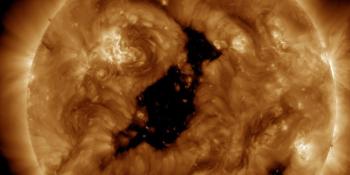
Coronal hole faces Earth

X1.5 solar flare

M2.7 solar flare, CME arrival possible
Ultimi messaggi dal forum
Supporta SpaceWeatherLive.com!
A lot of people come to SpaceWeatherLive to follow the Solar activity or if there is a chance to see the aurora, but with more traffic comes higher costs to keep the servers online. If you like SpaceWeatherLive and want to support the project you can choose a subscription for an ad-free site or consider a donation. With your help we can keep SpaceWeatherLive online!



Notizie sul meteo spaziale
| Ultimo brillamento X | 2026/04/24 | X2.5 |
| Ultimo brillamento M | 2026/05/22 | M2.3 |
| Ultima tempesta geomagnetica | 2026/05/16 | Kp6- (G2) |
| Giorni senza macchie | |
|---|---|
| Ultimi 365 giorni | 3 giorni |
| 2026 | 3 giorni (2%) |
| Ultimo giorno senza macchie | 2026/02/24 |
| Media mensile Numero di Macchie Solari | |
|---|---|
| aprile 2026 | 79.3 -6.6 |
| maggio 2026 | 88.6 +9.3 |
| Ultimi 30 giorni | 100.4 +10.3 |