Visualizzazione archivio di domenica, 17 maggio AM
Daily bulletin on solar and geomagnetic activity from the SIDC
Emesso: 2026 May 17 1231 UTC
SIDC Forecast
Brillamenti solari
C-class flares expected, (probability >=50%)
Geomagnetism
Quiet (A<20 and K<4)
Protoni solari
Quiet
| 10cm flux | Ap | |
|---|---|---|
| 17 May 2026 | 108 | 015 |
| 18 May 2026 | 110 | 007 |
| 19 May 2026 | 113 | 025 |
Solar Active Regions and flaring
Solar flaring activity was moderate over the past 24 hours, with four M-class flares. The strongest flares were two M1.9 flares: SIDC Flare 7718, peaking at 16:12 UTC on May 16, which was associated with the returning SIDC Sunspot Group 825 (NOAA Active Region 4436, magnetic type beta), and SIDC Flare 7714, peaking at 17:42 UTC on May 16, which was associated with SIDC Sunspot Group 844 (NOAA Active Region 4435). There are currently seven numbered active regions on the solar disk, with all regions classified as magnetic type beta or alpha. SIDC Sunspot Groups 871 and 872, both magnetic type beta, emerged in the southeast quadrant, while SIDC Sunspot Group 870 (NOAA Active Region 4441, magnetic type beta) emerged in the northeast quadrant. SIDC Sunspot Group 844 (NOAA Active Region 4435) has rotated across the west limb. The solar flaring activity is expected to be low over the next 24 hours, with C-class flares very likely and a chance for M-class flares.
Espulsioni di massa coronale
A wide and fast Coronal Mass Ejection (SIDC CME 656) was observed in LASCO/C2 and C3 coronagraph imagery starting from around 16:36 UTC on May 16, directed mainly toward the northwest. The CME is associated with an M1.9 flare peaking at 16:12 UTC on May 16 from SIDC Sunspot Group 825 (NOAA Active Region 4436), with associated dimming and field line movement observed in SDO/AIA data. Type IV radio emission was detected from 16:05 UTC on May 16, associated with this event. Preliminary analysis suggests that the CME has a fitted speed around 1200 km/s. Although the bulk of the ejecta appears to be directed mainly toward the northwest, preliminary modelling indicates that a glancing blow is expected at Earth around May 19. No other Earth-directed CMEs were observed in the available coronagraph imagery.
Vento solare
Over the past 24 hours, the solar wind parameters (ACE) reflected enhanced solar wind conditions under the waning influence of the high-speed stream from the large, negative polarity transequatorial coronal hole (returning SIDC Coronal Hole 147). Speed values ranged between 620 km/s and 730 km/s. The interplanetary magnetic field values ranged between 2 nT and 5 nT. The Bz component varied between -5 nT and 4 nT. Solar wind conditions are expected to gradually return towards a slow solar wind regime over the next 24 hours.
Geomagnetism
Geomagnetic conditions globally reached minor storm levels between 15:00 UTC and 18:00 UTC on May 16 (NOAA Kp 5- ), before returning to mostly quiet levels towards the end of the period. Locally, geomagnetic conditions reached active levels during several intervals at the beginning of the period (K BEL 4), before returning to mostly quiet levels towards the end of the period. Mostly quiet geomagnetic conditions are expected over the next 24 hours.
Proton flux levels
The greater than 10 MeV proton flux was below the 10 pfu threshold level over the past 24 hours. It is expected to remain below the threshold level over the next 24 hours.
Electron fluxes at geostationary orbit
The greater than 2 MeV electron flux measured by GOES 18 and GOES 19 was below the 1000 pfu threshold until around 16:00 UTC on May 16 and exceeded the threshold afterwards. The greater than 2 MeV electron flux is expected to remain around or above the 1000 pfu threshold levels in the next 24 hours. The 24-hour electron fluence was initially at normal levels and reached moderate levels for the rest of the period. It is expected to remain at moderate levels over the next 24 hours.
Today's estimated international sunspot number (ISN): 092, based on 14 stations.Solar indices for 16 May 2026
| Wolf number Catania | /// |
| 10cm solar flux | 109 |
| AK Chambon La Forêt | 033 |
| AK Wingst | 031 |
| Estimated Ap | 034 |
| Estimated international sunspot number | 055 - Based on 18 stations |
Noticeable events summary
| Day | Begin | Max | Fine | Loc | Strength | OP | 10cm | Catania/NOAA | Radio burst types |
|---|---|---|---|---|---|---|---|---|---|
| 16 | 1550 | 1612 | 1622 | N20W16 | M1.9 | 2 | 07/4436 | IV/2III/2 | |
| 16 | 1622 | 1629 | 1634 | N20W16 | M1.3 | 2N | 07/4436 | VI/1 | |
| 16 | 1739 | 1742 | 1744 | N21W67 | M1.9 | S | 02/4435 | ||
| 17 | 0329 | 0339 | 0342 | ---- | M1.4 | 02/4435 |
Provided by the Solar Influences Data analysis Center© - SIDC - Processed by SpaceWeatherLive
Tutti gli orari in UTC
<< Vai alla pagina della panoramica giornaliera
Ultime notizie
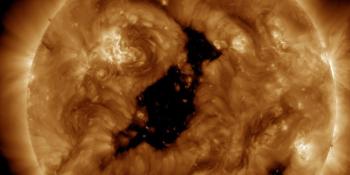
Coronal hole faces Earth

X1.5 solar flare

M2.7 solar flare, CME arrival possible
Ultimi messaggi dal forum
Supporta SpaceWeatherLive.com!
A lot of people come to SpaceWeatherLive to follow the Solar activity or if there is a chance to see the aurora, but with more traffic comes higher costs to keep the servers online. If you like SpaceWeatherLive and want to support the project you can choose a subscription for an ad-free site or consider a donation. With your help we can keep SpaceWeatherLive online!



Notizie sul meteo spaziale
| Ultimo brillamento X | 2026/04/24 | X2.5 |
| Ultimo brillamento M | 2026/05/17 | M1.4 |
| Ultima tempesta geomagnetica | 2026/05/16 | Kp6- (G2) |
| Giorni senza macchie | |
|---|---|
| Ultimi 365 giorni | 3 giorni |
| 2026 | 3 giorni (2%) |
| Ultimo giorno senza macchie | 2026/02/24 |
| Media mensile Numero di Macchie Solari | |
|---|---|
| aprile 2026 | 79.3 -6.6 |
| maggio 2026 | 91.4 +12.1 |
| Ultimi 30 giorni | 100.3 +9.3 |