Przeglądasz Archiwum z niedziela, 10 listopada 2013
Codzienne wiadomości na temat aktywności słonecznej i geomagnetycznej z SIDC
Odnotowany: 2013 Nov 10 1309 UTC
Prognoza SIDC
Rozbłyski słoneczne
Active (M-class flares expected, probability >=50%)
Geomagnetyzm
Quiet (A<20 and K<4)
Monitoring przepływu protonów
Warning condition (activity levels expected to increase, but no numeric forecast given)
| strumień 10cm | Ap | |
|---|---|---|
| 10 Nov 2013 | 150 | 013 |
| 11 Nov 2013 | 152 | 003 |
| 12 Nov 2013 | 156 | 005 |
Skrót wiadomości
Catania sunspot group 35 (NOAA AR 1890) produced an X1.1 flare peaking at 05:14 UT today. The flare was accompanied by coronal dimmings and a post- eruption arcade observed by SDO/AIA, indicating the eruption of a CME. Regarding space coronagraphs, only the data from COR2 onboard STEREO A is available at the moment of writing, and it confirms that the CME did take place. However, the COR2 data does not allow us to evaluate the CME propagation direction with a sufficient accuracy. It is clear that the bulk of the CME material propagates southward of the ecliptic plane, but the position of the source active region close to the solar central meridian indicates that the CME might arrive at the Earth. We will update the information on the CME direction when the SOHO/LASCO data becomes available. Catania sunspot group 35 (NOAA AR 1890) keeps the beta-gamma- delta configuration of its photospheric magnetic field, although the delta- spot continues to weaken. We expect flaring activity at the M-level in this group, with an X-class flare possible but unlikely. The position of the group in the western solar hemisphere leads us to maintain the warning condition for a proton event. The proton flux at energies above 10 MeV is currently above the background (due to earlier eastern hemisphere events), but it did not react to the above-mentioned CME/flare event and currently remains below the proton event threshold. The Earth is currently inside a fast (around 580 km/s) solar wind flow with average (around 5 nT) interplanetary magnetic field (IMF) magnitude. The fast flow probably originats from a small equatorial coronal hole that passed the solar central meridian on November 7. Yesterday's interval of elevated IMF magnitude (that led to active to minor storm geomagnetic conditions) probably represents a small-scale transient at the interplanetary sector boundary. Due to average values of the IMF magnitude, we expect quiet to unsettled (K < 4) geomagnetic conditions in the coming hours.
Dzisiejsza szacunkowa międzynarodowa liczba plam na Słońcu (ISN): 077, na podstawie 15 stacji.Indeksy solarne na 09 Nov 2013
| Liczba Wolfa z Katanii | /// |
| Fale radiowe 10,7 cm | 148 |
| AK Chambon La Forêt | 022 |
| AK Wingst | 018 |
| Szacunkowa Ap | 020 |
| Szacowana międzynarodowa liczba plam słonecznych | 076 - Na podstawie stacji 19 |
Podsumowanie wydarzeń godnych uwagi
| Dzień | Początek | Maksymalnie | Koniec | Lokalizacja | Siła | OP | 10cm | Katania/NOAA | Typy impulsów radiowych |
|---|---|---|---|---|---|---|---|---|---|
| 10 | 0508 | 0514 | 0518 | S14W13 | X1.1 | 2B | 360 | 35/1890 | II/2 |
Dostarczone przez Centrum Analizy Danych Wpływów Słonecznych© - SIDC - Przetworzone przez SpaceWeatherLive
Wszystkie czasy w UTC
<< Idź do codziennego przeglądu
Najnowsze wiadomości
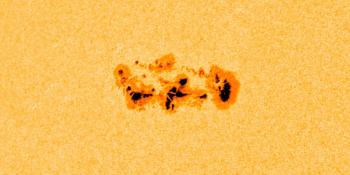
Complex sunspot region 4366

CME impact! S4 solar radiation storm

X1.9 solar flare with earth-directed CME
Najnowsze wiadomości z forum
Więcej tematówWesprzyj SpaceWeatherLive.com!
Wiele ludzi odwiedza stronę SpaceWeatherLive, aby śledzić aktywność słońca lub czy jest szansa na zobaczenie zorzy, ale większy ruch powoduje większe koszty utrzymania serwerów. Jeżeli podoba ci się strona SpaceWeatherLive i chciałbyś/chciałabyś wesprzeć ten projekt to możesz kupić subskrypcje aby uzyskać dostęp do strony bez reklam lub kupić darowiznę. Dzięki waszej pomocy, pomagacie utrzymać serwery SpaceWeatherLive!



Fakty na temat pogody kosmicznej
| Ostatnie rozbłyski klasy X | 2026/02/04 | X4.3 |
| Ostatnie rozbłyski klasy M | 2026/02/13 | M1.0 |
| Ostatnia burza geomagnetyczna | 2026/02/05 | Kp5+ (G1) |
| Dni bez plam słonecznych | |
|---|---|
| Ostatni dzień bez plamy słonecznej | 2022/06/08 |
| Średnia miesięczna liczba plam słonecznych | |
|---|---|
| stycznia 2026 | 112.6 -11.4 |
| lutego 2026 | 116.2 +3.6 |
| Ostatnie 30 dni | 130.8 +34.3 |