Просмотр архива за вторник, 10 марта 2015
Daily bulletin on solar and geomagnetic activity from the SIDC
Существующий: 2015 Mar 10 1232 UTC
SIDC Forecast
Солнечные вспышки
Active (M-class flares expected, probability >=50%)
Geomagnetism
Active conditions expected (A>=20 or K=4)
Солнечные протоны
Quiet
| 10cm flux | Ap | |
|---|---|---|
| 10 Mar 2015 | 122 | 015 |
| 11 Mar 2015 | 120 | 018 |
| 12 Mar 2015 | 118 | 019 |
Bulletin
Over the past 24 hours there were several C class flares and 3 M class flares, all were produced by NOAA AR (Active Region) 2297, which is located at S15E40, and is classified as a Beta-Delta region under the Mount Wilson magnetic classification system. The largest flares recorded over the past 24 hours, all produced by AR 2297, were a M4.5 flare on 2015-Mar-09 peaking at 14:33, a M5.8 flare on 2015-Mar-09 peaking at 23:53 and a M5.1 on 2015-Mar-10 peaking at 03:24. AR 2297 has shown some evolution with some flux emergence. There is a large filament located between S05W50 and S30E70, however this has remained, and appears, stable. AR 2297 produced continual out flows throughout the past 24 hours and several small CMEs (Coronal Mass Ejection) directed to the East. AR 2297 produced two Earth directed partial-halo CMEs, see below for details. Flaring is expected to continue at the C-class level with a strong possibility of M-class flares. The solar wind speed has been slowly decreasing over the past 24 hours from 450 km/s to 350 km/s. The total magnetic field has increased from around 3 nT to 6nT, and the Bz component has fluctuated from positive to negative. The Bz has ranged between +6 and -5 nT over the past 24 hours. Geomagnetic conditions ranged between Kp index 1-2 (NOAA) and local K index 1-2 (Dourbes; Nb. data gap) over the past 24 hours. A transient coronal hole is currently located at solar disk center, this may produce enhanced solar wind speeds in a couple of days. AR 2297 produced two partial halo CMEs; 1. A partial halo CME was observed in LASCO/C2 images at 00:00UT on 10-Mar-2015. This CME was related to the strong M5.8 flare produced by NOAA 2297 peaking at 23:53UT (09-Mar-2015). The related CME had a plane of the sky speed of 638 km/s (as recorded by CACTUS the Computer Aided CME Tracking tool), and a width of 188 degrees. The bulk of the CME is directed to the NorthEast. The CME is estimated to arrive at Earth at 00:30UT (+/- 12 hours) on 12-Mar-2015, and may impact the geomagnetic field; 2. A partial halo CME was observed in LASCO/C2 images at 03:36UT on 10-Mar-2015. This CME was related to the strong M5.1 flare produced by NOAA AR 2297 peaking at 03:24UT. The related CME had a plane of the sky speed of approximately 1150 km/s, and a width of 220 degrees. The bulk of the CME is directed to the NorthEast. The CME is estimated to arrive at Earth at 20:00UT (+/- 12 hours) on 11-Mar-2015, and may impact the geomagnetic field.
Today's estimated international sunspot number (ISN): 022, based on 18 stations.Solar indices for 09 Mar 2015
| Wolf number Catania | /// |
| 10cm solar flux | 123 |
| AK Chambon La Forêt | 008 |
| AK Wingst | 008 |
| Estimated Ap | 006 |
| Estimated international sunspot number | 019 - Based on 18 stations |
Noticeable events summary
| Day | Begin | Max | Конец | Loc | Strength | OP | 10cm | Catania/NOAA | Radio burst types |
|---|---|---|---|---|---|---|---|---|---|
| 09 | 1422 | 1433 | 1437 | S15E49 | M4.5 | 1N | --/2297 | III/2 | |
| 09 | 2329 | 2353 | 0012 | S18E45 | M5.8 | 2N | 170 | --/2297 | III/1IV/2 |
| 10 | 0319 | 0324 | 0328 | S15E40 | M5.1 | 2B | 130 | --/2297 | V/3III/3IV/1II/1 |
Provided by the Solar Influences Data analysis Center© - SIDC - Processed by SpaceWeatherLive
Все время в UTC
<< Перейти на сегодняшнюю страницу обзора
Последние новости

X1.5 solar flare

M2.7 solar flare, CME arrival possible
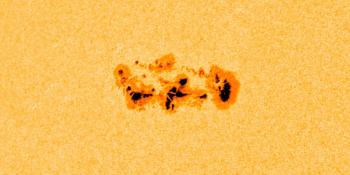
Complex sunspot region 4366
Последние сообщения с форума
Поддержка SpaceWeatherLive.com!
A lot of people come to SpaceWeatherLive to follow the Solar activity or if there is a chance to see the aurora, but with more traffic comes higher costs to keep the servers online. If you like SpaceWeatherLive and want to support the project you can choose a subscription for an ad-free site or consider a donation. With your help we can keep SpaceWeatherLive online!



Факты о космической погоде
| Последняя X-вспышка | 30/03/2026 | X1.4 |
| Последняя M-вспышка | 28/03/2026 | M1.3 |
| Последняя геомагнитная буря | 25/03/2026 | Kp5+ (G1) |
| Безупречные дни | |
|---|---|
| Последние 365 дней | 3 дней |
| 2026 | 3 дней (3%) |
| Последний безупречный день | 24/02/2026 |
| Среднемесячное количество солнечных пятен | |
|---|---|
| февраля 2026 | 78.2 -34.3 |
| марта 2026 | 86.6 +8.4 |
| Последние 30 дней | 86.6 +11.2 |