Перегляд архіву неділя, 15 січня 2023
Щоденний бюлетень про сонячну та геомагнітну активність від SIDC
Випущено: 2023 Jan 15 1302 UTC
Прогноз SIDC
Сонячні спалахи
M-class flares expected (probability >=50%)
Геомагнетизм
Active conditions expected (A>=20 or K=4)
Сонячні протони
Warning condition (activity levels expected to increase, but no numeric forecast given)
| 10 см потік | Ap | |
|---|---|---|
| 15 Jan 2023 | 210 | 019 |
| 16 Jan 2023 | 210 | 011 |
| 17 Jan 2023 | 210 | 015 |
Бюлетень
Solar flaring activity was at moderate levels in the past 24 hours with three low M-class flares. The strongest activity was an M6.0-class flare, start time 03:08 UTC, end time 04:07 UTC, peak time 03:42 UTC on Jan 15th, produced by NOAA AR 3191 (beta), which exhibited significant flux emergence. The rest of the moderate flaring was related to consecutive M3.5 and M4.6-class flares, with peak times 20:21 UTC and 21:00 UTC on Jan 14th. These flares were produced by NOAA AR 3182 (beta-gamma-delta) which has shown decreased in area and sunspot number, but significantly increased its magnetic complexity. The region also produced continuous high C-class flaring and was solely responsible for most of the activity activity over the past 24 hours. Further high C-class flaring was produced by NOAA AR 3192 (beta) and a new region to the east of NOAA AR 3191. Active regions NOAA 3184 and NOAA 3186 are now classified as magnetic type beta-delta, but have remained silent, together with NOAA 3190 (beta). Several other new active regions have emerged on disc, but are still relatively simple and have remained quiet. The solar flaring activity is expected to continue at moderate levels over the next 24 hours with likely isolated M-class flares and increasing chances for X-class flaring.
A slow south-west partial halo coronal mass ejection (CME) related to the M-class flaring from NOAA AR 3182 was detected in LASCO C2 imagery at 21:36 UTC on Jan 14th. The eruption is likely to have an Earth-directed component and could arrive to Earth at earliest on Jan 19th. Somewhat faster wide CME was observed at 03:24 UTC on Jan 15th following the M6.0-class flaring in the south-east. Preliminary analysis suggests that the trajectory of this eruption will miss Earth. No other Earth-directed CMEs were detected in the available coronagraph imagery over the past 24 hours.
The greater than 10 MeV proton flux was at nominal levels over the past 24 hours, but could become enhanced over the next 24 hours with chances of reaching minor radiation storm levels. The greater than 2 MeV electron flux has been below the1000 pfu threshold and is expected to remain so. The 24h electron fluence was at nominal levels and is expected to remain so over the next 24 hours.
Over the past 24 hours the solar wind parameters (ACE and DSCOVR) continued to be elevated under the influence of an ICME transient, suggesting an early arrival of the 17 UTC CME from Jan 11th. The solar wind velocity varied in the range of 404 km/s to 529 km/s. The interplanetary magnetic field increased to 11.7 nT with a minimum Bz of -10.26 nT. The B field remained predominantly in the negative sector. The solar wind parameters are expected to remain enhanced on Jan 15th and start recovering to nominal levels later on Jan 16th. Two positive polarity coronal holes have crossed the central meridian and high speed stream emanating from them is expected to arrive to Earth on Jan 17th and Jan 18th, which would likely cause further enhanced solar wind conditions.
The geomagnetic conditions over the past 24 hours were quiet to active over Belgium and globally reached an isolated minor storm levels. The geomagnetic conditions over the next 24 hours are expected to be quiet to active with remaining small chance of reaching isolated minor storms levels.
Розрахунок міжнародної кількості сонячних плям станом на сьогодні (ISN): 185, за даними 08 станцій.Сонячні індекси за 14 Jan 2023
| Число Вольфа, Катанія | /// |
| Сонячний потік 10 см | 228 |
| AK Chambon La Forêt | /// |
| AK Wingst | 009 |
| Розрахунковий індекс Ap | 010 |
| Розрахункова міжнародна кількість сонячних плям | 201 - За даними 11 станцій |
Зведення помітних подій
| День | Початок | Макс | Кінець | Розташування | Сила | OP | 10cm | Катанія/NOAA | Типи радіоімпульсів |
|---|---|---|---|---|---|---|---|---|---|
| 14 | 2006 | 2021 | 2028 | ---- | M3.5 | 100 | 38/3182 | ||
| 14 | 2037 | 2100 | 2119 | ---- | M4.6 | 38/3182 | |||
| 15 | 0308 | 0342 | 0408 | ---- | M6.0 | F | 47/3191 | I/1 2 |
Надано Центром Аналізу Даних Сонячного Впливу (SIDC)© - SIDC - Оброблено SpaceWeatherLive
Весь час у UTC
Останні новини
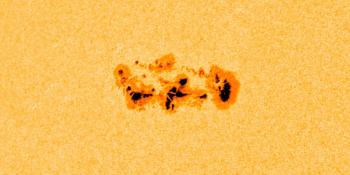
Complex sunspot region 4366

CME impact! S4 solar radiation storm

X1.9 solar flare with earth-directed CME
Останні повідомлення з форума
Підтримайте SpaceWeatherLive.com!
Багато людей заходять на SpaceWeatherLive, щоб стежити за сонячною активністю або якщо є можливість побачити полярне сяйво, але зі збільшенням трафіку зростають і витрати на підтримку серверів в мережі. Якщо вам подобається SpaceWeatherLive і ви хочете підтримати проект, ви можете вибрати підписку на безрекламний сайт або розглянути можливість зробити пожертву. З вашою допомогою ми зможемо підтримувати SpaceWeatherLive онлайн!



Факти про космічну погоду
| Останній X-спалах | 2026/02/03 | X1.5 |
| Останній M-спалах | 2026/02/03 | M3.4 |
| Останній геомагнітний шторм | 2026/01/28 | Kp5+ (G1) |
| Дні без сонячних плям | |
|---|---|
| Останній день без сонячних спалахів | 2022/06/08 |
| Середня кількість сонячних плям протягом місяця | |
|---|---|
| грудня 2025 | 124 +32.2 |
| лютого 2026 | 133 +9 |
| Останні 30 днів | 120.6 +10.9 |