Prohlížíte si archiv čtvrtek 30. ledna 2014
Denní bulletin o sluneční a geomagnetické aktivitě ze SIDC
Vydáno: 2014 Jan 30 1241 UTC
SIDC Předpověď
Sluneční erupce
Active (M-class flares expected, probability >=50%)
Geomagnetismus
Quiet (A<20 and K<4)
Sluneční protony
Quiet
| 10cm tok | Ap | |
|---|---|---|
| 30 Jan 2014 | 160 | 003 |
| 31 Jan 2014 | 162 | 004 |
| 01 Feb 2014 | 164 | 009 |
Bulletin
Solar activity has been at active levels over the last 24 hours. 11 C- and 2 M-class flares were recorded, which nearly all originated in the mixed polarity region near NOAA 1967's main spot. The strongest was an M2-flare peaking at 06:39UT. Of note was also a long duration C7-flare starting at 14:11UT and ending at 16:36UT. So far, this LDE was the most energetic in terms of NOAA 1967's integrated flare flux history. NOAA 1968 was the only other active region being able to produce a C-flare (C3 peaking at 04:46UT). The x-ray background has been all day above the C1-level. Active conditions are expected to continue, with a slight chance on an X-class flare. The CMEs associated with NOAA 1967's flaring activity were directed to the East and away from Earth. A faint halo CME was observed early on 29 January. Though it may be related to the frontside filament eruption event early on 29 January (trailing NOAA 1960 and 1959), it may also be related to a backside event that took place about an hour earlier (late 28 January, around 22:50UT) in the same line of sight. Most recent, but incomplete STEREO-A data now seem to favor the latter scenario. Earth is exiting the high speed wind stream. Solar wind has returned to average conditions, with a speed near 350 km/s and Bz fluctuating between -5 and +5 nT. Geomagnetic conditions were quiet. Solar wind may continue to be modulated by the effects of small coronal holes that have passed the central meridian on 27 and 29 January. Quiet geomagnetic conditions are expected. Late on 1 February, any effects of the 29 January frontside CME may drive local geomagnetic conditions to isolated active levels. Otherwise, quiet conditions should persist.
Dnešní odhadovaný mezinárodní počet slunečních skvrn (ISN): 075, na základě 07 stanic.Solární indexy za 29 Jan 2014
| Wolfovo číslo Catania | 107 |
| 10cm sluneční tok | 156 |
| AK Chambon La Forêt | 011 |
| AK Wingst | 006 |
| Odhadovaný Ap | 006 |
| Odhadovaný mezinárodní počet slunečních skvrn | 065 - Na základě 12 stanic |
Souhrn významných událostí
| Den | Začátek | Max | Konec | Místo | Síla | OP | 10cm | Catania/NOAA | Typy rádiových záblesků |
|---|---|---|---|---|---|---|---|---|---|
| 30 | 0633 | 0639 | 0644 | S15E54 | M2.1 | SF | 28/1967 | ||
| 30 | 0754 | 0811 | 0841 | S12E52 | M1.1 | SF | 69 | 28/1967 | III/1 |
Poskytuje Centrum pro analýzu dat o solárních vlivech© - SIDC - Zpracováno SpaceWeatherLive
Všechny časy v UTC
<< Přejít na stránku s denním přehledem
Poslední zprávy

X1.5 solar flare

M2.7 solar flare, CME arrival possible
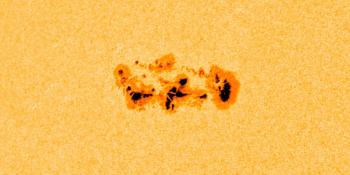
Complex sunspot region 4366
Nejnovější zprávy na fóru
Podpora SpaceWeatherLive.com!
Mnoho lidí navštěvuje SpaceWeatherLive, aby sledovali sluneční aktivitu nebo pokud je šance spatřit polární záři, ale s větší návštěvností přicházejí i vyšší náklady na udržování serverů online. Pokud se vám SpaceWeatherLive líbí a chcete projekt podpořit, můžete si zvolit předplatné pro web bez reklam nebo zvážit darování. S vaší pomocí můžeme SpaceWeatherLive udržet online!



Fakta o počasí ve vesmíru
| Poslední X-záblesk | 30. 03. 2026 | X1.4 |
| Poslední M-záblesk | 28. 03. 2026 | M1.3 |
| Poslední geomagnetická bouře | 25. 03. 2026 | Kp5+ (G1) |
| Dny bez skvrn | |
|---|---|
| Posledních 365 dnů | 3 dnů |
| 2026 | 3 dnů (3%) |
| Poslední den bez skvrn | 24. 02. 2026 |
| Průměrný měsíční počet slunečních skvrn | |
|---|---|
| února 2026 | 78.2 -34.3 |
| března 2026 | 86.6 +8.4 |
| Posledních 30 dnů | 86.6 +11.2 |