Prohlížíte si archiv úterý 4. února 2014
Denní bulletin o sluneční a geomagnetické aktivitě ze SIDC
Vydáno: 2014 Feb 04 1311 UTC
SIDC Předpověď
Sluneční erupce
Major flares expected (X-class flares expected, probability >=50%)
Geomagnetismus
Quiet (A<20 and K<4)
Sluneční protony
Warning condition (activity levels expected to increase, but no numeric forecast given)
| 10cm tok | Ap | |
|---|---|---|
| 04 Feb 2014 | 186 | 005 |
| 05 Feb 2014 | 184 | 004 |
| 06 Feb 2014 | 182 | 004 |
Bulletin
The solar soft X-ray background flux is slowly varying between the C and M-levels in response to slow activity in the Catania sunspot groups 27 and 28 (NOAA ARs 1968 and 1967 respectively). Numerous impulsive flares occur on top of this varying background. The two strongest flares of the past 24 hours occurred today: the M3.8 flare peaking at 01:23 UT in the Catania sunspot group 27 (NOAA AR 1968) and the M5.2 flare peaking at 04:00 UT in the Catania sunspot group 28 (NOAA AR 1967). None of the flares was associated with a major CME. Catania sunspot groups 27 and 28 maintain respectively beta-gamma and beta-gamma-delta configurations of their photospheric magnetic field. We expect continuing flaring activity on the M-level, with an isolated X-class flare being probable, especially in the Catania sunspot group 28 (NOAA AR 1967). Due to the position of the Catania sunspot group 28 close to the solar central meridian, a CME associated with a flare in this active region may arrive at the Earth. A major CME in this sunspot group may lead to a proton event, so we maintain the warning condition. A weak partial halo CME first appeared in the SOHO/LASCO C2 field of view today at 01:25 UT (after a data gap). It had the angular width of around 170 degrees and the plane-of-the-sky projected speed of around 700 km/s. The CME was most probably associated with an eruption in the western part of the Catania sunspot group 28 (NOAA AR 1967) accompanied with a weak and small coronal dimming and a post-eruption arcade. No flare was reported as the eruption seemed associated with one of the slow increases of the solar soft X-ray flux, with the above-mentioned (unrelated) M3.8 flare superposed on top of it. Due to the weakness of the partial halo and based on its morphology, we expect only the arrival of a CME-driven shock at the Earth, probably late on February 7, with weak geomagnetic consequences up to the active level (K = 4). The Earth is currently inside a slow (around 350 km/s) solar wind flow with slightly elevated (around 6-7 nT) interplanetary magnetic field magnitude. We expect quiet geomagnetic conditions in the coming hours.
Dnešní odhadovaný mezinárodní počet slunečních skvrn (ISN): 104, na základě 16 stanic.Solární indexy za 03 Feb 2014
| Wolfovo číslo Catania | 165 |
| 10cm sluneční tok | 188 |
| AK Chambon La Forêt | 010 |
| AK Wingst | 005 |
| Odhadovaný Ap | 005 |
| Odhadovaný mezinárodní počet slunečních skvrn | 096 - Na základě 21 stanic |
Souhrn významných událostí
| Den | Začátek | Max | Konec | Místo | Síla | OP | 10cm | Catania/NOAA | Typy rádiových záblesků |
|---|---|---|---|---|---|---|---|---|---|
| 04 | 0116 | 0123 | 0131 | N09W13 | M3.8 | SF | 27/1968 | ||
| 04 | 0357 | 0400 | 0406 | S14W06 | M5.2 | 1B | 28/1967 | ||
| 04 | 0938 | 0949 | 0958 | ---- | M1.4 | 28/1967 | III/1 |
Poskytuje Centrum pro analýzu dat o solárních vlivech© - SIDC - Zpracováno SpaceWeatherLive
Všechny časy v UTC
<< Přejít na stránku s denním přehledem
Poslední zprávy
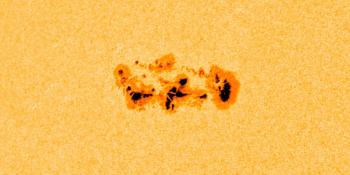
Complex sunspot region 4366

CME impact! S4 solar radiation storm

X1.9 solar flare with earth-directed CME
Nejnovější zprávy na fóru
Podpora SpaceWeatherLive.com!
Mnoho lidí navštěvuje SpaceWeatherLive, aby sledovali sluneční aktivitu nebo pokud je šance spatřit polární záři, ale s větší návštěvností přicházejí i vyšší náklady na udržování serverů online. Pokud se vám SpaceWeatherLive líbí a chcete projekt podpořit, můžete si zvolit předplatné pro web bez reklam nebo zvážit darování. S vaší pomocí můžeme SpaceWeatherLive udržet online!



Fakta o počasí ve vesmíru
| Poslední X-záblesk | 04. 02. 2026 | X4.21 |
| Poslední M-záblesk | 25. 02. 2026 | M2.4 |
| Poslední geomagnetická bouře | 03. 03. 2026 | Kp5 (G1) |
| Dny bez skvrn | |
|---|---|
| Posledních 365 dnů | 3 dnů |
| 2026 | 3 dnů (4%) |
| Poslední den bez skvrn | 24. 02. 2026 |
| Průměrný měsíční počet slunečních skvrn | |
|---|---|
| února 2026 | 78.2 -34.3 |
| března 2026 | 78.5 +0.3 |
| Posledních 30 dnů | 54.3 -74.5 |