Prohlížíte si archiv středa 12. února 2014
Denní bulletin o sluneční a geomagnetické aktivitě ze SIDC
Vydáno: 2014 Feb 12 1253 UTC
SIDC Předpověď
Sluneční erupce
Active (M-class flares expected, probability >=50%)
Geomagnetismus
Quiet (A<20 and K<4)
Sluneční protony
Warning condition (activity levels expected to increase, but no numeric forecast given)
| 10cm tok | Ap | |
|---|---|---|
| 12 Feb 2014 | 172 | 012 |
| 13 Feb 2014 | 176 | 009 |
| 14 Feb 2014 | 178 | 010 |
Bulletin
The solar flaring activity is increasing during past 24 hours with majority of activity originating from the Catania sunspot group 36 (NOAA AR 1974). The strongest of four reported M-class flares was observed this morning. The M3.7 flare peaked at 04:25 UT on February 12 and was associated with an EIT wave, coronal dimming and full halo CME first seen in the SOHO LASCO C2 field of view at 05:48 UT. From the currently available data we conclude that the CME is Earth directed. The impulsive M1.7 flare which peaked at 03:31 UT on February 11 was accompanied by an EIT wave, coronal dimmings and type II radio burst (indicating the shock speed of about 870 km/s). The flare originated from the Catania sunspot group 36 (NOAA AR 1974) currently situated at the center of the solar disc. The full halo CME associated with this flare was first seen in the SOHO LASCO C2 field of view at 04:12 UT. The expected arrival of this halo CME is late February 16. We do not expect strongly disturbed geomagnetic conditions (K index maximum 4) due to its faint structure and slow speed of 300 km/s (as reported by the CACTUS software). A partial halo CME detected in the SOHO/LASCO C2 field of view at 09:24 UT on February 11 had angular width of about 200 degrees, and speed around 320 km/s (as reported by the CACTUS software). The CME was associated with an eruption of a filament situated between the Catania sunspot group 35 (NOAA AR 1973) and newly emerged, unnumbered active region situated on the west from the Catania sunspot group 35. The eruption was accompanied by coronal dimmings and a post-eruption arcade observed by SDO/AIA. The bulk of the CME mass was directed northward of the Sun-Earth line, so we expect the arrival of only a CME-driven shock at the Earth, probably on February 16. It may result in active to minor storm geomagnetic conditions. A partial halo CME detected by SOHO/LASCO C2 field of view at 14:00 UT on February11 was associated with the flare at about W120 as seen from the Earth. This was a back side event and it will not arrive at the Earth. The M1.8 flare observed on February 11, originated from the Catania sunspot group 36 (NOAA AR 1974). The flare peaked at 16:51 UT on February 11 was accompanied by an EIT wave and small coronal dimming. The currently available data show the possibly associated partial halo CME first seen in the SOHO LASCO C2 field of view at 18:00 UT. The CME might be Earth directed. A full halo CME detected by SOHO/LASCO on February 11, had first appeared in the LASCO C2 field of view at 19:24 UT. The CME propagated with the speed of about 500 km/s (as reported by the CACTUS software) was most probably associated with the flare at the back side of the Sun, as seen from the Earth. Since this was a back side event it will not arrive at the Earth. The Catania sunspot group 36 (NOAA AR 1974) is growing fast and currently has beta-gamma-delta configuration of its photospheric magnetic field. Therefore, we expect C-class and M-class flares, and possibly also an isolated X-class flare. Due to position of the Catania sunspot group 36 (NOAA AR 1974), at center of the solar disc, a major CME from this active region may lead to a proton event, so we issue the warning condition for a proton event. Earth is currently inside a slow solar wind with the speed of about 450 km/s. The interplanetary magnetic field is stable with the magnitude of 5 nT. We expect quiet geomagnetic conditions in the coming hours.
Dnešní odhadovaný mezinárodní počet slunečních skvrn (ISN): 117, na základě 15 stanic.Solární indexy za 11 Feb 2014
| Wolfovo číslo Catania | /// |
| 10cm sluneční tok | 172 |
| AK Chambon La Forêt | 016 |
| AK Wingst | 006 |
| Odhadovaný Ap | 006 |
| Odhadovaný mezinárodní počet slunečních skvrn | 116 - Na základě 14 stanic |
Souhrn významných událostí
| Den | Začátek | Max | Konec | Místo | Síla | OP | 10cm | Catania/NOAA | Typy rádiových záblesků |
|---|---|---|---|---|---|---|---|---|---|
| 11 | 1634 | 1651 | 1710 | ---- | M1.8 | 36/1974 | |||
| 12 | 0352 | 0425 | 0438 | S12W02 | M3.7 | 2N | 36/1974 | ||
| 12 | 0654 | 0658 | 0704 | ---- | M2.3 | 36/1974 |
Poskytuje Centrum pro analýzu dat o solárních vlivech© - SIDC - Zpracováno SpaceWeatherLive
Všechny časy v UTC
<< Přejít na stránku s denním přehledem
Poslední zprávy

X1.5 solar flare

M2.7 solar flare, CME arrival possible
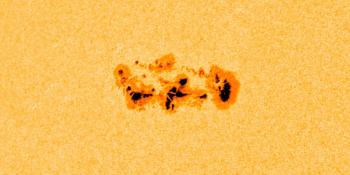
Complex sunspot region 4366
Nejnovější zprávy na fóru
Podpora SpaceWeatherLive.com!
Mnoho lidí navštěvuje SpaceWeatherLive, aby sledovali sluneční aktivitu nebo pokud je šance spatřit polární záři, ale s větší návštěvností přicházejí i vyšší náklady na udržování serverů online. Pokud se vám SpaceWeatherLive líbí a chcete projekt podpořit, můžete si zvolit předplatné pro web bez reklam nebo zvážit darování. S vaší pomocí můžeme SpaceWeatherLive udržet online!



Fakta o počasí ve vesmíru
| Poslední X-záblesk | 30. 03. 2026 | X1.5 |
| Poslední M-záblesk | 03. 04. 2026 | M1.3 |
| Poslední geomagnetická bouře | 02. 04. 2026 | Kp6- (G2) |
| Dny bez skvrn | |
|---|---|
| Posledních 365 dnů | 3 dnů |
| 2026 | 3 dnů (3%) |
| Poslední den bez skvrn | 24. 02. 2026 |
| Průměrný měsíční počet slunečních skvrn | |
|---|---|
| března 2026 | 85.9 +7.7 |
| dubna 2026 | 141 +55.1 |
| Posledních 30 dnů | 94.6 +27 |