Prohlížíte si archiv středa 7. března 2018
Denní bulletin o sluneční a geomagnetické aktivitě ze SIDC
Vydáno: 2018 Mar 07 1230 UTC
SIDC Předpověď
Sluneční erupce
Quiet conditions (<50% probability of C-class flares)
Geomagnetismus
Quiet (A<20 and K<4)
Sluneční protony
Quiet
| 10cm tok | Ap | |
|---|---|---|
| 07 Mar 2018 | 068 | 010 |
| 08 Mar 2018 | 068 | 017 |
| 09 Mar 2018 | 068 | 024 |
Bulletin
Solar X ray flux remained below B level and with no spotted regions on the visible disk chances for any flare occurrences remain very low.
SDO/AIA 304 images show the eruption after 16:00 UT of a filament stretching from around S18E35 to the disk centre. SoHO/LASCO coronagraph images do not display any identifiable CME signature, but an associated narrow (40 degree width) CME is visible in Stereo A COR2 images from around midnight (propagating to the west as seen from Stereo A location). The location of the erupting filament together with the direction as seen by Stereo indicate that Earth may well be on the propagation path of the ejecta. Given the slow speed (400 km/s as measured from the Stereo A COR2 images) and the faint nature of the event, possible impacts on Earth are expected to be fairly insignificant, and should not be expected before noon March 10.
Proton flux levels were at background values and are expected to remain so.
Solar wind showed some enhancement with speed increasing to just over 430 km/s. Before the increase in speed, total magnetic field reached close to 7nT, afterwards recovering to around a nominal 4nT. Bz was variable and the magnetic field phi angle made an excursion away from the positive sector to which it afterwards restored. All of this seems indicative that this was a minor and short lived influence of the negative polarity coronal hole just south of the equator. Late today or early tomorrow we may expect some renewed minor increase of solar wind conditions due to the extension of the northern polar coronal hole. Later, late on March 9, there is a small possibility of minor perturbations associated to the possible passage of the ejecta of March 6. The possible passage of the ejecta of today March 7, should not be expected before noon March 10 in the wake of the coronal hole high speed stream. Also those impacts are expected to be fairly minor, if identifiable at all.
Geomagnetic conditions were quiet (both local K Dourbes and NOAA Kp 0-2). Geomagnetic conditions are initially expected to be quiet to unsettled. From noon March 9 onwards an increase to active conditions can not be excluded should any of the mentioned ejecta arrive at Earth and carry a distinctive southward directed magnetic field.
Dnešní odhadovaný mezinárodní počet slunečních skvrn (ISN): 000, na základě 06 stanic.Solární indexy za 06 Mar 2018
| Wolfovo číslo Catania | /// |
| 10cm sluneční tok | 068 |
| AK Chambon La Forêt | 006 |
| AK Wingst | 006 |
| Odhadovaný Ap | 004 |
| Odhadovaný mezinárodní počet slunečních skvrn | 000 - Na základě 23 stanic |
Souhrn významných událostí
| Den | Začátek | Max | Konec | Místo | Síla | OP | 10cm | Catania/NOAA | Typy rádiových záblesků | |
|---|---|---|---|---|---|---|---|---|---|---|
| Žádný | ||||||||||
Poskytuje Centrum pro analýzu dat o solárních vlivech© - SIDC - Zpracováno SpaceWeatherLive
Všechny časy v UTC
<< Přejít na stránku s denním přehledem
Poslední zprávy
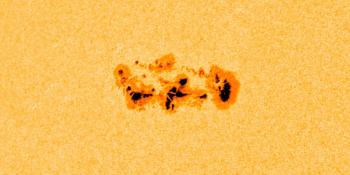
Complex sunspot region 4366

CME impact! S4 solar radiation storm

X1.9 solar flare with earth-directed CME
Nejnovější zprávy na fóru
Podpora SpaceWeatherLive.com!
Mnoho lidí navštěvuje SpaceWeatherLive, aby sledovali sluneční aktivitu nebo pokud je šance spatřit polární záři, ale s větší návštěvností přicházejí i vyšší náklady na udržování serverů online. Pokud se vám SpaceWeatherLive líbí a chcete projekt podpořit, můžete si zvolit předplatné pro web bez reklam nebo zvážit darování. S vaší pomocí můžeme SpaceWeatherLive udržet online!



Fakta o počasí ve vesmíru
| Poslední X-záblesk | 04. 02. 2026 | X4.21 |
| Poslední M-záblesk | 25. 02. 2026 | M2.4 |
| Poslední geomagnetická bouře | 22. 02. 2026 | Kp5+ (G1) |
| Dny bez skvrn | |
|---|---|
| Posledních 365 dnů | 3 dnů |
| 2026 | 3 dnů (5%) |
| Poslední den bez skvrn | 24. 02. 2026 |
| Průměrný měsíční počet slunečních skvrn | |
|---|---|
| ledna 2026 | 112.6 -11.4 |
| února 2026 | 75.5 -37.1 |
| Posledních 30 dnů | 79.9 -40.9 |