Prohlížíte si archiv sobota 22. dubna 2023
Denní bulletin o sluneční a geomagnetické aktivitě ze SIDC
Vydáno: 2023 Apr 22 1235 UTC
SIDC Předpověď
Sluneční erupce
C-class flares expected, (probability >=50%)
Geomagnetismus
Active conditions expected (A>=20 or K=4)
Sluneční protony
Warning condition (activity levels expected to increase, but no numeric forecast given)
| 10cm tok | Ap | |
|---|---|---|
| 22 Apr 2023 | 148 | 010 |
| 23 Apr 2023 | 148 | 018 |
| 24 Apr 2023 | 148 | 065 |
Bulletin
Solar flaring activity reached moderate levels in the past 24 hours with an isolated low M-class flaring from NOAA AR 3283 (beta), namely a long duration M1.7 flare, start time 17:44 UTC, peak time 18:12 UTC, end time 18:37 UTC on April 21st. This flaring activity was driven by a nearby filament eruption and no other significant flaring was observed from NOAA AR 3283. NOAA AR 3279 (alpha) was also triggered by the magnetic field reconfiguration during the previous eruptions and has produced multiple C-class flaring, the most significant one being a C4.8 flare, peak time 01:48 UTC on April 22nd. NOAA AR 3285 (beta) was numbered and has produced isolated low C-class flaring. NOAA AR 3282 (beta-gamma) remains the largest and most complex region on the visible solar disc, but has been quiet and inactive. The remaining active regions are relatively simple and have shown no significant flaring. The solar flaring activity is expected to be at low levels over the next 24 hours with chances for further isolated M-class flaring.
A fast full halo coronal mass ejection (CME) was first observed in the LASCO/C2 chronograph imagery at 18:12 UTC on April 21st. The CME was driven by a long-duration M-class flaring from NOAA AR 3283 and a related filament eruption on the central meridian close to the disc centre. The estimated projected velocity of the CME is close to 1100 km/s and current analysis suggests an estimated arrival at Earth late April 23rd to early April 24th. The nature and location of the CME suggest strong impact on Earth. No other Earth-directed CMEs have been detected in the available coronagraph imagery.
Over the past 24 hours the greater than 10 MeV GOES proton flux was at nominal levels and is expected to register gradual enhancements over the next 24 hours with the possibility of reaching minor radiation storm levels. The greater than 2 MeV electron flux has been below the 1000 pfu threshold and is expected to remain so. The 24h electron fluence was at nominal levels and is expected to remain so over the next 24 hours.
Over the past 24 hours the solar wind parameters (ACE and DSCOVR) were mainly at background slow solar wind levels with an indication of a sector boundary crossing in the evening of April 21st. The solar wind velocity varied around 400 km/s and is currently reaching 450 km/s. The interplanetary magnetic field was weak with a maximum value of 6.6 nT and a minimum Bz of -6.5 nT. The B field was switching orientation between the positive and the negative sector (directed away from and towards the Sun). The solar wind conditions are expected to remain mostly at background slow solar wind regime over the next 24 hours with possible slight enhancements later today pending a mild high speed stream arrival from a narrow patchy negative polarity coronal hole, which crossed the central meridian on April 18th. Strong solar wind disturbances are expected on April 24th with the anticipated arrival of the full halo CME related to the M1.7-flaring from NOAA 3283 (beta) and a nearby filament eruption around 18:00 UTC on April 21st. The CME-related shock might arrive late on April 23rd.
The geomagnetic conditions over the past 24 hours were globally quiet to unsettled and locally registered an isolated active period over Belgium in the interval of 21-22 UTC after prolonged periods of negative Bz. Quiet to unsettled geomagnetic conditions are expected over the next 24 hours with probable active periods pending an anticipated mild high speed stream arrival. Moderate to major geomagnetic storms might be expected in the night of April 23rd with chances for severe storm levels on April 24th due to an expected ICME arrival.
Dnešní odhadovaný mezinárodní počet slunečních skvrn (ISN): 109, na základě 15 stanic.Solární indexy za 21 Apr 2023
| Wolfovo číslo Catania | 136 |
| 10cm sluneční tok | 151 |
| AK Chambon La Forêt | 014 |
| AK Wingst | /// |
| Odhadovaný Ap | 012 |
| Odhadovaný mezinárodní počet slunečních skvrn | 110 - Na základě 19 stanic |
Souhrn významných událostí
| Den | Začátek | Max | Konec | Místo | Síla | OP | 10cm | Catania/NOAA | Typy rádiových záblesků |
|---|---|---|---|---|---|---|---|---|---|
| 21 | 1744 | 1812 | 1844 | S22W11 | M1.7 | 2N | 110 | 61/3283 | II/3V/3IV/2 |
Poskytuje Centrum pro analýzu dat o solárních vlivech© - SIDC - Zpracováno SpaceWeatherLive
Všechny časy v UTC
<< Přejít na stránku s denním přehledem
Poslední zprávy
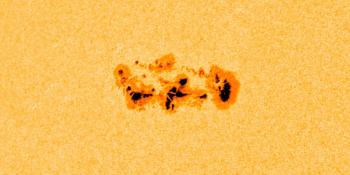
Complex sunspot region 4366

CME impact! S4 solar radiation storm

X1.9 solar flare with earth-directed CME
Nejnovější zprávy na fóru
Podpora SpaceWeatherLive.com!
Mnoho lidí navštěvuje SpaceWeatherLive, aby sledovali sluneční aktivitu nebo pokud je šance spatřit polární záři, ale s větší návštěvností přicházejí i vyšší náklady na udržování serverů online. Pokud se vám SpaceWeatherLive líbí a chcete projekt podpořit, můžete si zvolit předplatné pro web bez reklam nebo zvážit darování. S vaší pomocí můžeme SpaceWeatherLive udržet online!



Fakta o počasí ve vesmíru
| Poslední X-záblesk | 04. 02. 2026 | X4.21 |
| Poslední M-záblesk | 25. 02. 2026 | M2.4 |
| Poslední geomagnetická bouře | 22. 02. 2026 | Kp5+ (G1) |
| Dny bez skvrn | |
|---|---|
| Posledních 365 dnů | 3 dnů |
| 2026 | 3 dnů (5%) |
| Poslední den bez skvrn | 24. 02. 2026 |
| Průměrný měsíční počet slunečních skvrn | |
|---|---|
| ledna 2026 | 112.6 -11.4 |
| Posledních 30 dnů | 72.7 -45.8 |