Prohlížíte si archiv středa 18. března 2026
Denní bulletin o sluneční a geomagnetické aktivitě ze SIDC
Vydáno: 2026 Mar 18 1236 UTC
SIDC Předpověď
Sluneční erupce
C-class flares expected, (probability >=50%)
Geomagnetismus
Quiet (A<20 and K<4)
Sluneční protony
Quiet
| 10cm tok | Ap | |
|---|---|---|
| 18 Mar 2026 | 113 | 010 |
| 19 Mar 2026 | 115 | 024 |
| 20 Mar 2026 | 117 | 041 |
Slunečně aktivní oblasti a vzplanutí
Solar flaring activity was moderate over the past 24 hours. The largest flare was an M2.7 flare (SIDC Flare 7228) peaking on March 18 at 08:42 UTC, which was produced by SIDC Sunspot Group 820 (NOAA Active Region 4392). This region is the largest on disk, with Beta-Gamma magnetic configuration. There are currently 5 numbered regions on the disk. SIDC Sunspot Group 824 emerged in the southeast quadrant and was numbered over the period. Sunspot Group 823 (NOAA Active Region 4396) decayed to a plage region. SIDC Sunspot Group 819 (NOAA Active Region 4393) also produced C-class flaring activity while the other regions are simple and were mostly quiet. Solar flaring activity is expected to be low over the next 24 hours, with C-class flares expected and further isolated M-class flares possible.
Vyhazování koronální hmoty
The filament eruption reported yesterday, originating from around S05W10, is visible as a faint Coronal Mass Ejection (CME) E in STEREO-A COR-2 coronagraph data and may have a glancing blow at Earth from late on March 20. The M2.7 flare (SIDC Flare 7228) was also associated with a large dimming, EUV wave and Type II radio burst. An associated CME was observed in STEREO A COR2 at 09:23 UTC on March 18 and to the west in SOHO/LASCO-C2 data rom 10:36 UTC on March 18, after a data gap. Analysis of this CME is ongoing.
Koronální díra
The southern midlatitude extension of the large positive polarity coronal hole (SIDC Coronal Hole 154) continues to cross the central meridian. A northern midlatitude extension to a large negative polarity Coronal hole (SIDC Coronal Hole 147) has also begun to transit the central meridian.
Solární bouře
Over the past 24 hours, the solar wind parameters gradually returned to slow solar wind conditions. The solar wind speed decreased from 500 kms to around 400 km/s. The total magnetic field was stable around 5 nT. Bz had a minimum of -4 nT. The interplanetary magnetic field phi angle was mostly in the positive sector (directed towards the Sun). Slow solar wind conditions are expected for March 18 and enhanced conditions are expected from late on March 19 due to an anticipated CME arrival (SIDC CME 639) combined with a possible sector boundary crossing.
Geomagnetismus
Over the past 24 hours, the geomagnetic conditions were at quiet levels globally and locally (NOAA KP 3 and K BEL 3). Quiet conditions are expected on March 18 and Minor to moderate storm conditions are possible from late on March 19 due to the possible ICME arrival and influence from the sector boundary crossing.
Úrovně protonového toku
The greater than 10 MeV proton flux was below the 10 pfu threshold over the past 24 hours. It is expected to remain below this threshold level over the next 24 hours.
Elektronové toky na geostacionární oběžné dráze
The greater than 2 MeV electron flux, as measured by GOES-18 and GOES-19 satellites, exceeded the 1000 pfu threshold and reached a maximum of 2232 pfu. The greater than 2 MeV electron flux is expected to again exceed the 1000 pfu threshold over the next 24 hours. The electron fluence was at moderate levels and is expected to be at moderate levels for the next 24 hours.
Dnešní odhadovaný mezinárodní počet slunečních skvrn (ISN): 068, na základě 22 stanic.Solární indexy za 17 Mar 2026
| Wolfovo číslo Catania | /// |
| 10cm sluneční tok | 111 |
| AK Chambon La Forêt | 007 |
| AK Wingst | 004 |
| Odhadovaný Ap | 003 |
| Odhadovaný mezinárodní počet slunečních skvrn | 066 - Na základě 21 stanic |
Souhrn významných událostí
| Den | Začátek | Max | Konec | Místo | Síla | OP | 10cm | Catania/NOAA | Typy rádiových záblesků |
|---|---|---|---|---|---|---|---|---|---|
| 18 | 0826 | 0842 | 0857 | ---- | M2.7 | 54/4392 | III/2 |
Poskytuje Centrum pro analýzu dat o solárních vlivech© - SIDC - Zpracováno SpaceWeatherLive
Všechny časy v UTC
<< Přejít na stránku s denním přehledem
Poslední zprávy
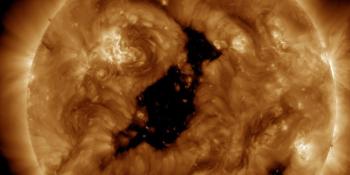
Coronal hole faces Earth

X1.5 solar flare

M2.7 solar flare, CME arrival possible
Nejnovější zprávy na fóru
Podpora SpaceWeatherLive.com!
Mnoho lidí navštěvuje SpaceWeatherLive, aby sledovali sluneční aktivitu nebo pokud je šance spatřit polární záři, ale s větší návštěvností přicházejí i vyšší náklady na udržování serverů online. Pokud se vám SpaceWeatherLive líbí a chcete projekt podpořit, můžete si zvolit předplatné pro web bez reklam nebo zvážit darování. S vaší pomocí můžeme SpaceWeatherLive udržet online!



Fakta o počasí ve vesmíru
| Poslední X-záblesk | 24. 04. 2026 | X2.5 |
| Poslední M-záblesk | 22. 05. 2026 | M2.3 |
| Poslední geomagnetická bouře | 16. 05. 2026 | Kp6- (G2) |
| Dny bez skvrn | |
|---|---|
| Posledních 365 dnů | 3 dnů |
| 2026 | 3 dnů (2%) |
| Poslední den bez skvrn | 24. 02. 2026 |
| Průměrný měsíční počet slunečních skvrn | |
|---|---|
| dubna 2026 | 79.3 -6.6 |
| května 2026 | 91.5 +12.2 |
| Posledních 30 dnů | 96.4 +4.5 |