Archiv von Dienstag, 2 September 2014 anzeigen
Tägliches Bulletin zur solaren und geomagnetischen Aktivität des SIDC
Ausgestellt: 2014 Sep 02 1246 UTC
Vorhersage des SIDC
Sonneneruptionen
Active (M-class flares expected, probability >=50%)
Geomagnetismus
Quiet (A<20 and K<4)
Sonnenprotonen
Warning condition (activity levels expected to increase, but no numeric forecast given)
| 10cm Fluss | Ap | |
|---|---|---|
| 02 Sep 2014 | 129 | 013 |
| 03 Sep 2014 | 132 | 011 |
| 04 Sep 2014 | 136 | 005 |
Bulletin
The strongest flare of the past 24 hours was the C2.6 flare peaking at 00:59 UT today in the Catania sunspot group 40 (NOAA AR 2152). This active region is growing while maintaining the beta-gamma configuration of its photospheric magnetic field. Another active region will appear during the next 24 hours from behind the east-south-east limb. It was the source of several powerful behind-the-limb CMEs yesterday. The solar background X-ray flux increased to above C1 level due to this active region. We expect flaring activity up to the M-level, primarily from the east-south-east limb and perhaps also from the Catania sunspot group 40. The long filament in the northern hemisphere is finishing its crossing of the solar central meridian. It is rising slowly, so its eruption looks imminent now. The resulting CME may be directed towards the Earth. Two partial halo CMEs were detected late yesterday evening. The first halo CME appeared at 21:36 UT in the SOHO/LASCO C2 field of view above the north- west limb, and had angular width around 165 degrees. The position of the CME source region is not entirely clear due to the data gap in the STEREO data, but the absence of CME-associated signatures in the SDO/AIA data (in the north-west quadrant around this time) indicates that the CME originated from the far side of the Sun. The second partial halo CME first appeared at 22:24 UT above the east limb and had angular width around 160 degrees. STEREO B EUVI data indicate that it was associated with a flare (probably an M-class flare) peaking at 22:15 UT in the active region just behind the east-south-east limb (as seen from the Earth). No geomagnetic consequences of these two CMEs are expected. However, the second partial halo CME (perhaps together with yesterday's full halo CME) is most probably associated with the slow rise of the proton flux measured by GOES and ACE since late yesterday evening. We issue a warning condition for a proton event. The Earth is currently inside a slow (around 410 km/s) solar wind flow with average (around 5 nT) interplanetary magnetic field magnitude. We expect quiet geomagnetic conditions.
Die heute international geschätzte Sonnenfleckenanzahl (ISN): 079, basierend auf 10 Stationen.Solarindizes für den 01 Sep 2014
| Wolf-Zahl Catania | 125 |
| 10cm Solarflux | 127 |
| AK Chambon La Forêt | 014 |
| AK Wingst | 011 |
| Geschätzer Ap-Wert | 013 |
| Geschätzte internationale Sonnenfleckenzahl | 068 - Basierend auf 22 Stationen |
Zusammenfassung auffälliger Ereignisse
| Tag | Start | Max | Ende | Loc | Stärke | OP | 10cm | Catania/NOAA | Radioburst-Typen | |
|---|---|---|---|---|---|---|---|---|---|---|
| Keine | ||||||||||
Zur Verfügung gestellt vom Solar Influences Data Analysis Center© - SIDC - Verarbeitet von SpaceWeatherLive
Alle Zeiten in UTC
Neueste Nachrichten

X1.5 solar flare

M2.7 solar flare, CME arrival possible
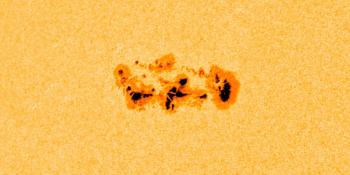
Complex sunspot region 4366
Neue Nachrichten im Forum
Unterstützen Sie SpaceWeatherLive!
Viele Menschen nutzen SpaceWeatherLive, um die Sonnenaktivität zu verfolgen oder um zu schauen, ob es eine Chance gibt Polarlichter, zu sehen. Mit zunehmendem Datenverkehr steigen jedoch die Kosten für die Serververfügbarkeit. Wenn Ihnen SpaceWeatherLive gefällt und Sie das Projekt unterstützen möchten, können Sie ein Abonnement für eine werbefreie Website abschließen oder eine Spende tätigen. Mit Ihrer Hilfe können wir SpaceWeatherLive online halten!



Weltraumwetter-Fakten
| Letzte Klasse X-Eruption | 30/03/2026 | X1.5 |
| Letzte Klasse M-Eruption | 09/04/2026 | M1.0 |
| Letzter geomagnetischer Sturm | 20/04/2026 | Kp5 (G1) |
| Tage ohne Flecken | |
|---|---|
| Letzte 365 Tage | 3 Tage |
| 2026 | 3 Tage (3%) |
| Letzter fleckenlose Tag | 24/02/2026 |
| Monatliche mittlere Sonnenfleckenzahl | |
|---|---|
| März 2026 | 85.9 +7.7 |
| April 2026 | 78.7 -7.2 |
| Letzte 30 Tage | 91.5 +25.1 |