Viendo archivo del miércoles, 16 enero 2002
Informe actividad solar
Any mentioned solar flare in this report has a scaling factor applied by the Space Weather Prediction Center (SWPC). Because of the SWPC scaling factor, solar flares are reported as 42% smaller than for the science quality data. The scaling factor has been removed from our archived solar flare data to reflect the true physical units.
Informe de actividad Solar-Geofísica 2002 Jan 16 2200 UTCPreparado por NOAA © SWPC y procesado por SpaceWeatherLive.com
Informe conjunto USAF/NOAA de actividad Solar y Geofísica
SDF Número 016 Publicado el 2200Z a las 16 Jan 2002IA. Análisis de regiones solares activas y de actividad desde 15-2100Z hasta 16-2100Z Solar activity remained at moderate levels. Region 9775
(S06W86) produced an M1/Sf flare at 16/1013 UTC as well as
occasional C-class subflares. No significant changes were observed
in this region as it began to cross the west limb. Region 9773
(N16W93) produced an isolated C-class subflare as it crossed the
west limb early in the period. Region 9782 (N06E05) showed a minor
increase in area, but appeared to simplify due to the loss of a
delta magnetic configuration in the southern portion of its leader
spots. New Region 9786 (S26E07) was numbered.
IB. Pronóstico de la actividad solar
Solar activity is expected to be at
low to moderate levels. An isolated M-class flare will be possible
from Region 9775 as it continues to rotate out of view. There will
also be a chance for an M-class flare from Region 9782.
IIA. Resumen de la actividad geofísica 15-2100Z a 16-2100Z
Geomagnetic field activity was at mostly quiet levels. The greater
than 10 MeV proton event that began at 15/1435 UTC ended at 16/1205
UTC. The maximum for this event was 15 PFU at 15/2000 UTC. The
greater than 2 MeV electron flux briefly reached high levels during
the latter half of the period.
IIB. Pronóstico de la actividad geofísica
Geomagnetic field activity is
expected to be at quiet to unsettled levels. There will be a slight
chance for a proton flare during the period. The greater than 2 MeV
electron flux is expected to decrease to normal to moderate levels.
III. Probabilidades del evento 17 Jan a 19 Jan
| Clase M | 70% | 60% | 60% |
| Clase X | 10% | 10% | 10% |
| Protón | 10% | 10% | 10% |
| PCAF | yellow | ||
IV. Penticton 10.7cm flujo
  Observado       16 Jan 216
  Previsto   17 Jan-19 Jan  215/220/220
  Media de 90 Días        16 Jan 224
V. Índices Geomagnéticos A
  Observado Afr/Ap 15 Jan  004/006
  Estimado     Afr/Ap 16 Jan  005/005
  Previsto    Afr/Ap 17 Jan-19 Jan  008/010-008/008-008/008
VI. Probabilidades de Actividad Geomagnética 17 Jan a 19 Jan
| A. Latitudes Medias | |||
|---|---|---|---|
| Activo | 15% | 15% | 15% |
| Tormenta Menor | 05% | 05% | 05% |
| Tormenta Mayor-Severa | 01% | 01% | 01% |
| B. Latitudes Altas | |||
|---|---|---|---|
| Activo | 20% | 20% | 20% |
| Tormenta Menor | 10% | 10% | 10% |
| Tormenta Mayor-Severa | 01% | 01% | 01% |
All times in UTC
< < Ir a la visión general diaria
Últimas noticias
domingo, 1 febrero 2026
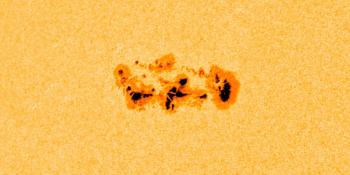
Complex sunspot region 4366

lunes, 19 enero 2026
CME impact! S4 solar radiation storm

domingo, 18 enero 2026
X1.9 solar flare with earth-directed CME
Últimos mensajes del foro
What, no CH/HSS thread? 40Incoming & Unnumbered Active Regions 165AR4374 19Current Farside Activity 382Filaments and prominences 489
Más temasApoye a SpaceWeatherLive.com!
A lot of people come to SpaceWeatherLive to follow the Solar activity or if there is a chance to see the aurora, but with more traffic comes higher costs to keep the servers online. If you like SpaceWeatherLive and want to support the project you can choose a subscription for an ad-free site or consider a donation. With your help we can keep SpaceWeatherLive online!



Hechos clima espacial
| Último evento clase X | 04/02/2026 | X4.21 |
| Último evento clase M | 16/02/2026 | M2.4 |
| Últimas tormentas geomagnéticas | 15/02/2026 | Kp5+ (G1) |
| Días sin manchas | |
|---|---|
| Último día sin manchas | 08/06/2022 |
| Promedio de manchas solares mensuales | |
|---|---|
| enero 2026 | 112.6 -11.4 |
| febrero 2026 | 109 -3.6 |
| Last 30 days | 126.1 +25.9 |