Viendo archivo del martes, 1 marzo 2011
Informe actividad solar
Any mentioned solar flare in this report has a scaling factor applied by the Space Weather Prediction Center (SWPC). Because of the SWPC scaling factor, solar flares are reported as 42% smaller than for the science quality data. The scaling factor has been removed from our archived solar flare data to reflect the true physical units.
Informe de actividad Solar-Geofísica 2011 Mar 01 2200 UTCPreparado por NOAA © SWPC y procesado por SpaceWeatherLive.com
Informe conjunto USAF/NOAA de actividad Solar y Geofísica
SDF Número 060 Publicado el 2200Z a las 01 Mar 2011IA. Análisis de regiones solares activas y de actividad desde 28-2100Z hasta 01-2100Z Solar activity has been low. Occasional C-class x-ray
flares occurred throughout the period, the largest of which was a
C6/Sf at 01/0413Z from Region 1164 (N25E19). This region grew in
size and magnetic complexity, ending the period as an Ekc type with
Beta-Gamma-Delta magnetic characteristics. The remaining regions
were quiescent.
IB. Pronóstico de la actividad solar
Solar activity is expected to be low,
with an increasing chance for an M-class x-ray flare from Region
1164.
IIA. Resumen de la actividad geofísica 28-2100Z a 01-2100Z
The geomagnetic field ranged from quiet to minor storm activity
levels during the period. Solar wind speed at the ACE spacecraft
began to rise from 310 km/s at approximately 01/0500Z and ended the
period near 500 km/s. The Bz component of the interplanetary
magnetic field turned south coincident with the increase in solar
wind speed, temperature, and density. These events suggest the
arrival of a corotating interaction region between 01/05-12Z in
advance of a coronal hole high speed stream. Bz averaged -10 nT
for several hours, bringing two periods of minor storm levels at
middle latitudes.
IIB. Pronóstico de la actividad geofísica
The geomagnetic field is
expected to be predominantly unsettled with a chance for active
conditions over the next three days (2-4 March). A slight chance
for isolated minor storm periods exists on days one and two (2-3
March).
III. Probabilidades del evento 02 Mar a 04 Mar
| Clase M | 35% | 35% | 35% |
| Clase X | 05% | 05% | 05% |
| Protón | 05% | 05% | 05% |
| PCAF | Green | ||
IV. Penticton 10.7cm flujo
  Observado       01 Mar 111
  Previsto   02 Mar-04 Mar  110/110/110
  Media de 90 Días        01 Mar 088
V. Índices Geomagnéticos A
  Observado Afr/Ap 28 Feb  002/003
  Estimado     Afr/Ap 01 Mar  019/025
  Previsto    Afr/Ap 02 Mar-04 Mar  015/015-015/015-012/012
VI. Probabilidades de Actividad Geomagnética 02 Mar a 04 Mar
| A. Latitudes Medias | |||
|---|---|---|---|
| Activo | 30% | 30% | 20% |
| Tormenta Menor | 15% | 15% | 10% |
| Tormenta Mayor-Severa | 01% | 01% | 01% |
| B. Latitudes Altas | |||
|---|---|---|---|
| Activo | 40% | 40% | 30% |
| Tormenta Menor | 20% | 20% | 15% |
| Tormenta Mayor-Severa | 05% | 05% | 05% |
All times in UTC
< < Ir a la visión general diaria
Últimas noticias
domingo, 1 febrero 2026
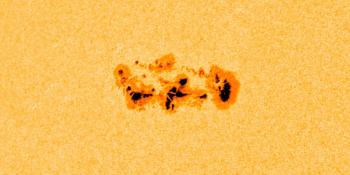
Complex sunspot region 4366

lunes, 19 enero 2026
CME impact! S4 solar radiation storm

domingo, 18 enero 2026
X1.9 solar flare with earth-directed CME
Últimos mensajes del foro
Do the high-resolution sunspot counts point to more complex sunspots? 75AR 4384 1Unexplained proton activity 114CME March 1 26AR4381 6
Más temasApoye a SpaceWeatherLive.com!
A lot of people come to SpaceWeatherLive to follow the Solar activity or if there is a chance to see the aurora, but with more traffic comes higher costs to keep the servers online. If you like SpaceWeatherLive and want to support the project you can choose a subscription for an ad-free site or consider a donation. With your help we can keep SpaceWeatherLive online!



Hechos clima espacial
| Último evento clase X | 04/02/2026 | X4.21 |
| Último evento clase M | 25/02/2026 | M2.4 |
| Últimas tormentas geomagnéticas | 03/03/2026 | Kp5 (G1) |
| Días sin manchas | |
|---|---|
| Last 365 days | 3 días |
| 2026 | 3 días (5%) |
| Último día sin manchas | 24/02/2026 |
| Promedio de manchas solares mensuales | |
|---|---|
| enero 2026 | 112.6 -11.4 |
| marzo 2026 | 77 -35.6 |
| Last 30 days | 63.9 -58.1 |