Viendo archivo del domingo, 15 marzo 2015
Daily bulletin on solar and geomagnetic activity from the SIDC
Emitido: 2015 Mar 15 1224 UTC
SIDC Forecast
Llamarada solar
Active (M-class flares expected, probability >=50%)
Geomagnetism
Quiet (A<20 and K<4)
Protones solares
Quiet
| 10cm flux | Ap | |
|---|---|---|
| 15 Mar 2015 | 116 | 008 |
| 16 Mar 2015 | 115 | 010 |
| 17 Mar 2015 | 115 | 010 |
Bulletin
Over the past 24 hours there were several C-class flares and 1 M-class flare which were produced by NOAA AR (Active Region) 2297, which is currently located at S15W25, and is classified as a Beta-Gamma-Delta region under the Mount Wilson magnetic classification system. The largest flare recorded over the past 24 hours, produced by AR 2297, was an M1.0 flare on 2015-Mar-15 peaking at 09:40UT. ARs 2297 and 2299, have shown little magnetic evolution with a small amount of flux emergence, which may lead to future eruptions. AR 2301, which emerged near disk center on 2015-Mar-14, has shown evidence of a small amount of flux emergence, but has remained small. A partial halo coronal mass ejection (CME) was reported by CACTus and first seen in LASCO/C2 images at 02:00UT, this CME was related to a C9.1 flare from NOAA AR 2297 peaking at 02:13UT, see below for details. There is a large filament located between S15W90 and S50W05, however this has remained, and appears, stable. The solar wind speed has decreased over the past 24 hours from 350 km/s to 300 km/s. The total magnetic field has remained roughly constant around 6 nT, and the Bz component has changed from positive (around +5 nT) to negative (around -3 nT) over the past 24 hours. Geomagnetic conditions ranged between Kp index 1-3 (NOAA) and local K index 1-3 (Dourbes) over the past 24 hours. A small shock front was observed by the ACE satellite at 21:00 UT on 2015-Mar-14. A partial halo coronal mass ejection (CME) was reported by CACTus and first seen in LASCO/C2 images at 02:00UT, produced by AR 2297. This CME was related to a C9.1 flare from NOAA 2297 peaking at 02:13UT. The CME had a plane of the sky speed of 712 km/s, and a width of 160 degrees. The bulk of the CME is directed away from Earth to the West, but a glancing blow cannot be ruled out based on current imagery. The CME is estimated to arrive at Earth on 16 March at 18:00UT (+/- 12 hours).
Today's estimated international sunspot number (ISN): 053, based on 06 stations.Solar indices for 14 Mar 2015
| Wolf number Catania | /// |
| 10cm solar flux | 116 |
| AK Chambon La Forêt | /// |
| AK Wingst | 006 |
| Estimated Ap | 006 |
| Estimated international sunspot number | 043 - Based on 15 stations |
Noticeable events summary
| Day | Begin | Max | Fin | Loc | Strength | OP | 10cm | Catania/NOAA | Radio burst types |
|---|---|---|---|---|---|---|---|---|---|
| 15 | 0936 | 0940 | 0946 | S20W24 | M1.0 | SN | 01/2297 |
Provided by the Solar Influences Data analysis Center© - SIDC - Processed by SpaceWeatherLive
All times in UTC
< < Ir a la visión general diaria
Últimas noticias

X1.5 solar flare

M2.7 solar flare, CME arrival possible
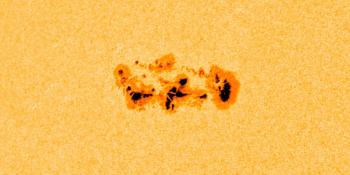
Complex sunspot region 4366
Últimos mensajes del foro
Apoye a SpaceWeatherLive.com!
A lot of people come to SpaceWeatherLive to follow the Solar activity or if there is a chance to see the aurora, but with more traffic comes higher costs to keep the servers online. If you like SpaceWeatherLive and want to support the project you can choose a subscription for an ad-free site or consider a donation. With your help we can keep SpaceWeatherLive online!



Hechos clima espacial
| Último evento clase X | 30/03/2026 | X1.5 |
| Último evento clase M | 04/04/2026 | M1.0 |
| Últimas tormentas geomagnéticas | 03/04/2026 | Kp7- (G3) |
| Días sin manchas | |
|---|---|
| Last 365 days | 3 días |
| 2026 | 3 días (3%) |
| Último día sin manchas | 24/02/2026 |
| Promedio de manchas solares mensuales | |
|---|---|
| marzo 2026 | 85.9 +7.7 |
| abril 2026 | 133.3 +47.4 |
| Last 30 days | 96.9 +35.1 |