Affichage des archives de mercredi, 22 janvier 2025
Bulletin quotidien sur l'activité solaire et géomagnétique du SIDC
Publié: 2025 Jan 22 1254 UTC
Prévisions SIDC
Éruptions solaires
M-class flares expected (probability >=50%)
Géomagnétisme
Quiet (A<20 and K<4)
Moniteur de Flux de Proton
Quiet
| Flux de 10 cm | Ap | |
|---|---|---|
| 22 Jan 2025 | 220 | 007 |
| 23 Jan 2025 | 219 | 026 |
| 24 Jan 2025 | 218 | 050 |
Régions solaires actives et éruptions solaires
Solar flaring activity was moderate over the past 24 hours, with few C-class flares and a M-class flare identified. The largest flare was a M1.3 flare peaking at 11:08 UTC on Jan 22, which was produced by SIDC Sunspot Group 346 (NOAA Active Region 3961). During the flare, the source region (SIDC 346) of the flare had beta-gamma configuration of its photospheric magnetic field. A total of 9 numbered sunspot groups were identified on the disk over the past 24 hours. SIDC Sunspot Groups 346, 347, 378, and 381 are the complex regions with their beta-gamma magnetic configurations. The solar flaring activity is expected to be at low to moderate levels over the next 24 hours with C-class flares expected, M-class flares probable, and a chance of X-class flares.
Éjection de masse coronale
Further analysis of the coronal mass ejections (CME) detected at 03:48 UTC on Jan 21 in SOHO/LASCO-C2 images, shows that it has a projected width of about 70 degree and a projected speed of about 800 km/s with the main propagation direction towards North. No corresponding on-disk source has been identified so it is likely to be backsided and will not influence the Earth. Another CME has been first observed in STEREO-A/SECCHI coronograph images at 10:53 UTC on Jan 21. This CME was associated with a M3.4 flare, which peaked at 10:39 UTC on Jan 21, produced by SIDC Sunspot Group 347 (NOAA Active Region 3967, S17 E23) and the filament eruption near the same AR. Associted type II radio emissions were detected at 10:27 UTC during the flaring activity. Associated coronal dimming and EUV wave were also observed. It has a projected width of about 110 deg and a projected speed of about 700 km/s. With its main component in the SE direction, a glancing blow is expected to influence the Earth on Jan 23-24.
Vent solaire
Solar wind conditions are transitioning from fast to slow solar wind. The solar wind speed ranged from 445 km/s to 575 km/s. The North- South component (Bz) ranged between -5 nT and 4 nT. The interplanetary magnetic field ranged between 2 nT and 6 nT. In the next 24 hours, we expect a transition to slow solar wind conditions.
Géomagnétisme
Geomagnetic conditions were globally and locally at quiet to unsettled conditions (NOAA Kp and K_BEL 1 to 3), due to the continued impact of high speed streams from the elongated, negative polarity coronal hole which crossed the central meridian on Jan 17. We expect quiet to unsettled conditions (K 1 to 3) in the next 24 hours.
Niveaux de flux de protons
The greater than 10 MeV GOES proton flux was below the threshold level over the past 24 hours and is expected to remain so for the next 24 hours.
Flux d'électrons sur l'orbite géostationnaire
The greater than 2 MeV electron flux, as measured by the GOES-16 satellite, was below the 1000 pfu threshold level over the past 24 hours and is expected to remain so in the coming 24 hours. However, greater than 2 MeV electron flux, as measured by the GOES-18 satellite, reached above the threshold level at 17:20 UTC on Jan 21 and dropped finally below the threshold level at 02:20 UTC on Jan 22 in the last 24 hours. The 24h electron fluence is presently at normal level, and it is expected to remain so in the next 24 hours.
Estimation du nombre international de taches solaires (ISN) pour aujourd'hui : 161, sur la base de 05 stations.Indices solaires pour 21 Jan 2025
| Nombre de Wolf, observé par Catania | 271 |
| Flux solaire à 10 cm | 225 |
| AK Chambon La Forêt | 015 |
| AK Wingst | 013 |
| Ap estimé | 012 |
| Nombre international de taches solaires estimé | 161 - Basé sur 11 stations |
Résumé des événements marquants
| Jour | Commencer | Max | Fin | Loc | Force | OP | 10cm | Catania/NOAA | Types de sursaut radio |
|---|---|---|---|---|---|---|---|---|---|
| 22 | 1044 | 1108 | 1135 | S11W25 | M1.3 | S | 02/3961 | III/1II/2 |
Données fournies par le Solar Influences Data analysis Center© - SIDC - Traité par SpaceWeatherLive
Toutes les heures sont indiquées en UTC
Dernières nouvelles
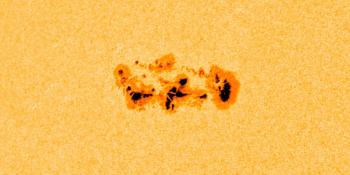
Complex sunspot region 4366

CME impact! S4 solar radiation storm

X1.9 solar flare with earth-directed CME
Forum
Aidez SpaceWeatherLive.com !
De nombreuses personnes consultent SpaceWeatherLive pour suivre l'activité solaire ou observer les aurores boréales, mais l'augmentation du trafic engendre des coûts plus élevés pour maintenir les serveurs en ligne. Si vous appréciez SpaceWeatherLive et souhaitez soutenir le projet, vous pouvez vous abonner pour un site sans publicité ou faire un don. Grâce à votre aide, SpaceWeatherLive restera accessible !



La Météo Spatiale en faits
| Dernière classe X | 04/02/2026 | X4.21 |
| Dernière classe M | 25/02/2026 | M2.4 |
| Dernier orage géomagnétique | 03/03/2026 | Kp5 (G1) |
| Jours sans taches solaires | |
|---|---|
| 365 derniers jours | 3 jours |
| 2026 | 3 jours (5%) |
| Dernier jour sans taches solaires | 24/02/2026 |
| Nombre mensuel moyen de taches solaires | |
|---|---|
| janvier 2026 | 112.6 -11.4 |
| mars 2026 | 77 -35.6 |
| 30 derniers jours | 63.9 -58.1 |