Просмотр архива за четверг, 30 января 2014
Daily bulletin on solar and geomagnetic activity from the SIDC
Существующий: 2014 Jan 30 1241 UTC
SIDC Forecast
Солнечные вспышки
Active (M-class flares expected, probability >=50%)
Geomagnetism
Quiet (A<20 and K<4)
Солнечные протоны
Quiet
| 10cm flux | Ap | |
|---|---|---|
| 30 Jan 2014 | 160 | 003 |
| 31 Jan 2014 | 162 | 004 |
| 01 Feb 2014 | 164 | 009 |
Bulletin
Solar activity has been at active levels over the last 24 hours. 11 C- and 2 M-class flares were recorded, which nearly all originated in the mixed polarity region near NOAA 1967's main spot. The strongest was an M2-flare peaking at 06:39UT. Of note was also a long duration C7-flare starting at 14:11UT and ending at 16:36UT. So far, this LDE was the most energetic in terms of NOAA 1967's integrated flare flux history. NOAA 1968 was the only other active region being able to produce a C-flare (C3 peaking at 04:46UT). The x-ray background has been all day above the C1-level. Active conditions are expected to continue, with a slight chance on an X-class flare. The CMEs associated with NOAA 1967's flaring activity were directed to the East and away from Earth. A faint halo CME was observed early on 29 January. Though it may be related to the frontside filament eruption event early on 29 January (trailing NOAA 1960 and 1959), it may also be related to a backside event that took place about an hour earlier (late 28 January, around 22:50UT) in the same line of sight. Most recent, but incomplete STEREO-A data now seem to favor the latter scenario. Earth is exiting the high speed wind stream. Solar wind has returned to average conditions, with a speed near 350 km/s and Bz fluctuating between -5 and +5 nT. Geomagnetic conditions were quiet. Solar wind may continue to be modulated by the effects of small coronal holes that have passed the central meridian on 27 and 29 January. Quiet geomagnetic conditions are expected. Late on 1 February, any effects of the 29 January frontside CME may drive local geomagnetic conditions to isolated active levels. Otherwise, quiet conditions should persist.
Today's estimated international sunspot number (ISN): 075, based on 07 stations.Solar indices for 29 Jan 2014
| Wolf number Catania | 107 |
| 10cm solar flux | 156 |
| AK Chambon La Forêt | 011 |
| AK Wingst | 006 |
| Estimated Ap | 006 |
| Estimated international sunspot number | 065 - Based on 12 stations |
Noticeable events summary
| Day | Begin | Max | Конец | Loc | Strength | OP | 10cm | Catania/NOAA | Radio burst types |
|---|---|---|---|---|---|---|---|---|---|
| 30 | 0633 | 0639 | 0644 | S15E54 | M2.1 | SF | 28/1967 | ||
| 30 | 0754 | 0811 | 0841 | S12E52 | M1.1 | SF | 69 | 28/1967 | III/1 |
Provided by the Solar Influences Data analysis Center© - SIDC - Processed by SpaceWeatherLive
Все время в UTC
<< Перейти на сегодняшнюю страницу обзора
Последние новости
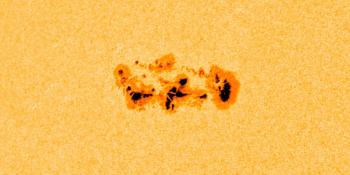
Complex sunspot region 4366

CME impact! S4 solar radiation storm

X1.9 solar flare with earth-directed CME
Последние сообщения с форума
Поддержка SpaceWeatherLive.com!
A lot of people come to SpaceWeatherLive to follow the Solar activity or if there is a chance to see the aurora, but with more traffic comes higher costs to keep the servers online. If you like SpaceWeatherLive and want to support the project you can choose a subscription for an ad-free site or consider a donation. With your help we can keep SpaceWeatherLive online!



Факты о космической погоде
| Последняя X-вспышка | 04/02/2026 | X4.21 |
| Последняя M-вспышка | 25/02/2026 | M2.4 |
| Последняя геомагнитная буря | 22/02/2026 | Kp5+ (G1) |
| Безупречные дни | |
|---|---|
| Последние 365 дней | 3 дней |
| 2026 | 3 дней (5%) |
| Последний безупречный день | 24/02/2026 |
| Среднемесячное количество солнечных пятен | |
|---|---|
| января 2026 | 112.6 -11.4 |
| Последние 30 дней | 72.7 -45.8 |