Prohlížíte si archiv úterý 20. února 2024
Denní bulletin o sluneční a geomagnetické aktivitě ze SIDC
Vydáno: 2024 Feb 20 1231 UTC
SIDC Předpověď
Sluneční erupce
C-class flares expected, (probability >=50%)
Geomagnetismus
Quiet (A<20 and K<4)
Sluneční protony
Quiet
| 10cm tok | Ap | |
|---|---|---|
| 20 Feb 2024 | 148 | 008 |
| 21 Feb 2024 | 146 | 010 |
| 22 Feb 2024 | 144 | 010 |
Slunečně aktivní oblasti a vzplanutí
Solar flaring activity over the past 24 hours was at low levels. The largest flare was a C5.7-flare, with peak time 12:47 UTC on February 19, associated with NOAA AR 3590 (beta-gamma). There are currently 5 numbered active regions on the visible disk. NOAA AR 3590 (beta-gamma), NOAA AR 3586 (beta) and NOAA AR 3583 (beta) are the most magnetically complex region. NOAA AR 3583 are NOAA AR 3581 (alfa) are rotating over the west limb. All other regions on disk have simple magnetic configuration and did not show any significant flaring activity. The solar flaring activity is likely to be at low levels over the coming days with C-class flares expected and M-class flares possible.
Vyhazování koronální hmoty
A Coronal Mass Ejection (CME), was detected at 23:24 UTC on February 19, in LASCO C2 data. The CME is associated with an eruption seen in SDO/AIA 193 at 22:58 UTC on February 19 associated with NOAA AR 3583. Further analysis is ongoing.
Solární bouře
Slow solar wind conditions were recorded over the past 24 hours. The solar wind speed as measured by ACE, fluctuated between 280 km/s and 357 km/s. The interplanetary magnetic field fluctuated between 2 nT and 8 nT, with the Bz reaching a minimum value of -7 nT. The phi-angle was in the positive sector (directed away the Sun) with periods on the negative sector. In the next 24-hours slow solar wind conditions are expected.
Geomagnetismus
The geomagnetic conditions over the past 24 hours were globally and locally quiet (Kp 2 and K Bel 2). Geomagnetic conditions are expected to be at quiet levels over the next 24 hours.
Úrovně protonového toku
Over the past 24 hours the greater than 10 MeV GOES proton flux continued to decrease and, although still slightly elevated, remained below the 10 pfu threshold. The proton flux is expected to continue to decrease over the next 24 hours.
Elektronové toky na geostacionární oběžné dráze
The greater than 2 MeV GOES 16 electron flux was below the 1000 pfu threshold and is expected to remain so in the upcoming days. The 24h electron fluence was at nominal level and is expected to remain so in the next days.
Dnešní odhadovaný mezinárodní počet slunečních skvrn (ISN): 049, na základě 17 stanic.Solární indexy za 19 Feb 2024
| Wolfovo číslo Catania | /// |
| 10cm sluneční tok | 152 |
| AK Chambon La Forêt | 006 |
| AK Wingst | 002 |
| Odhadovaný Ap | 002 |
| Odhadovaný mezinárodní počet slunečních skvrn | 075 - Na základě 17 stanic |
Souhrn významných událostí
| Den | Začátek | Max | Konec | Místo | Síla | OP | 10cm | Catania/NOAA | Typy rádiových záblesků | |
|---|---|---|---|---|---|---|---|---|---|---|
| Žádný | ||||||||||
Poskytuje Centrum pro analýzu dat o solárních vlivech© - SIDC - Zpracováno SpaceWeatherLive
Všechny časy v UTC
<< Přejít na stránku s denním přehledem
Poslední zprávy
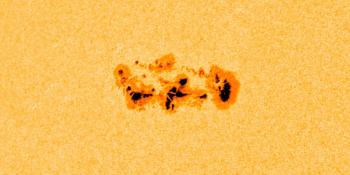
Complex sunspot region 4366

CME impact! S4 solar radiation storm

X1.9 solar flare with earth-directed CME
Nejnovější zprávy na fóru
Podpora SpaceWeatherLive.com!
Mnoho lidí navštěvuje SpaceWeatherLive, aby sledovali sluneční aktivitu nebo pokud je šance spatřit polární záři, ale s větší návštěvností přicházejí i vyšší náklady na udržování serverů online. Pokud se vám SpaceWeatherLive líbí a chcete projekt podpořit, můžete si zvolit předplatné pro web bez reklam nebo zvážit darování. S vaší pomocí můžeme SpaceWeatherLive udržet online!



Fakta o počasí ve vesmíru
| Poslední X-záblesk | 04. 02. 2026 | X4.21 |
| Poslední M-záblesk | 16. 02. 2026 | M2.4 |
| Poslední geomagnetická bouře | 16. 02. 2026 | Kp6 (G2) |
| Dny bez skvrn | |
|---|---|
| Poslední den bez skvrn | 08. 06. 2022 |
| Průměrný měsíční počet slunečních skvrn | |
|---|---|
| ledna 2026 | 112.6 -11.4 |
| února 2026 | 109 -3.6 |
| Posledních 30 dnů | 126.2 +24.2 |