What is a filament?
Solar filaments are clouds of ionized gas above the solar surface squeezed between magnetic regions of opposite polarity. Being cooler and denser than the plasma underneath and their surroundings, they appear as dark lines when seen on the solar disk. When a solar filament is seen near the solar limb with the blackness of space as background it is called a “prominence” instead.
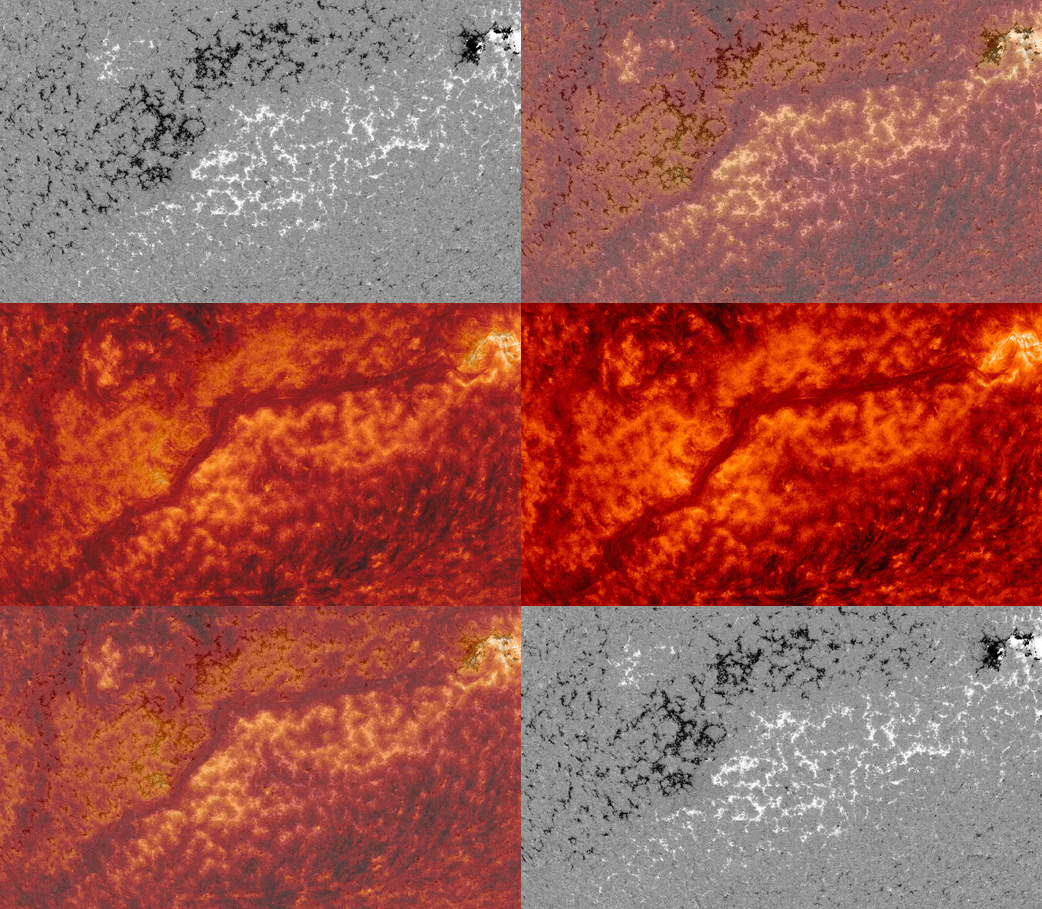
Image: A filament as seen by NASA’s Solar Dynamics Observatory which is suspended between two areas of opposite magnetic polarity.
Solar filaments can last a long time before they disappear. Some survive for weeks! When solar filaments become unstable they can either fall back onto the Sun or erupt into space, sending a coronal mass ejection away from the Sun which can come towards Earth if the solar filament was well positioned. Just like coronal mass ejections produced by solar flares, a coronal mass ejection from a solar filament could also very well cause a geomagnetic storm on Earth. Space weather forecasters keep an eye on these filaments as they can be just as important as solar flares!
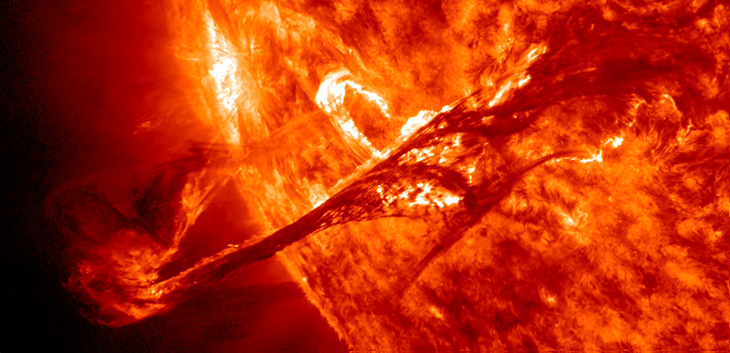
Image: A gorgeous filament eruption as seen by NASA’s Solar Dynamics Observatory.
Latest news
X1.1 solar flare, G2 watch
G3 geomagnetic storm watch for 4 and 5 June
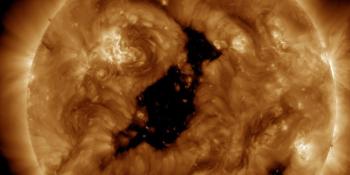
Coronal hole faces Earth
Latest forum messages
Support SpaceWeatherLive.com!
A lot of people come to SpaceWeatherLive to follow the Solar activity or if there is a chance to see the aurora, but with more traffic comes higher costs to keep the servers online. If you like SpaceWeatherLive and want to support the project you can choose a subscription for an ad-free site or consider a donation. With your help we can keep SpaceWeatherLive online!



Space weather facts
| Last X-flare | 2026/07/04 | X1.3 |
| Last M-flare | 2026/07/20 | M3.4 |
| Last geomagnetic storm | 2026/07/04 | Kp7+ (G3) |
| Spotless days | |
|---|---|
| Last 365 days | 3 days |
| 2026 | 3 days (1%) |
| Last spotless day | 2026/02/24 |
| Monthly mean Sunspot Number | |
|---|---|
| June 2026 | 94.4 -7.1 |
| July 2026 | 70.5 -23.9 |
| Last 30 days | 86 -20 |