M2.1 and M1.4 solar flares from a sunspot region behind the limb
Thursday, 11 September 2014 21:34 UTC
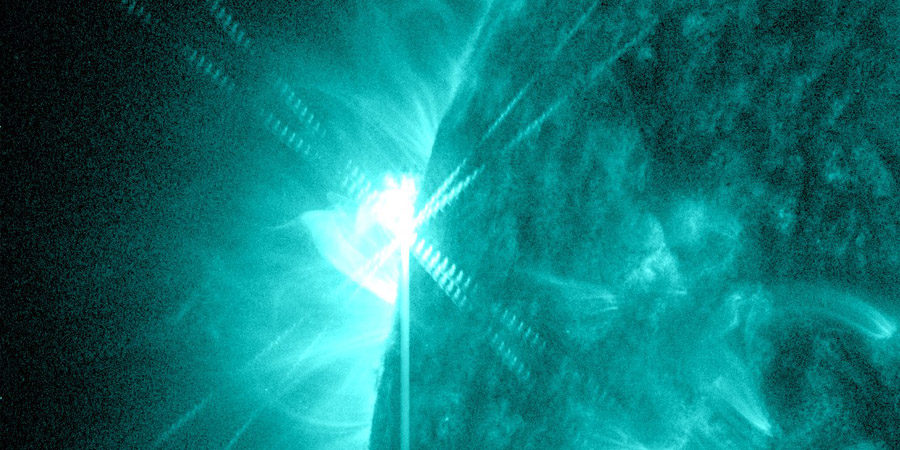
We are still excited following yesterday's X-class solar flare from sunspot region 2158 but there is another sunspot region that is demanding our attention: a new sunspot region on the eastern limb produced an M2.13 (R1-minor radio blackout) solar flare that peaked at 15:26 UTC and just now an impulsive M1.41 (R1-minor radio blackout) solar flare that peaked at 21:26 UTC. Image: the M2.1 solar flare as seen by NASA SDO.
The solar flares were impulsive in nature (short duration) and will likely not produce a Coronal Mass Ejection. Even if it does release a CME it will be directed away from Earth as the solar flare occured behind the eastern limb. STEREO footage reveals that this group might be the return of old sunspot region 2146.
Everyone's focus of course remains on sunspot regions 2157 and 2158 who are directly facing Earth. Both regions seem to slowly decay but both regions remain capable of producing an isolated M-class event. However, it does seem that there might be a new region coming in that could continue the high solar activity even when sunspot regions 2157 and 2158 disappear.
NOAA SWPC alerts from the M2 solar flare
SUMMARY: 10cm Radio Burst
Begin Time: 2014 Sep 11 1523 UTC
Maximum Time: 2014 Sep 11 1523 UTC
End Time: 2014 Sep 11 1525 UTC
Duration: 2 minutes
Peak Flux: 210 sfu
Latest Penticton Noon Flux: 160 sfu
Thank you for reading this article! Did you have any trouble with the technical terms used in this article? Our help section is the place to be where you can find in-depth articles, a FAQ and a list with common abbreviations. Still puzzled? Just post on our forum where we will help you the best we can!
Latest news
Coronal hole faces Earth

X1.5 solar flare

M2.7 solar flare, CME arrival possible
Latest forum messages
More topicsSupport SpaceWeatherLive.com!
A lot of people come to SpaceWeatherLive to follow the Solar activity or if there is a chance to see the aurora, but with more traffic comes higher costs to keep the servers online. If you like SpaceWeatherLive and want to support the project you can choose a subscription for an ad-free site or consider a donation. With your help we can keep SpaceWeatherLive online!



Space weather facts
| Last X-flare | 2026/04/24 | X2.5 |
| Last M-flare | 2026/05/22 | M2.3 |
| Last geomagnetic storm | 2026/05/16 | Kp6- (G2) |
| Spotless days | |
|---|---|
| Last 365 days | 3 days |
| 2026 | 3 days (2%) |
| Last spotless day | 2026/02/24 |
| Monthly mean Sunspot Number | |
|---|---|
| April 2026 | 79.3 -6.6 |
| May 2026 | 94.2 +14.9 |
| Last 30 days | 97.1 +4.3 |