Coronal hole faces Earth
Monday, 5 December 2016 20:41 UTC
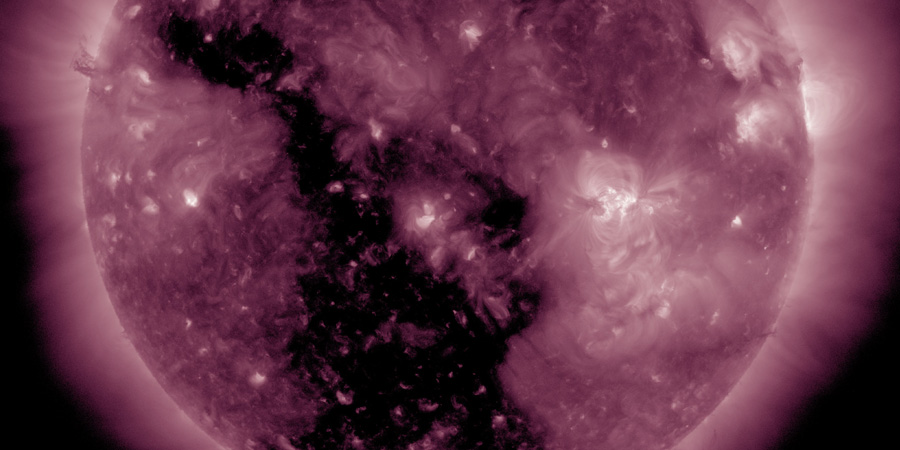
Sunspot region 2615 never really got going again after the two M-class events on 29 November. The sunspot region grew in size the past few days but never regained the magnetic complexity needed for M-class events. A shame as a nice earth-directed coronal mass ejection would have been very welcome during these quiet times. That means we shift our attention to coronal holes once more and guess what... we have a large coronal hole facing our planet today!
Our automated coronal hole detection system detected the coronal hole and sent a tweet to our Twitter account @_spaceweather_ this morning:
A coronal hole is facing Earth. Enhanced solar wind could arrive in ~3 days - Follow live on https://t.co/T1Jkf6i4Cb pic.twitter.com/cMu3mf9lZa
— SpaceWeatherLive (@_SpaceWeather_) 5 december 2016
As you can see it is a very large northward extension of the southern hemisphere polar coronal hole. It is indeed a pretty large opening that extends all the way to the solar equator so we should see a very decent solar wind stream impact at our planet in 2 to 3 days (7 or 8 December) from now. Minor G1 geomagnetic storm conditions are likely and an isolated period where we reach moderate G2 geomagnetic storm conditions should not be excluded.
Thank you for reading this article! Did you have any trouble with the technical terms used in this article? Our help section is the place to be where you can find in-depth articles, a FAQ and a list with common abbreviations. Still puzzled? Just post on our forum where we will help you the best we can!
Latest news
Coronal hole faces Earth

X1.5 solar flare

M2.7 solar flare, CME arrival possible
Latest forum messages
Support SpaceWeatherLive.com!
A lot of people come to SpaceWeatherLive to follow the Solar activity or if there is a chance to see the aurora, but with more traffic comes higher costs to keep the servers online. If you like SpaceWeatherLive and want to support the project you can choose a subscription for an ad-free site or consider a donation. With your help we can keep SpaceWeatherLive online!



Space weather facts
| Last X-flare | 2026/04/24 | X2.5 |
| Last M-flare | 2026/05/22 | M2.3 |
| Last geomagnetic storm | 2026/05/16 | Kp6- (G2) |
| Spotless days | |
|---|---|
| Last 365 days | 3 days |
| 2026 | 3 days (2%) |
| Last spotless day | 2026/02/24 |
| Monthly mean Sunspot Number | |
|---|---|
| April 2026 | 79.3 -6.6 |
| May 2026 | 87.5 +8.2 |
| Last 30 days | 94.2 +1.3 |