Long duration C2.6 solar flare
Wednesday, 11 November 2020 20:26 UTC
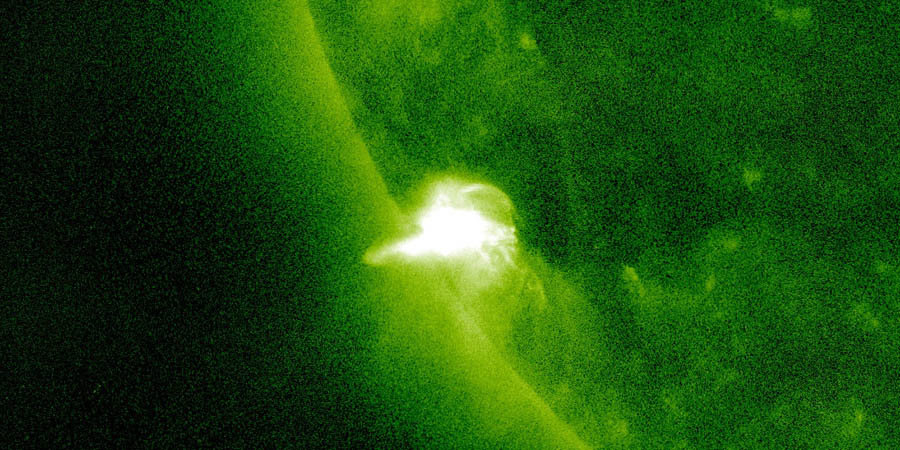
Sunspot region 2782 which is located near the south-east limb produced a long duration C2.6 solar flare which peaked today at 19:11 UTC.
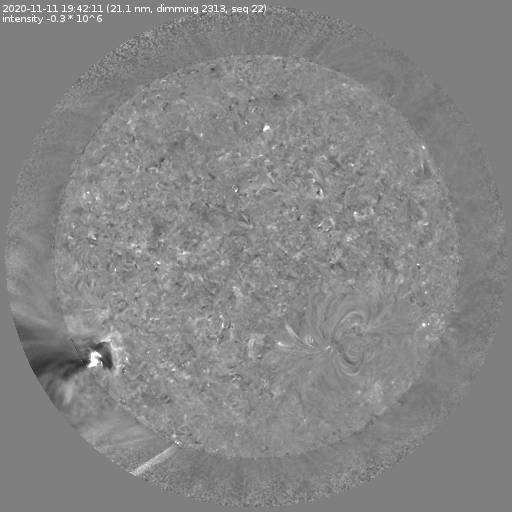
C-class solar flares aren't the strongest solar flares out there but its long duration caught our attention as long duration solar flares are often associated with the release of a plasma cloud or what we usually call a coronal mass ejection. Based on SDO AIA 193 imagery we see that the explosion caused a rippling effect trough the corona (coronal wave) and darkening of the corona (coronal dimming) which are two signs that this solar flare might have released a coronal mass ejection into space. We can not confirm this yet due to the lack of coronagraph imagery from STEREO and SOHO at the moment but we will take a look at the coronagraph imagery as it becomes available. Due to the location of this solar flare, any ejected solar material is likely aimed away from Earth but this is also something we will analyse as soon as coronagraph imagery becomes available.
Thank you for reading this article! Did you have any trouble with the technical terms used in this article? Our help section is the place to be where you can find in-depth articles, a FAQ and a list with common abbreviations. Still puzzled? Just post on our forum where we will help you the best we can!
Latest news

M8.1 solar flare with earth-directed CME
X1.9 solar flare, Coronal hole faces Earth
X4.0 solar flare
Latest forum messages
Support SpaceWeatherLive.com!
A lot of people come to SpaceWeatherLive to follow the Solar activity or if there is a chance to see the aurora, but with more traffic comes higher costs to keep the servers online. If you like SpaceWeatherLive and want to support the project you can choose a subscription for an ad-free site or consider a donation. With your help we can keep SpaceWeatherLive online!



Space weather facts
| Last X-flare | 2025/12/08 | X1.1 |
| Last M-flare | 2025/12/12 | M1.1 |
| Last geomagnetic storm | 2025/12/12 | Kp5 (G1) |
| Spotless days | |
|---|---|
| Last spotless day | 2022/06/08 |
| Monthly mean Sunspot Number | |
|---|---|
| November 2025 | 91.8 -22.8 |
| December 2025 | 144.3 +52.5 |
| Last 30 days | 107.5 +8.8 |