M1.1 solar flare
Tuesday, 20 April 2021 18:26 UTC

Surprise surprise! Sunspot region 2816 produced an M1.1 solar flare which peaked at 23:42 UTC. This is the first M-class solar flare since 29 November and the third M-class solar flare of Solar Cycle 25 thus far. Our Sun decided to wake up as we now all of a sudden have three numbered sunspot regions on the earth-facing solar disk.
Associated with the M1.1 solar flare (R1-minor) were Type II and Type IV radio emissions which indicates the launch of a coronal mass ejection. SOHO/LASCO (see the tweet below) confirms the launch of a slow and narrow plasma cloud which shows up as a partial halo going to the east on these images as seen from Earth's point of view. While sunspot region 2816 was just east of the Sun's central meridian, based on the images from SOHO we do think it is unlikely that the plasma cloud will arrive at Earth.
The M1.1 solar flare from sunspot region 2816 was associated with a narrow and slow coronal mass ejection that is not expected to arrive at Earth.
— SpaceWeatherLive (@_SpaceWeather_) April 20, 2021
Sunspot region 2817 is at the moment the most likely candidate to produce M-class activity after strong spot development today. pic.twitter.com/94zzLKzn9Z
While it was sunspot region 2816 that gave us the M-class solar flare, it is sunspot region 2817 that seen the most significant growth during the past few hours and it is this region that is the most likely candidate to produce C or perhaps even a low-level M-class solar flares in the next 24 hours. Sunspot region 2817 has also been the source today of numerous B-class solar flares. Good to see some Solar Cycle 25 action after this long period with hardly any solar activity at all!
Thank you for reading this article! Did you have any trouble with the technical terms used in this article? Our help section is the place to be where you can find in-depth articles, a FAQ and a list with common abbreviations. Still puzzled? Just post on our forum where we will help you the best we can!
Latest news

X1.5 solar flare

M2.7 solar flare, CME arrival possible
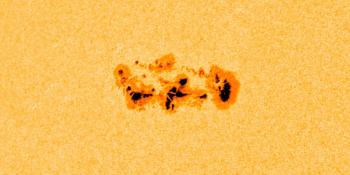
Complex sunspot region 4366
Latest forum messages
Support SpaceWeatherLive.com!
A lot of people come to SpaceWeatherLive to follow the Solar activity or if there is a chance to see the aurora, but with more traffic comes higher costs to keep the servers online. If you like SpaceWeatherLive and want to support the project you can choose a subscription for an ad-free site or consider a donation. With your help we can keep SpaceWeatherLive online!



Space weather facts
| Last X-flare | 2026/03/30 | X1.5 |
| Last M-flare | 2026/04/04 | M1.0 |
| Last geomagnetic storm | 2026/04/03 | Kp7- (G3) |
| Spotless days | |
|---|---|
| Last 365 days | 3 days |
| 2026 | 3 days (3%) |
| Last spotless day | 2026/02/24 |
| Monthly mean Sunspot Number | |
|---|---|
| March 2026 | 85.9 +7.7 |
| April 2026 | 133.3 +47.4 |
| Last 30 days | 96.9 +35.1 |