C3.0 solar flare with earth-directed CME
Friday, 27 August 2021 13:31 UTC
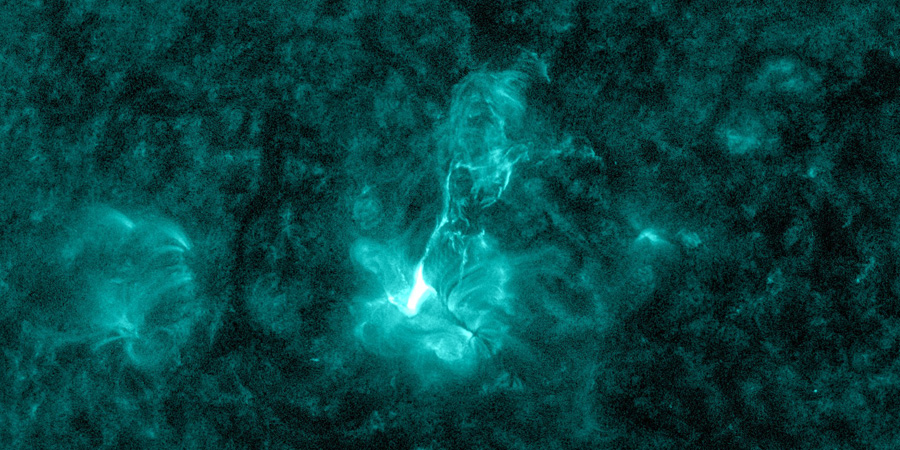
Sunspot region 2859 produced a long duration C3.0 solar flare yesterday which launched a coronal mass ejection into space. The plasma cloud has a good chance to impact our planet in a few days time.
Sunspot region 2859 produced an interesting solar flare today which peaked at 18:18 UTC. The flare reached a maximum of C3.0 and looks eruptive. Any resulting CME could be earth-directed. We will update with more info later when coronagraph imagery becomes available. pic.twitter.com/zlKc8dad4o
— SpaceWeatherLive (@_SpaceWeather_) August 26, 2021
The solar flare launched a partial halo coronal mass ejection at a speed of about 500km/s which is moderately slow. The partial halo signature of about 270 degrees gives us confidence that the plasma cloud has a good chance of arriving at Earth. Considering the speed of the plasma cloud, we expect it to arrive at Earth on Monday, 30 August. Active geomagnetic storm conditions (Kp4) are likely with a chance of minor G1 (Kp5) geomagnetic storm conditions.
Yesterday's C3.0 flare launched a partial halo coronal mass ejection which is likely to arrive at Earth on Monday, 30 August. Active geomagnetic storm conditions are likely with a chance of minor G1 geomagnetic storm conditions.
— SpaceWeatherLive (@_SpaceWeather_) August 27, 2021
Follow it live on https://t.co/XHATH0OOfT pic.twitter.com/323TSgqr7w
Type II radio sweep
A Type II Radio Emission was observed yesterday at 23:29 UTC. This was the result of an impulsive C3.9 solar flare from sunspot region 2860. The resulting coronal mass ejection was unimpressive and unlikely to arrive at Earth. Sunspot region 2860 has been growing during the past 24 hours and developed a Beta-Gamma magnetic layout. More C-class solar flare are possible from this sunspot region.
00:15 UTC - Type II Radio Emission
— SpaceWeatherLive (@_SpaceWeather_) August 27, 2021
Begin Time: 26/08/2021 23:29 UTC
Estimated Velocity: 691km/sec.
Thank you for reading this article! Did you have any trouble with the technical terms used in this article? Our help section is the place to be where you can find in-depth articles, a FAQ and a list with common abbreviations. Still puzzled? Just post on our forum where we will help you the best we can!
Latest news
Coronal hole faces Earth

X1.5 solar flare

M2.7 solar flare, CME arrival possible
Latest forum messages
Support SpaceWeatherLive.com!
A lot of people come to SpaceWeatherLive to follow the Solar activity or if there is a chance to see the aurora, but with more traffic comes higher costs to keep the servers online. If you like SpaceWeatherLive and want to support the project you can choose a subscription for an ad-free site or consider a donation. With your help we can keep SpaceWeatherLive online!



Space weather facts
| Last X-flare | 2026/04/24 | X2.5 |
| Last M-flare | 2026/05/22 | M2.3 |
| Last geomagnetic storm | 2026/05/16 | Kp6- (G2) |
| Spotless days | |
|---|---|
| Last 365 days | 3 days |
| 2026 | 3 days (2%) |
| Last spotless day | 2026/02/24 |
| Monthly mean Sunspot Number | |
|---|---|
| April 2026 | 79.3 -6.6 |
| May 2026 | 87.6 +8.3 |
| Last 30 days | 99.3 +9.1 |