Lot's of sunspots! Big chance for major flare activity?
Monday, 22 April 2024 21:58 UTC
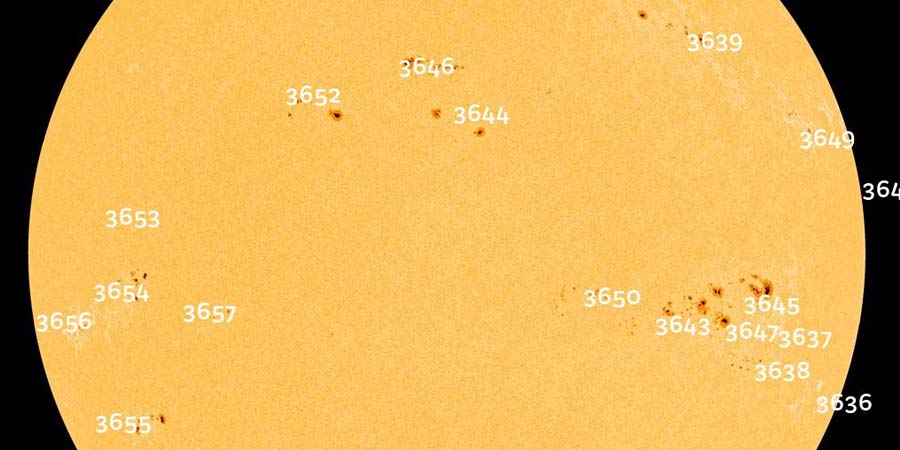
Our Sun is peppered with numbered sunspot regions at the moment... 18 to be precise! This adds up to a sunspot number of 283 which is very high.
Sunspot region 3646 is currently facing Earth and one of the more complex regions on the disk. This region along with sunspot region 3645 and 3656 have been the source of multiple low-level M-class solar flares today but none of them were eruptive. Do keep an eye on our nearest star for further spot development, especially in earth-facing sunspot region 3646 as this would be the most likely candidate to produce an earth-directed CME in the days ahead. However, we do need to see more spot development in this region before solar flares reaching the M5 threshold or higher will be possible. While there are many numbered sunspot regions on the disk, most of them are unremarkable and there is a low chance for major flare activity right now.
Thank you for reading this article! Did you have any trouble with the technical terms used in this article? Our help section is the place to be where you can find in-depth articles, a FAQ and a list with common abbreviations. Still puzzled? Just post on our forum where we will help you the best we can!
Latest news

M8.1 solar flare with earth-directed CME
X1.9 solar flare, Coronal hole faces Earth
X4.0 solar flare
Latest forum messages
Support SpaceWeatherLive.com!
A lot of people come to SpaceWeatherLive to follow the Solar activity or if there is a chance to see the aurora, but with more traffic comes higher costs to keep the servers online. If you like SpaceWeatherLive and want to support the project you can choose a subscription for an ad-free site or consider a donation. With your help we can keep SpaceWeatherLive online!



Space weather facts
| Last X-flare | 2025/12/08 | X1.1 |
| Last M-flare | 2025/12/12 | M1.1 |
| Last geomagnetic storm | 2025/12/12 | Kp5 (G1) |
| Spotless days | |
|---|---|
| Last spotless day | 2022/06/08 |
| Monthly mean Sunspot Number | |
|---|---|
| November 2025 | 91.8 -22.8 |
| December 2025 | 128 +36.2 |
| Last 30 days | 108.4 +15.8 |