X5.1 solar flare, G4 geomagnetic storm watch
Tuesday, 11 November 2025 19:07 UTC

Here she blows! Sunspot region 4274 produced its strongest solar flare thus far since it appeared on the east limb and the sixth strongest solar flare of the current solar cycle. An impressive long duration and highly eruptive X5.1 (R3-strong) solar flare peaked this morning at 10:04 UTC.
It became quickly clear that the eruption would be followed by an impressive coronal mass ejection (CME). The resulting coronal wave following the solar explosion as well as the coronal dimming observed as the CME was propelled into space were of a spectacular magnitude as can be seen in the animation below provided by halocme.
Another eruption from AR12474, associated with an X5.1 flare. It has become a full halo CME. I am truly impressed by how fast and global this coronal wave is. The CME will arrive on November 13, but because of earlier CMEs it will be challenging to isolate the ICME from this. pic.twitter.com/H6eNjzQUGz
— Halo CME (@halocme) November 11, 2025
Taking a look at coronagraph imagery provided by GOES-19 CCOR-1 we see the gorgeous fast halo coronal mass ejection as it propagates away from the Sun. It doesn't take a rocket scientist to come to the conclusion that this plasma cloud of course has an earth-directed component and it is pretty clear that this will be a strong impact when it arrives at our planet. This rightfully so prompted the NOAA SWPC to issue a G4 or greater geomagnetic storm watch for tomorrow as the cloud could impact our planet as early as 16 UTC on 12 November. Not only is the CME fast but it will also travel trough an area with high ambient solar wind speed and low density thanks to two other CMEs released earlier by this region. More about that below.
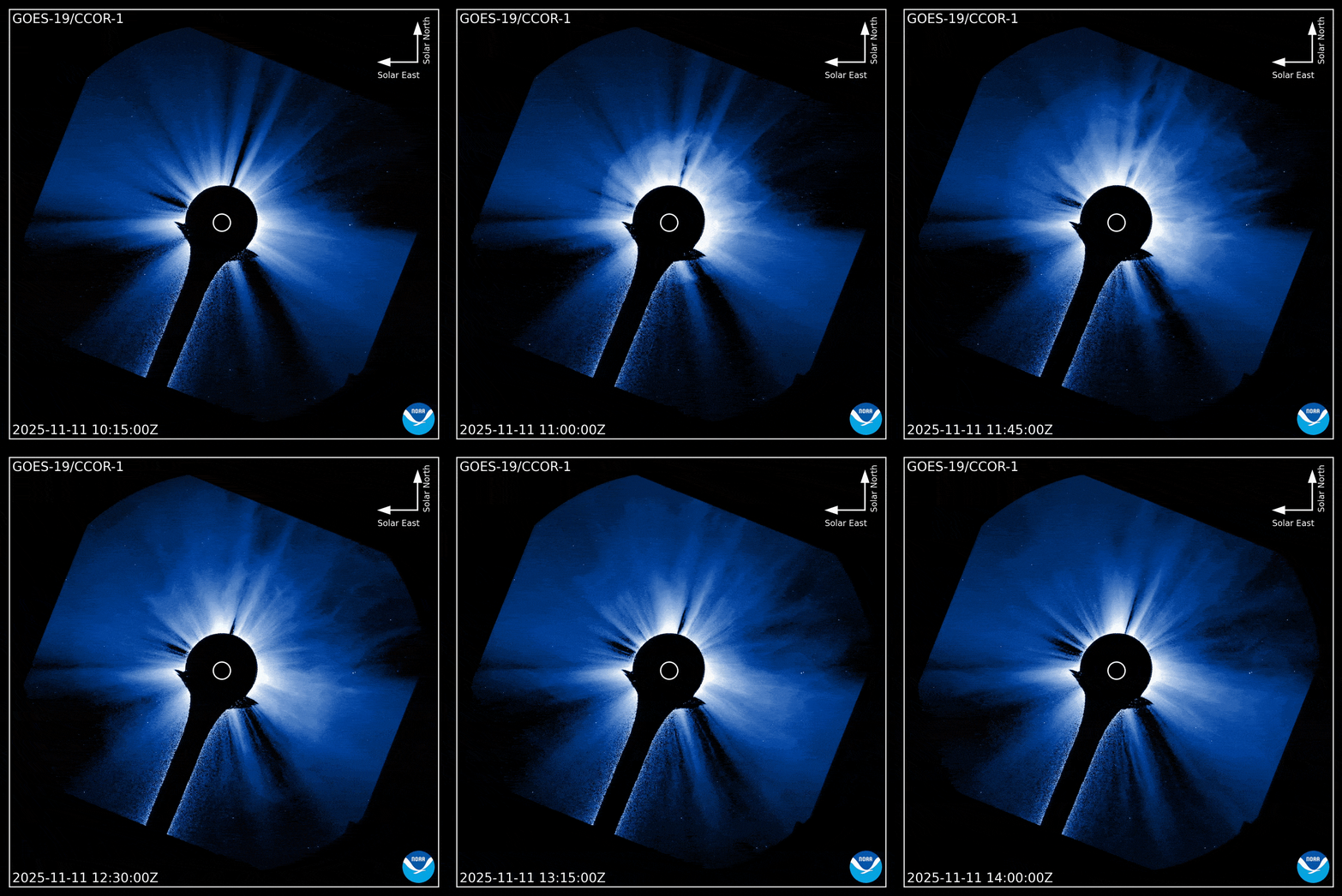
If the solar wind and interplanetary magnetic field values at Earth are favorable this could result in a geomagnetic storm which is strong enough for aurora to become visible from locations as far south as northern France, Germany, Ukraine, Switzerland and Austria. In the US it could become visible as far south as Nevada and Arkansas. No guarantees of course, this is space weather we are talking about but be sure to download the SpaceWeatherLive app to your mobile device, turn on the alerts and keep an eye on the solar wind data from ACE and DSCOVR!
We also want to remind you that we still have two coronal mass ejections on their way to Earth. These are not as impressive as this X5.1 CME but these two plasma clouds will likely arrive within the next 6 to 18 hours. This is a tricky one as they could arrive as one impact or two impacts close intill each other. More information in yesterday's news.
Thank you for reading this article! Did you have any trouble with the technical terms used in this article? Our help section is the place to be where you can find in-depth articles, a FAQ and a list with common abbreviations. Still puzzled? Just post on our forum where we will help you the best we can!
Latest news
X1.1 solar flare, G2 watch
G3 geomagnetic storm watch for 4 and 5 June
Coronal hole faces Earth
Latest forum messages
Support SpaceWeatherLive.com!
A lot of people come to SpaceWeatherLive to follow the Solar activity or if there is a chance to see the aurora, but with more traffic comes higher costs to keep the servers online. If you like SpaceWeatherLive and want to support the project you can choose a subscription for an ad-free site or consider a donation. With your help we can keep SpaceWeatherLive online!



Space weather facts
| Last X-flare | 2026/07/04 | X1.3 |
| Last M-flare | 2026/07/20 | M3.4 |
| Last geomagnetic storm | 2026/07/04 | Kp7+ (G3) |
| Spotless days | |
|---|---|
| Last 365 days | 3 days |
| 2026 | 3 days (1%) |
| Last spotless day | 2026/02/24 |
| Monthly mean Sunspot Number | |
|---|---|
| June 2026 | 94.4 -7.1 |
| July 2026 | 70.7 -23.7 |
| Last 30 days | 85.8 -20.7 |